
 by
by Our #1 recommendation for lightweight sleepers
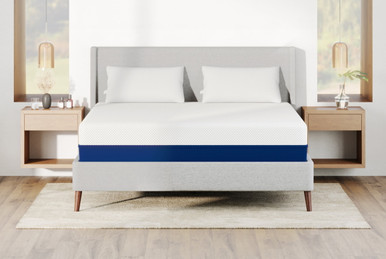
Amerisleep AS3
If you prefer a boxed all-foam mattress, the AS3's HIVE zoning activates with less body pressure than most foam mattresses, delivering real contouring where lighter bodies need it at the shoulders, hips, and lumbar.
Our first recommendation for lightweight sleepers is the Amerisleep AS3. If you prefer a boxed all-foam mattress, the AS3's HIVE zoning activates with less body pressure than most foam mattresses, delivering real contouring where lighter bodies need it at the shoulders, hips, and lumbar. The Saatva Classic is our runner-up.
Amerisleep AS3
8.7/10
- HIVE 5-zone comfort layer contours at lighter body weights without requiring deep compression
- Partially plant-based Bio-Pur open-cell foam stays cooler than standard memory foam
- CertiPUR-US certified, made in the USA
- Medium 5/10 feel registers closer to medium-soft for sleepers under 130 lbs
- Side sleepers under 110 lbs may prefer the softer AS5
- Softer edge support than a coil hybrid
If you prefer a boxed all-foam mattress, the AS3's HIVE zoning activates with less body pressure than most foam mattresses, delivering real contouring where lighter bodies need it at the shoulders, hips, and lumbar.
Saatva Classic
9.2/10
- Plush Soft option (4/10) gives lightweight sleepers the comfort-layer compression their body weight cannot force on its own
- Dual-coil construction with zoned lumbar foam reinforcement keeps the spine aligned even at lower body weights
- Euro pillow-top and foam comfort layers are substantial enough for sub-130-lb sleepers to actually feel
- Free white-glove delivery, setup, and old-mattress removal; 365-night trial; lifetime warranty
- Higher motion transfer than all-foam, not ideal for light-sleeping partners
- $99 return fee applies during the trial
The Saatva Classic in Plush Soft is the most complete pick for lightweight sleepers who want a responsive, hotel-quality feel. The dual-coil system compresses appropriately at lighter loads while the reinforced lumbar zone keeps alignment intact, and the 365-night trial is the longest in the category.
Why lightweight sleepers need a different mattress
Mattress firmness ratings assume a standard body weight of roughly 150 to 180 lbs. At that weight, a medium (5/10) mattress compresses the comfort layer far enough to contour around the shoulders and hips. At 110 or 120 lbs, the same mattress compresses much less, so the rated medium feels like a firm 7/10, and comfort-layer foam barely conforms to the body's curves.
The practical consequence: a lightweight side sleeper on a standard medium-firm mattress often wakes with shoulder or hip pain because the foam never compressed enough to relieve pressure at those points. A lightweight back sleeper may find the lumbar unsupported because the hips did not sink enough to let the spine settle into neutral alignment.
This is a physics problem, and the fix is choosing a mattress that either has a softer overall rating (go one level softer than the standard recommendation for your position) or a comfort layer engineered to activate at lower compression loads, like open-cell foam or low-ILD latex.
Firmness guide by sleep position (under 130 lbs)
| Sleep Position | Standard Recommendation | Lightweight Adjustment (under 130 lbs) |
|---|---|---|
| Side | Soft-Medium (3-5) | Ultra-Soft-Soft (2-3), need extra sinkage at shoulder and hip |
| Back | Medium-Medium Firm (5-6) | Medium-Medium Soft (4-5) |
| Stomach | Firm (6-7) | Medium-Medium Firm (5-6), still need spinal alignment |
| Combination | Medium (5) | Medium Soft (4) |
Best mattress types for lightweight sleepers
Coil hybrid with thick comfort layer, top choice
A coil hybrid with a substantial comfort layer of at least 3 inches is the best overall option for lightweight sleepers who want both support and pressure relief. The coil system provides zoned response while the pillow-top or foam layer above it gives the surface compliance that lighter bodies need. The Saatva Classic in Plush Soft is the benchmark here: its dual-coil design keeps the lumbar zone supported while the Euro pillow-top provides genuine pressure relief at the shoulders and hips.
Memory foam, strong all-foam alternative
Memory foam responds to body heat as well as compression pressure, which means lightweight sleepers still get contouring even without heavy body weight forcing the foam down. Open-cell foam formulations (like Amerisleep's Bio-Pur) activate more readily at lower loads than dense closed-cell foams. Choose soft to medium-soft ILD, typically ILD 10 to 16 in the top comfort layer.
Natural latex (soft ILD), excellent alternative
Latex with an ILD of 10 to 16 provides responsive contouring for lightweight bodies with better bounce and temperature regulation than most memory foams. The buoyant response means repositioning is easy even without the deep sinkage a heavier sleeper would create. Dunlop or Talalay in the 10-19 ILD range are both appropriate for sub-130-lb sleepers.
Standard innerspring, generally avoid
Traditional innerspring mattresses with minimal comfort layers are the worst option for lightweight sleepers. The thin foam layers do not compress enough to contour, leaving pressure points at the shoulder and hip entirely unrelieved.
Key specs to look for
- Comfort layer ILD 10-16: foam or latex that activates at lower compression weights, lightweight sleepers need the material to soften with less than 130 lbs pressing down.
- Comfort layer thickness 3"+: more material to contour into, even with reduced compression force.
- Memory foam density 3.5-4.5 PCF: slightly lower density activates more readily at light weights versus ultra-dense 5+ PCF slow-response foams.
- Zoned support: zone-differentiated comfort layers firm up the support core while keeping the comfort layer responsive, useful for lightweight sleepers who need both contouring and alignment.
Mattress comparison for lightweight sleepers
| Mattress | Type | Best Firmness for <130 lb | Trial | Queen Price |
|---|---|---|---|---|
| Saatva Classic | Coil-on-coil hybrid | Plush Soft 4/10 | 365 nights | From $1,395 |
| Amerisleep AS3 | All-foam (Bio-Pur) | Medium 5/10 (feels softer for lightweight) | 100 nights | From $1,049 |
| PlushBeds Botanical Bliss | Natural latex | Soft (ILD 19) | 100 nights | From $1,800 |
| Puffy Lux | All-foam | Medium 5/10 | 101 nights | From $1,349 |
PlushBeds Botanical Bliss
8.4/10
- GOLS-certified organic Dunlop latex in Soft ILD 19 activates well for lightweight bodies
- Buoyant latex response makes repositioning easy without deep sinkage
- GOTS-certified organic cotton and wool cover, no off-gassing
- Customizable layers: can be reconfigured if firmness does not suit your weight
- Higher price point than foam alternatives
- Heavier and less portable than boxed mattresses
For lightweight sleepers who want natural materials and responsive contouring, the Botanical Bliss in Soft gives excellent pressure relief with the buoyancy that makes latex ideal for sub-130-lb bodies.
How to use the trial period as a lightweight sleeper
Memory foam takes 3 to 4 weeks to fully break in. Lightweight sleepers accelerate this by sleeping directly on the mattress for the first two weeks without a topper, you need to compress the foam to establish the contour pattern. If after 4 weeks the mattress still feels too firm at the shoulders or hips, that is a signal the ILD is too high for your weight. Saatva offers a 365-night trial, giving you substantial time to confirm fit.
One practical note: a adjustable base in zero-gravity position reduces the body-weight load on the comfort layer further, making even medium mattresses feel softer for lightweight back sleepers.
Lightweight sleepers should go one firmness level softer than standard guides recommend and prioritize a thick, responsive comfort layer (3"+ at ILD 10-16). The Saatva Classic in Plush Soft is our top pick on a 365-night trial; the Amerisleep AS3 is the strongest all-foam alternative on a 100-night trial.
Frequently asked questions
What firmness should a lightweight person choose?
Go one level softer than standard recommendations for your sleep position. A lightweight side sleeper (under 130 lbs) should choose soft (3/10) to ultra-soft (2/10) rather than the standard medium-soft (4/10). A lightweight back sleeper should choose medium-soft (4/10) rather than medium-firm (6/10). The Saatva Classic's Plush Soft option at 4/10 is designed specifically for sleepers who need the comfort layer to give more.
Can a lightweight person use a firm mattress?
Only for strict stomach sleeping. For side or back sleeping, a firm mattress under 130 lbs will not compress the comfort layer enough to relieve shoulder and hip pressure, leading to contact pain and poor spinal alignment. If you prefer a firmer feel overall, choose a medium and accept that it will register firmer than the label suggests at your weight.
Why does my memory foam mattress feel too firm?
Memory foam firmness ratings are calibrated for average body weight (150 to 180 lbs). At lighter weights, you compress less into the foam, making the mattress feel firmer than rated. Choose a softer ILD option or a mattress using open-cell foam, which activates at lower compression loads.
What is the best mattress type for a lightweight side sleeper?
A coil hybrid in Plush Soft (like the Saatva Classic) or all-foam in a soft to medium-soft ILD. Memory foam with an open-cell structure contours well at lighter body weights. Avoid standard innersprings with thin comfort layers and hybrids with less than 3 inches of comfort foam above the coils, at sub-130 lbs, you will feel the coils before the foam provides relief.
This guide is part of our Best Mattress by Body Type hub, compare all the top picks and narrow down your choice there.
Verdict
Our #1 pick for lightweight sleepers
The Amerisleep AS3 is where we would start: HIVE five-zone support, plant-based Bio-Pur foam, a 100-night trial and a 20-year warranty.