
 by
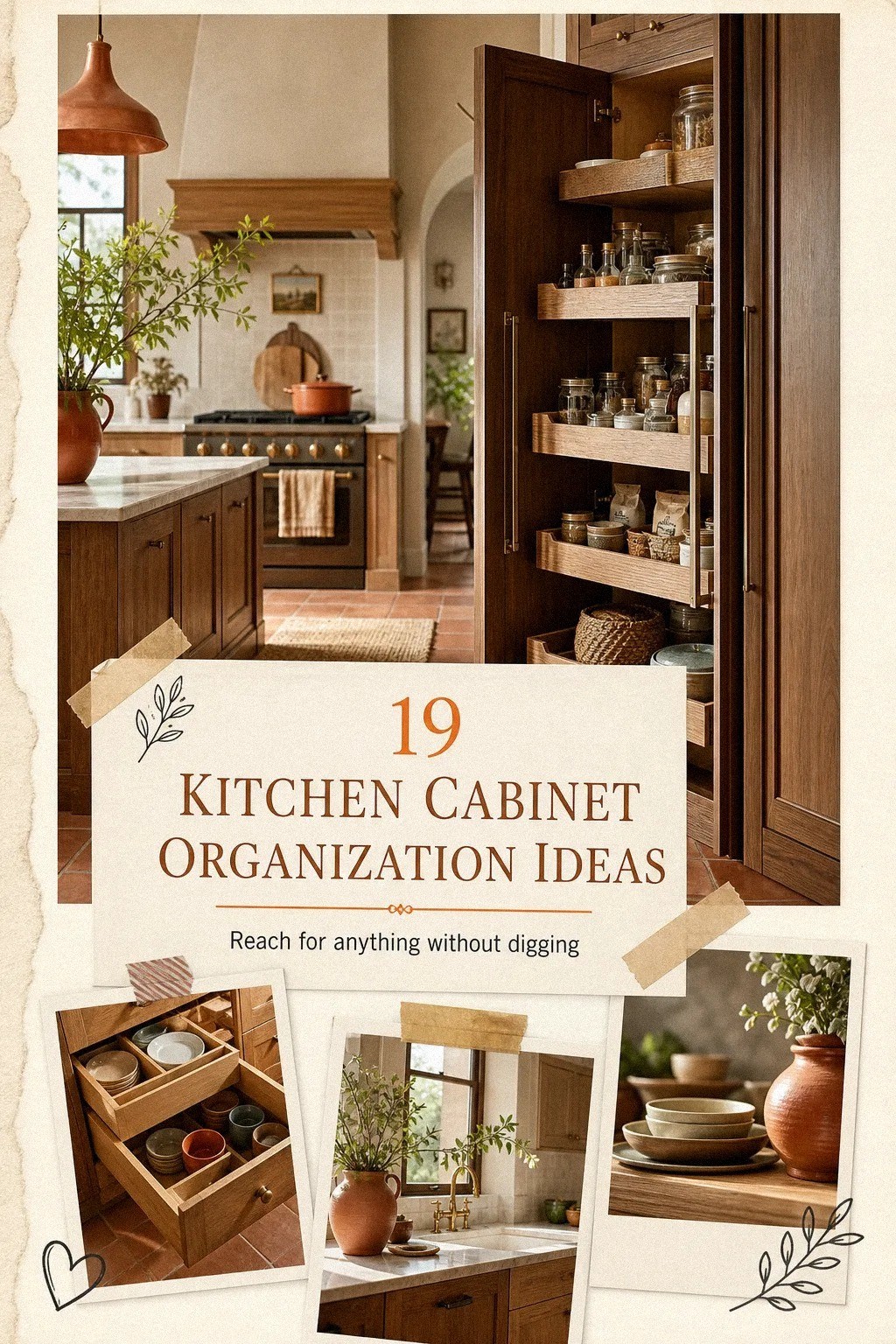
by Kitchen cabinet organization ideas for a clutter-free kitchen work best when you treat them like traffic control, not decoration. I learned that after stuffing deep cabinets with pretty bins and still losing the cumin, the wraps, and half the breakfast bowls. The short answer: you do not need a remodel to make this feel better. You need smarter zones, a few measured inserts, and rules you'll keep using.
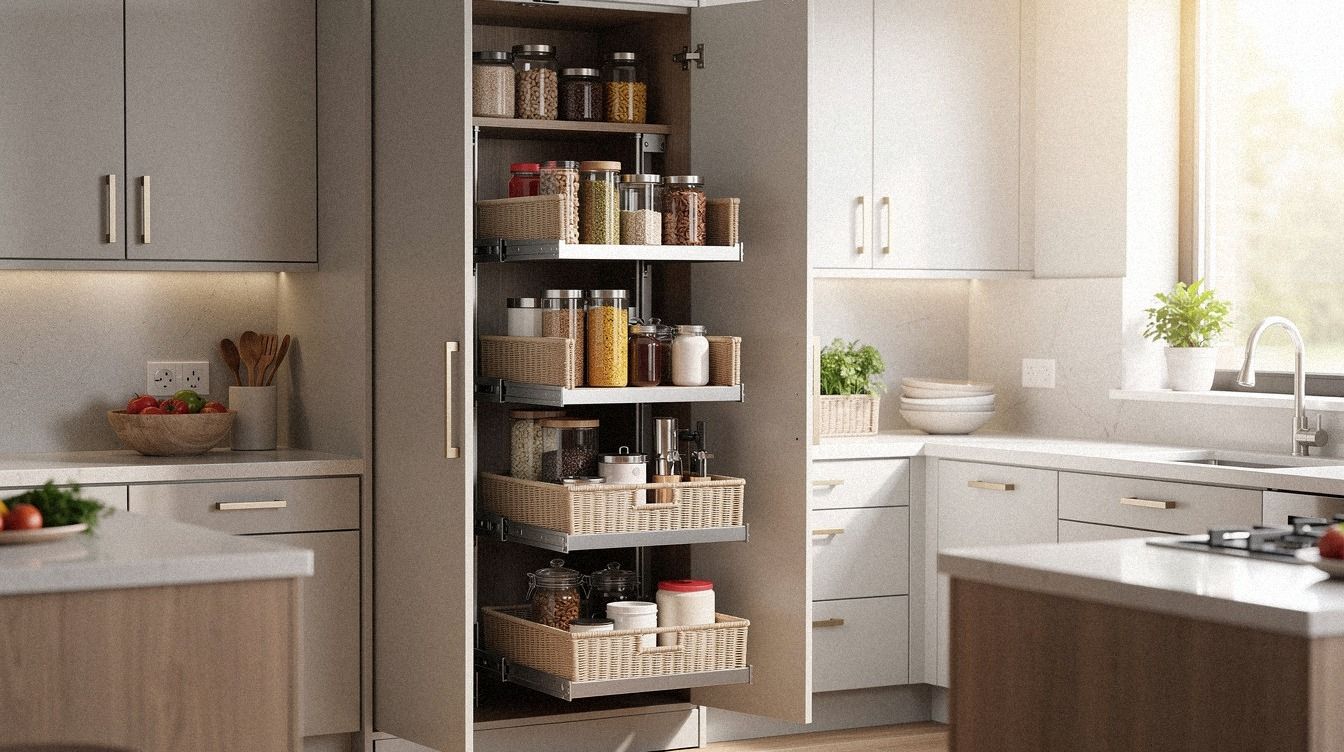
- Install pull-out pantry baskets behind deep doors
- Add tiered spice steps inside upper cabinets
- Mount a hidden spice rack on hinges
- Will a vertical divider finally fix your baking sheet pile-up?
- Use clear bins for breakfast cabinet zones
- Hang measuring cups on inner doors
- Fit lazy Susans in blind corner cabinets
- Label matching jars on pull-out shelves
- Stack plate racks in deep lower drawers
- Create a coffee station behind cabinet doors
- The IKEA KALLAX Mug Overflow Move
- Use drawer inserts for lids and food wraps
- Mount slim racks for cutting boards
- Round Canisters vs Square Canisters: The Shelf-Space Verdict
- Add toe-kick drawers for flat linens
- Can risers really make canned goods disappear?
- Install pegboard inserts for pots and pans
- The Lift-Up Appliance Garage (Why It Beats a Tray)
- Build a snack cabinet with pull-out trays
1Install pull-out pantry baskets behind deep doors
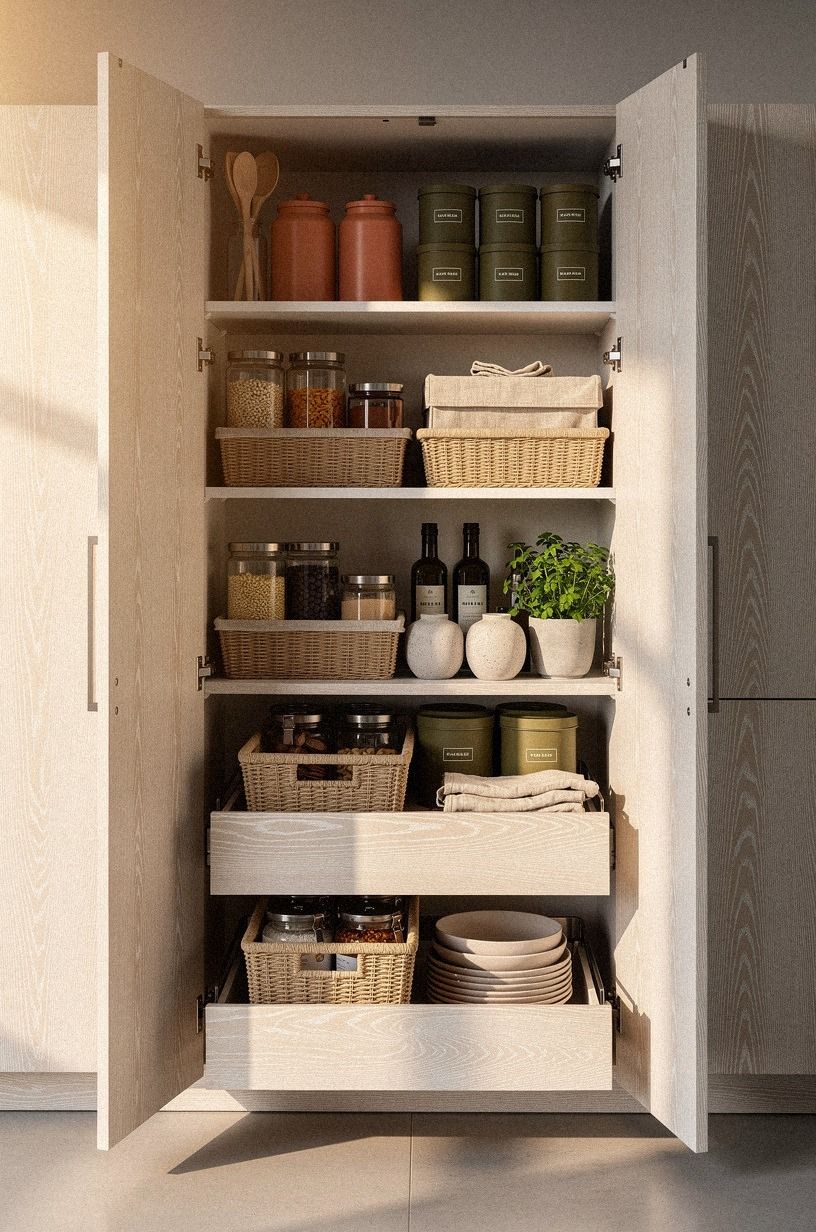
Deep pantry organization cabinets don't fail because you bought the wrong basket. They fail because you cannot see the back half, so you keep buying pasta, canned tomatoes, and crackers you already own. I made that mistake in a tall white oak pull-out wall once, and the fix wasn't more storage, it was full-extension movement you could reach with one hand.
Use baskets that slide all the way forward behind those cerused white oak doors, then build three visual zones you can spot fast: terracotta for dry goods, stone for baking, olive for snacks. If your wall of storage is similar to the tall layouts in kitchen tall cabinet ideas to use every vertical inch, you'll get more mileage from narrow, stacked pull-outs than from one huge cavern.
Leave your heaviest cans between hip and shoulder height, because you won't keep a system if it asks you to wrestle it every day. Pick stainless full-extension glides rated to 100 lb so the drawer doesn't sag after a year of canned tomato nights. A wire pull-out basket breathes better than melamine for dry goods, and the IKEA RAGRUND wire basket fits a standard 18 in cabinet without trimming.
2Add tiered spice steps inside upper cabinets
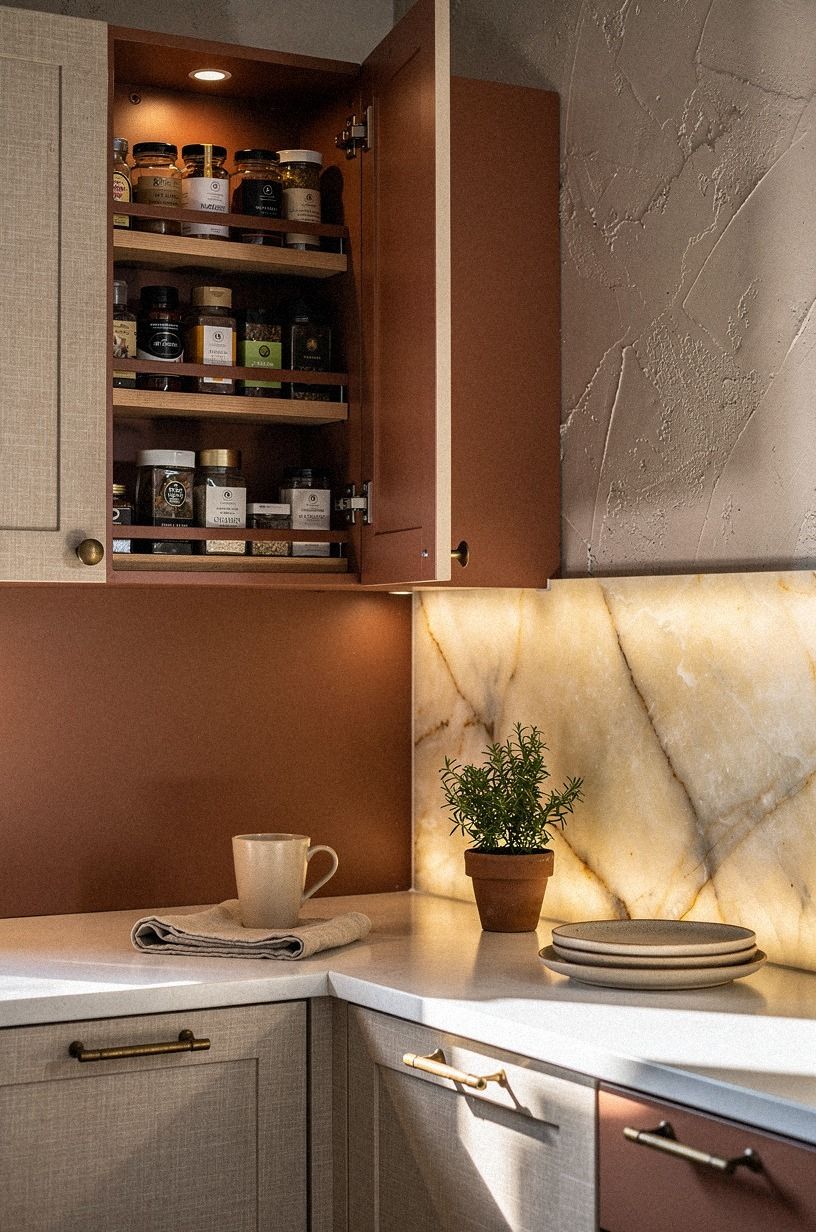
Upper cabinets are where kitchen storage organization cabinets start acting like junk drawers in disguise. If your spices sit in one flat row, the back bottles disappear and you end up buying cinnamon twice. But a stepped insert changes the sightline right away, especially inside a clay and linen cabinet with aged brass pulls where the warm finishes already make the shelf feel intentional.
Choose a two- or three-tier step that fits the 18 in gap between counter and uppers without crowding the door swing, then line up only the jars you use weekly. I like the glow you get when translucent onyx shelf backing is softly lit, but even in a plain cabinet the logic is the same: front row for salts and pepper blends, second row for weekday spices, top row for the once-a-month ones.
The shelf color matters more than people think; a back panel in Farrow & Ball Inchyra Blue makes the spices feel intentional instead of accidental. Want the cabinet color to carry more weight too? Two tone kitchen cabinet ideas that add instant depth shows why contrast helps organization feel sharper.
3Mount a hidden spice rack on hinges
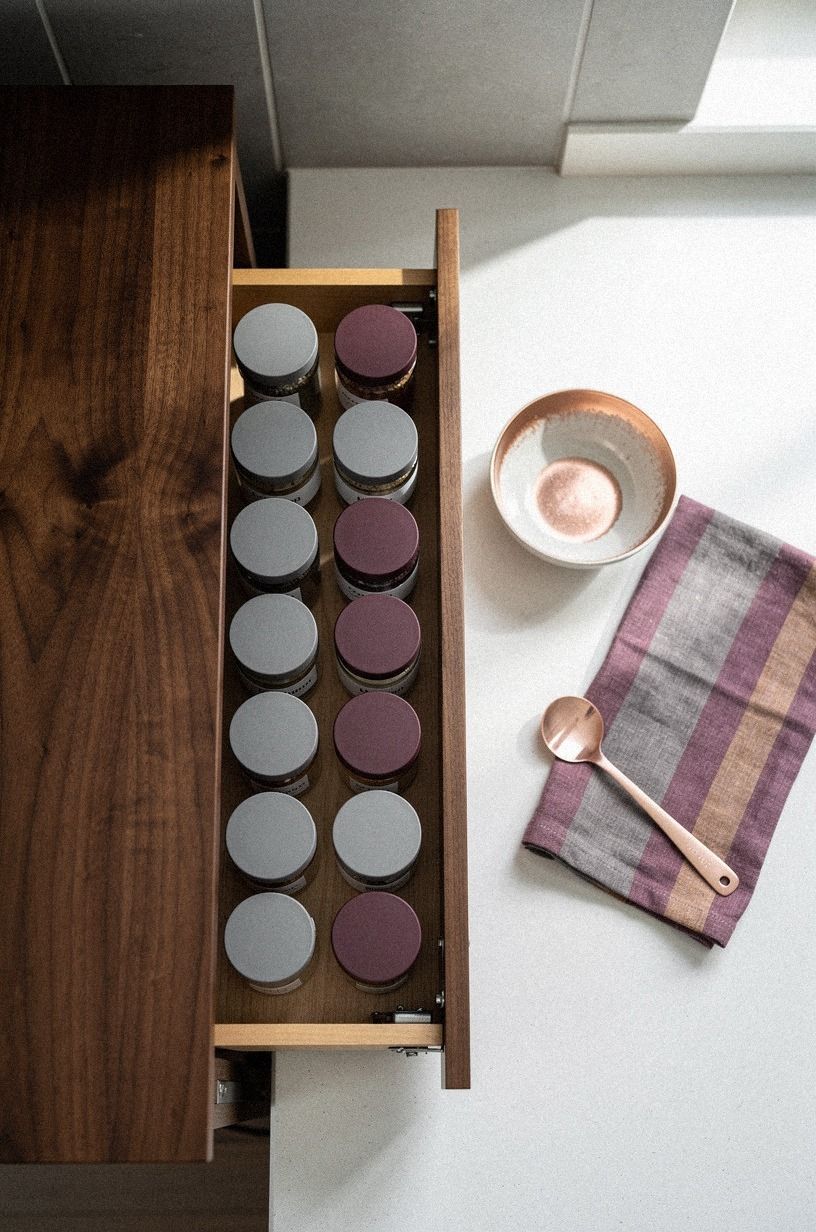
A hinged rack is one of those hidden spice rack ideas that looks fancy and earns its keep. Instead of letting tiny jars scatter across one shelf, you mount a slim organizer to the inside edge so it swings out cleanly from the cabinet frame. The bird's-eye order matters here, because you want every blank lid facing up and every label rhythm to feel calm, not busy.
Go slimmer than you think. A shallow walnut hinge rack keeps the cabinet edge crisp and stops the whole door from feeling heavy.
I would not overfill it either. Twenty matching jars beat thirty-five mismatched ones every time, because you can read the category at a glance and still close the door without knocking cumin into coriander.
The hinge itself matters more than the rack: look for soft-close brass hinges so the door shuts without slamming and the jars stay upright. If you like that concealed-storage look, modern kitchen cabinet ideas for a sleek clean look is full of clean runs that prove less visual noise helps you stay organized.
4Will a vertical divider finally fix your baking sheet pile-up?
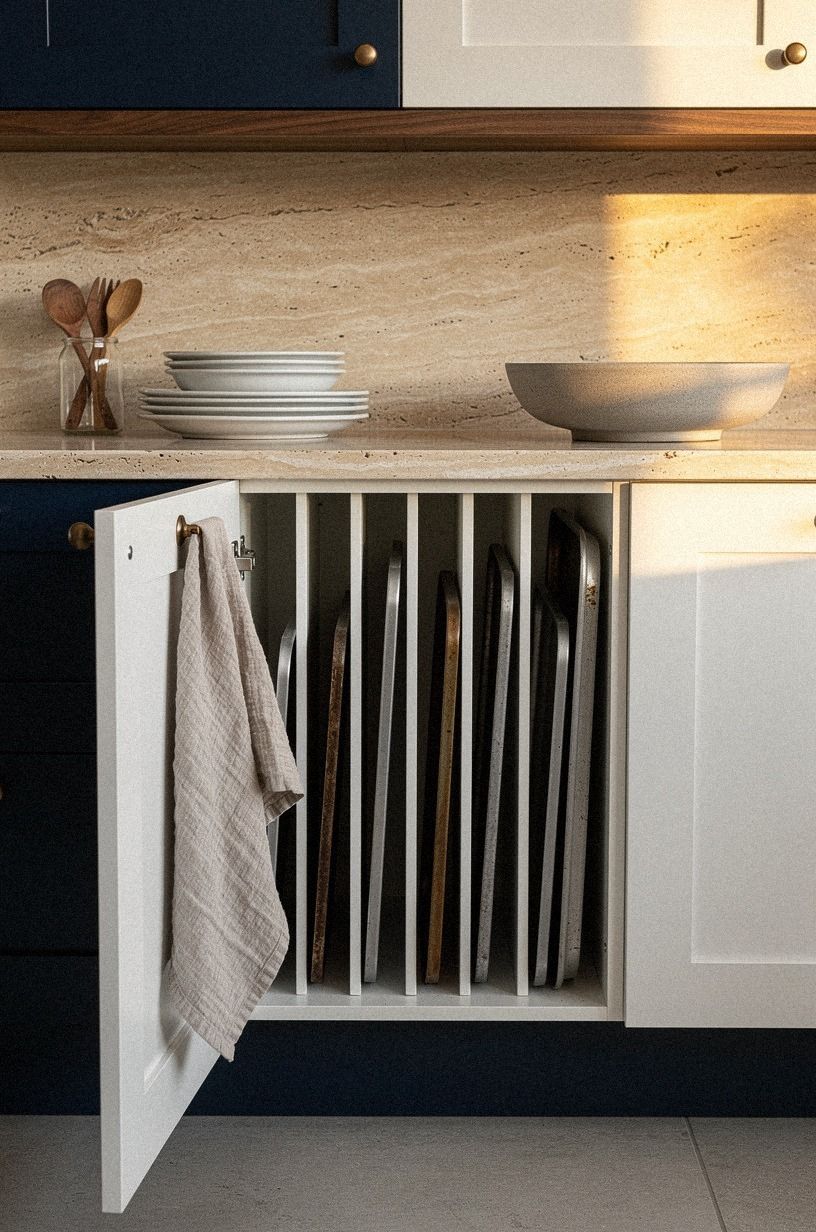
Baking sheets stacked flat are a daily annoyance, and you know it the second you need the pan on the bottom.
5Use clear bins for breakfast cabinet zones
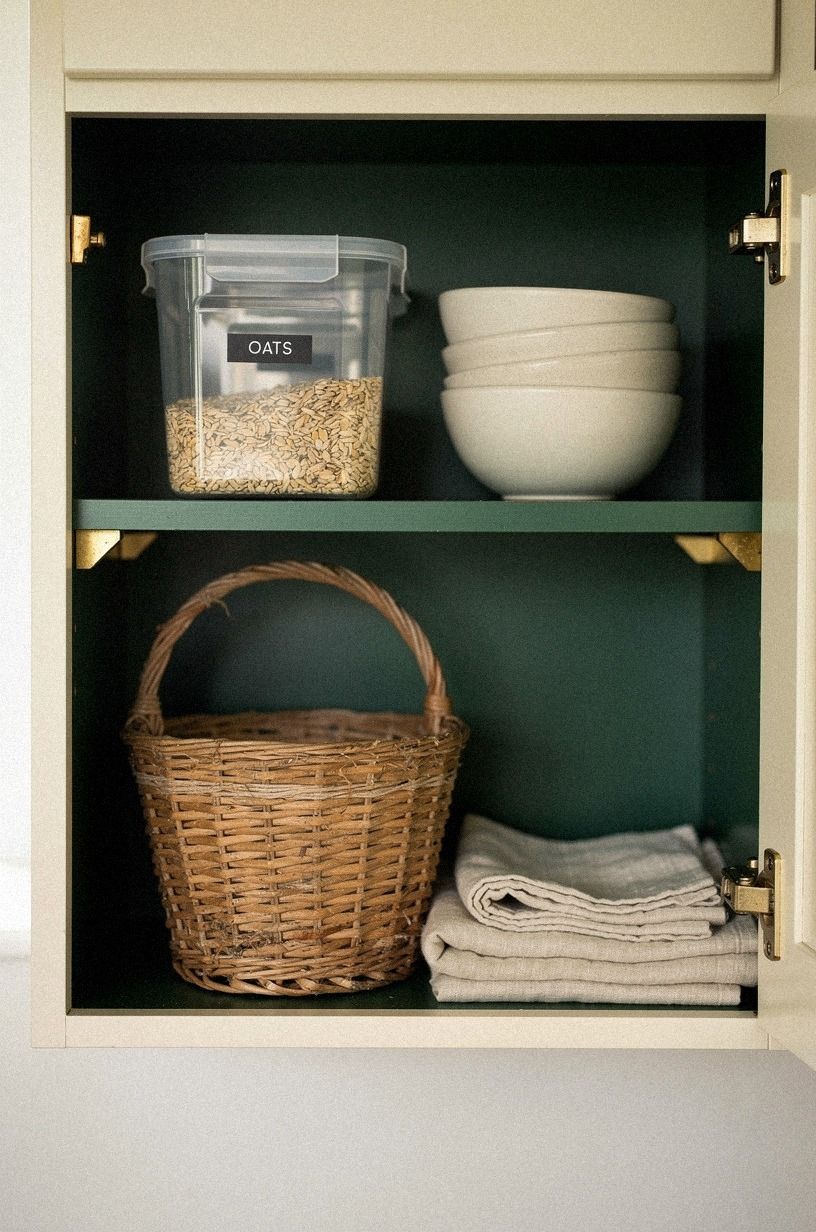
Breakfast chaos usually isn't about volume. It's about mixing oats, bowls, bars, napkins, honey, and tea in one cream cabinet and asking your brain to sort it before coffee. I did that for months, and every morning felt more annoying than it needed to.
Clear bins solve the decision part because you can see the category before you even reach in.
Set one bin for cereal and oats, one for bowls and spoons, and one for napkins or lunchbox extras. If you're styling inside kitchen cabinets with an emerald accent nearby, transparent containers keep the color from getting blocked while still doing the hard work. Acrylic pantry bins are worth it here, because opaque baskets make breakfast feel like a treasure hunt.
A frosted PET container keeps cereal crisp without scratching the cabinet interior. And if your pantry wall needs more structure beyond the bins, kitchen pantry cabinet ideas for smart storage maps out the bigger zone logic beautifully.
6Hang measuring cups on inner doors
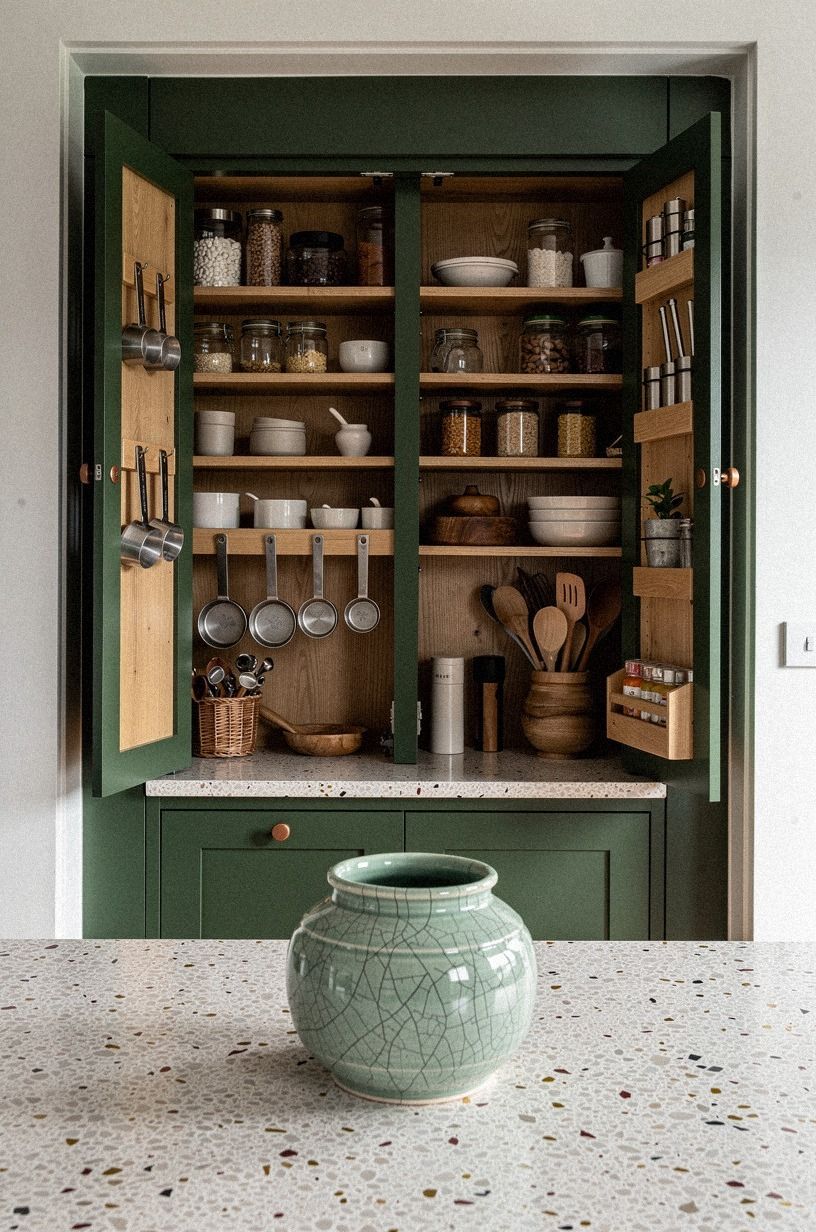
Inner-door storage is underrated because it looks too simple.
7Fit lazy Susans in blind corner cabinets
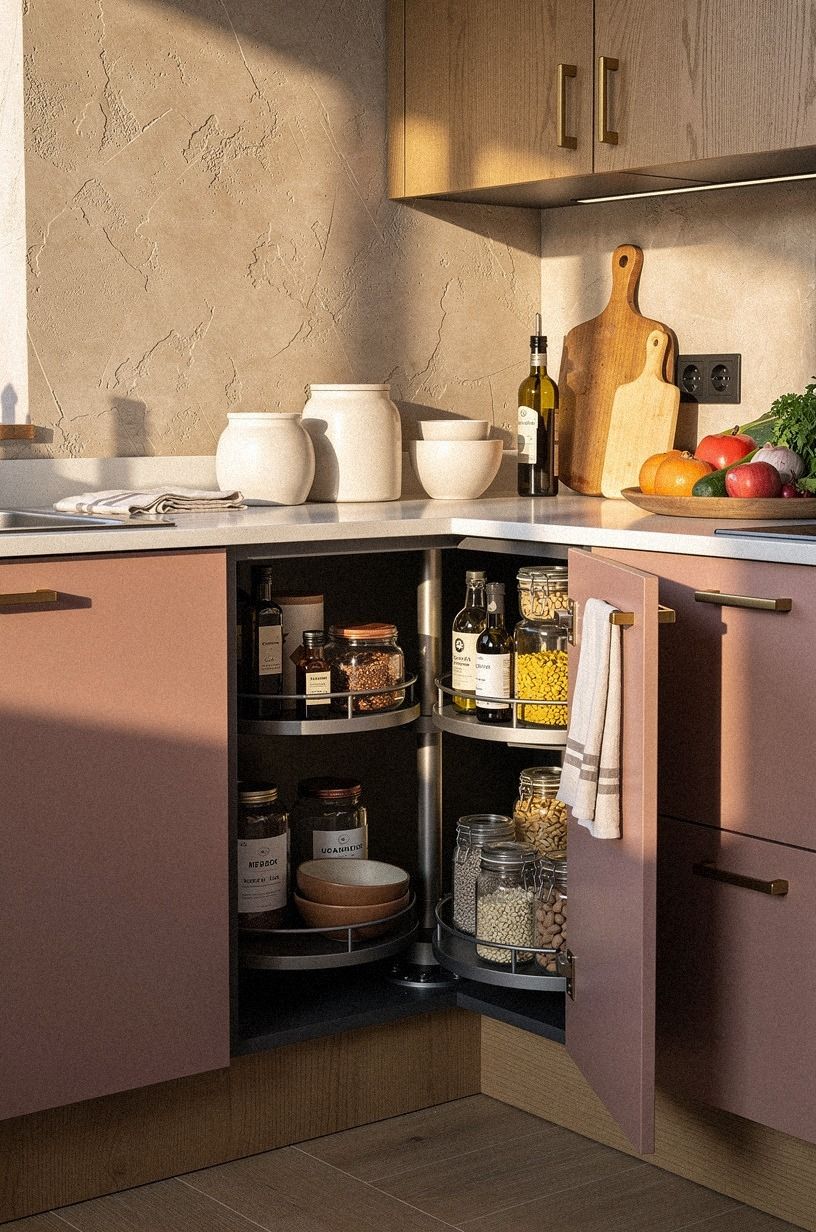
Blind corners make people give up too fast. Yes, they're awkward. No, they don't need to stay useless.
A fitted turntable lets you pull oils, bowls, vinegars, and back-stock condiments into view without crawling halfway into the cabinet, and that's what makes it worth it in real life.
And pick a diameter that clears the hinge path and the door opening, then group by use, not by package size. One wood-rim lazy Susan for oils and sauces, another for mixing bowls or snack refills, and enough breathing room that each shelf rotates without catching a label. Ask yourself this: if you can't reach the bottle with one easy turn, will you keep the system up by November?
Probably not.
Group olive oils in a Belgian flax linen sleeve if your bottles look chaotic on the turntable. For more corner-specific planning, kitchen corner cabinet ideas to fix that awkward space is the sister guide I'd read next.
8Label matching jars on pull-out shelves
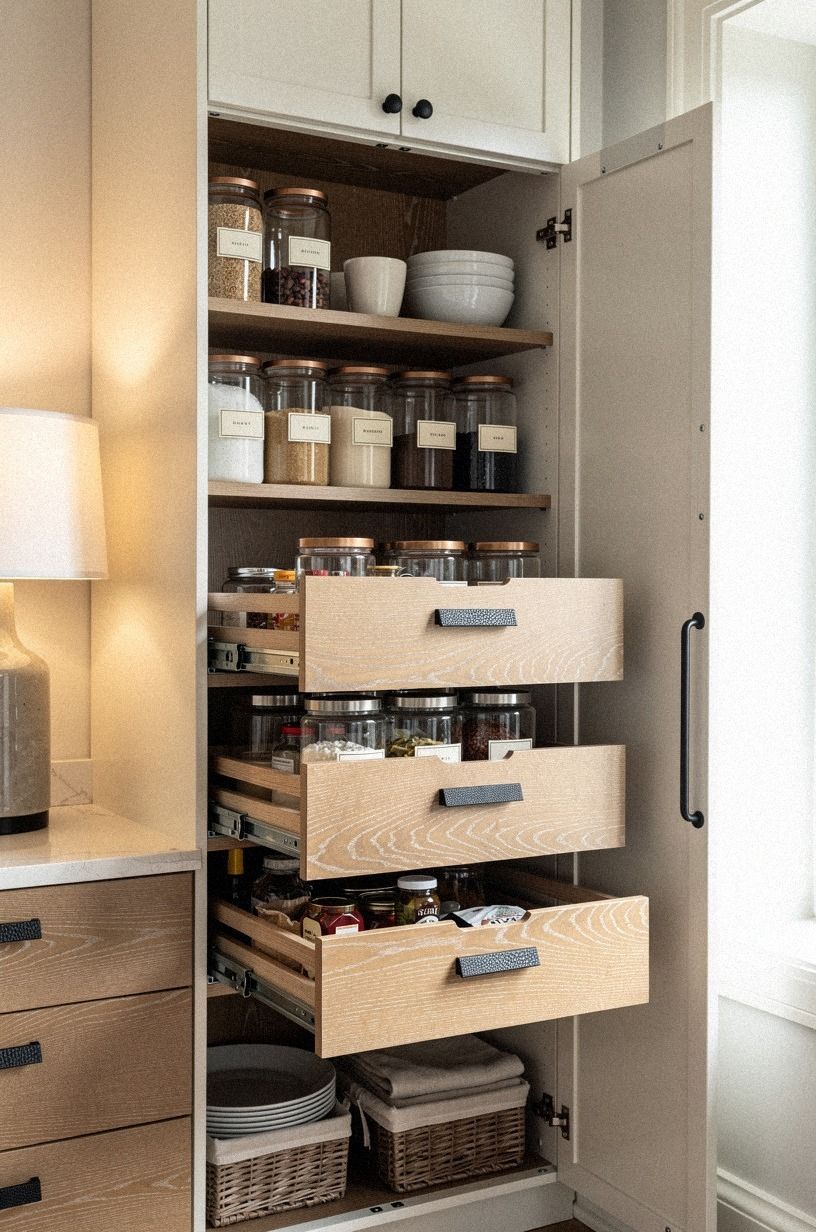
Labels don't matter because they look cute. They matter because they stop the little hesitation that slows you down every single day. On pull-out shelves, matching jars create instant order, especially in a warm white and camel pantry where black accents already sharpen the lines.
But I wouldn't label everything under the sun, because over-labeling turns useful order into homework.
Label flour, sugar, rice, oats, pasta, and snacks you refill often. Leave specialty ingredients alone unless you buy them regularly. The pull-out action does half the work, and the uniformity of glass pantry jars finishes it.
A black serif label in Helvetica or Futura reads cleaner than handwritten tags and stays consistent across jars. If you are balancing a tall cabinet layout with visibility and not just capacity, kitchen tall cabinet ideas to use every vertical inch shows why slide-out storage beats deep fixed shelving for everyday food.
9Stack plate racks in deep lower drawers
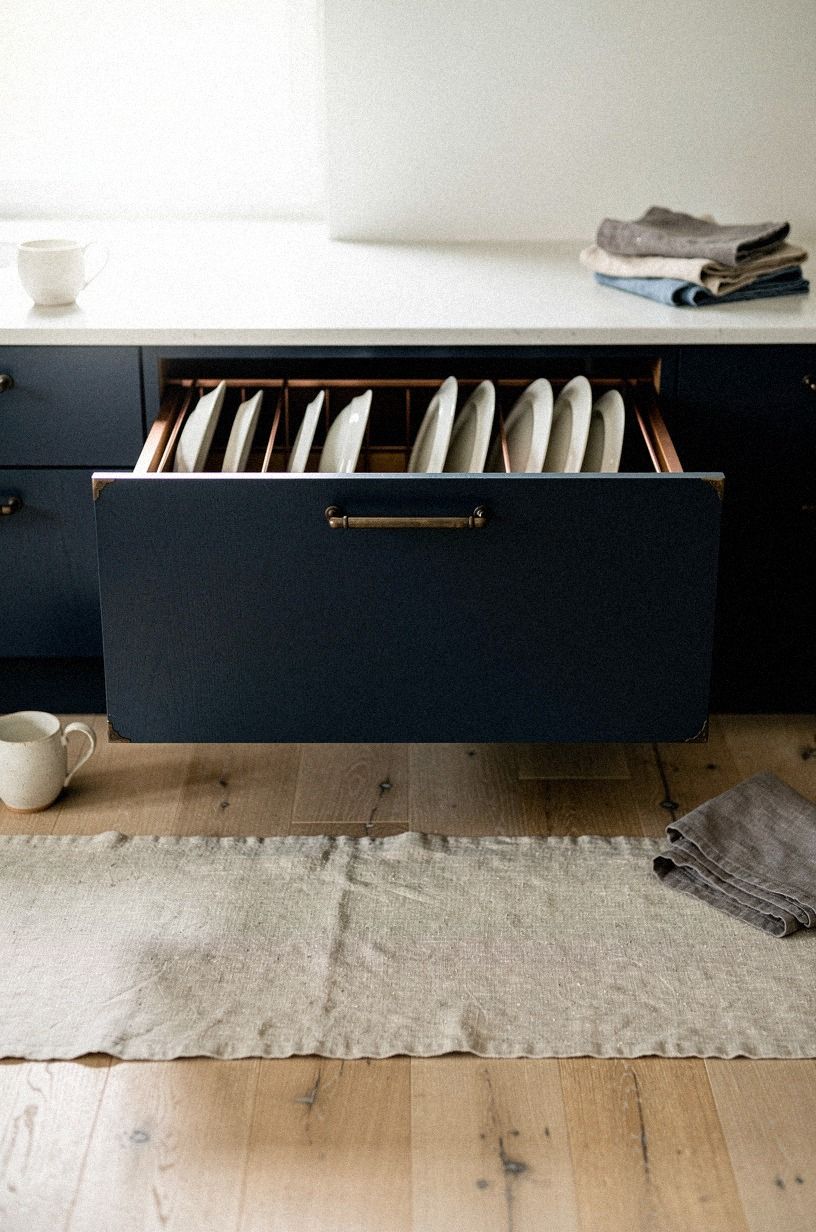
Deep drawers are better plate storage than upper shelves, and I'll stand by that. You do not want to lift heavy stacks down from shoulder height if you can help it. Floor-level drawers with upright separators keep plates stable, visible, and easier on your wrists, especially in a midnight blue base cabinet where ivory ceramic and copper dividers already make the drawer read clean.
Use plate pegs or ready-made racks sized to your dinner plates, salad plates, and shallow bowls. Keep your most-used set closest to the sink side, because small motions matter more than people admit. A drawer interior with copper plate dividers looks polished, but the real win is that every dish has a slot instead of a teetering stack.
A pewter plate rack with adjustable pegs fits the new stoneware sets better. The CB2 Primitivo line in ivory ceramic keeps the drawer looking cohesive against the navy cabinet. If the lower run around your sink still feels messy, kitchen sink cabinet ideas to organize under the sink helps connect the whole base-cabinet workflow.
10Create a coffee station behind cabinet doors
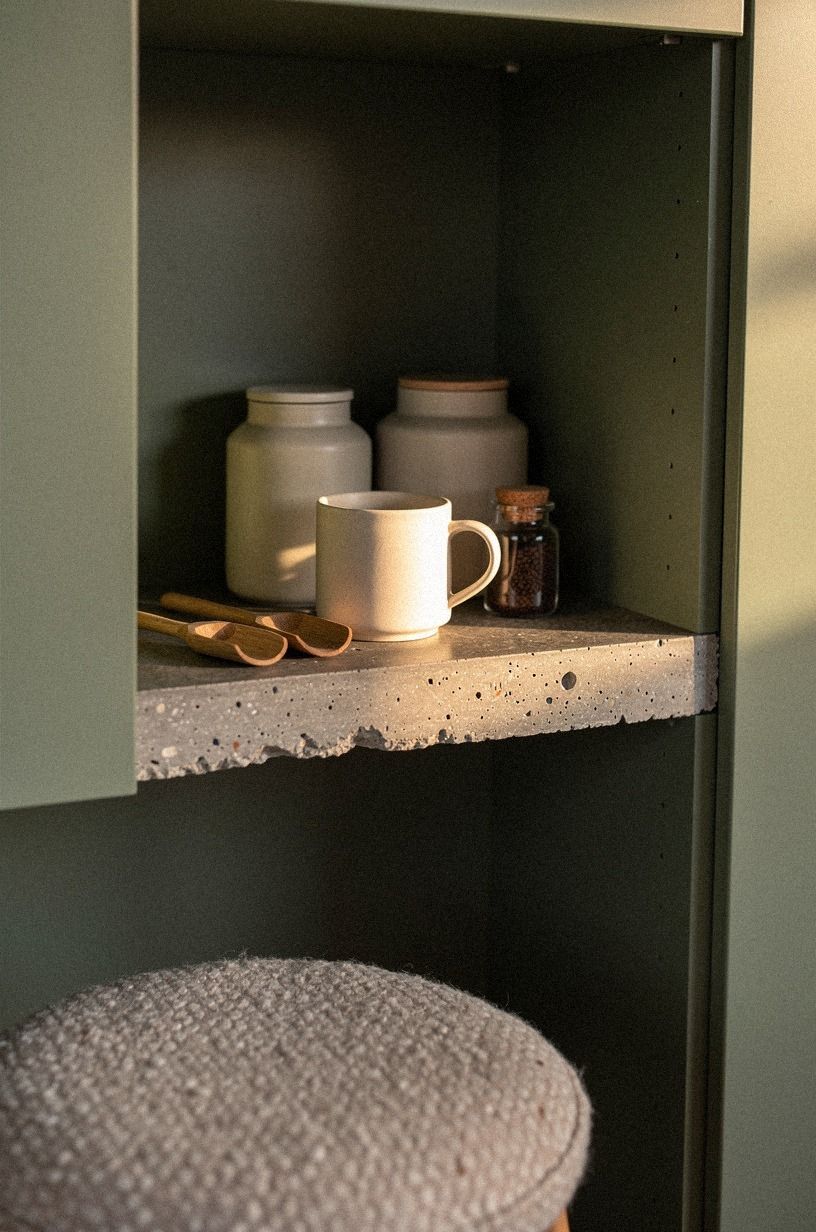
A closed coffee station keeps counters calmer than any tray ever will. Tuck the mugs, beans, filters, scoops, and sweetener behind one set of doors so your morning routine lives in a single pocket. In a sage green interior with cream mugs and a poured concrete counter, the setup feels grounded instead of busy, which is exactly why it works.
Give the cabinet three levels: mugs at eye height, jars below, and equipment off to one side so the grinder cord doesn't snake across everything. I like one shelf in Sherwin-Williams Evergreen Fog SW 9130 for this, because the color plays nicely with wood scoops and pale ceramics without looking flat in morning light.
A small brass scoop and a stack of cream stoneware mugs make the eye land on texture, not plastic. If your cabinet fronts need a refresh to support that tucked-away look, modern kitchen cabinet ideas for a sleek clean look has the cleanest inspiration.
11The IKEA KALLAX Mug Overflow Move
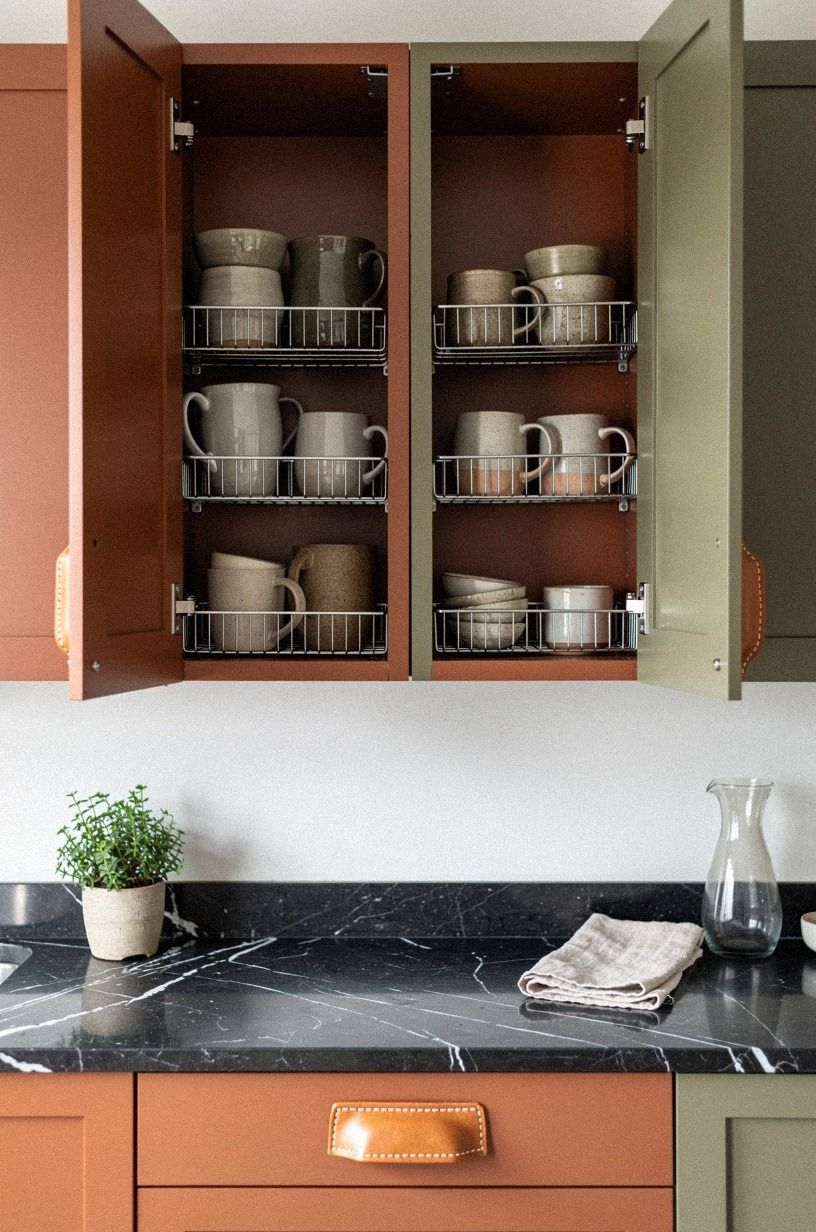
Overflow mugs are where good intentions go to die.
12Use drawer inserts for lids and food wraps
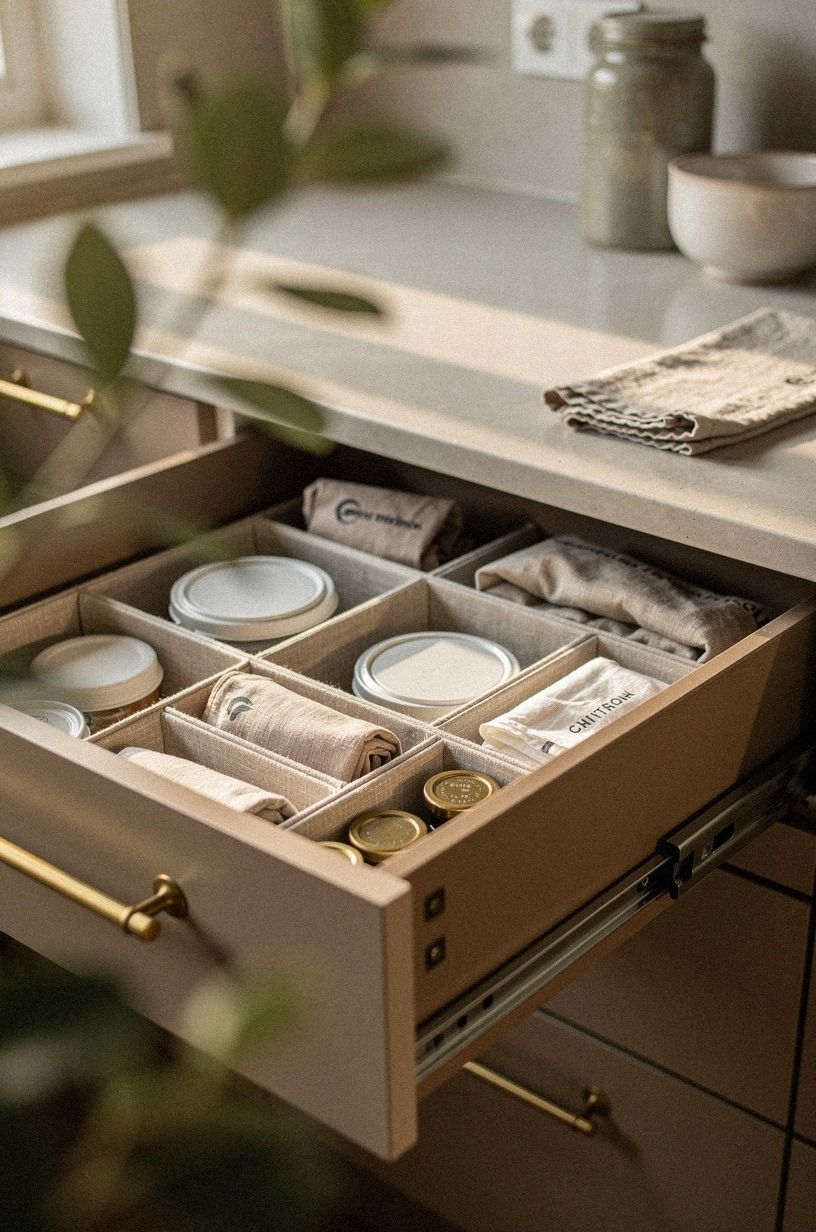
Lids and wraps create the kind of mess that makes organized kitchens look fake on social media. They're all odd shapes, they slide, and they never stay where you tossed them last.
That is why a divided drawer is such a relief. Frame the drawer through a leafy plant if you want it to feel softer, but inside, be strict.
Give each category its own lane: pot lids standing vertically, foil and parchment boxed on one side, reusable bags or clips in a shallower pocket. Linen-colored compartments keep the drawer feeling calm without hiding what matters. I like rigid birch drawer inserts more than stretchy plastic dividers here, because the compartments hold their shape over time.
Add a small ceramic tray for the rolls of parchment and foil so they don't roll loose at the back. For adjacent cleanup, kitchen sink cabinet ideas to organize under the sink pairs well when wraps and cleaning refills tend to overlap in your layout.
13Mount slim racks for cutting boards
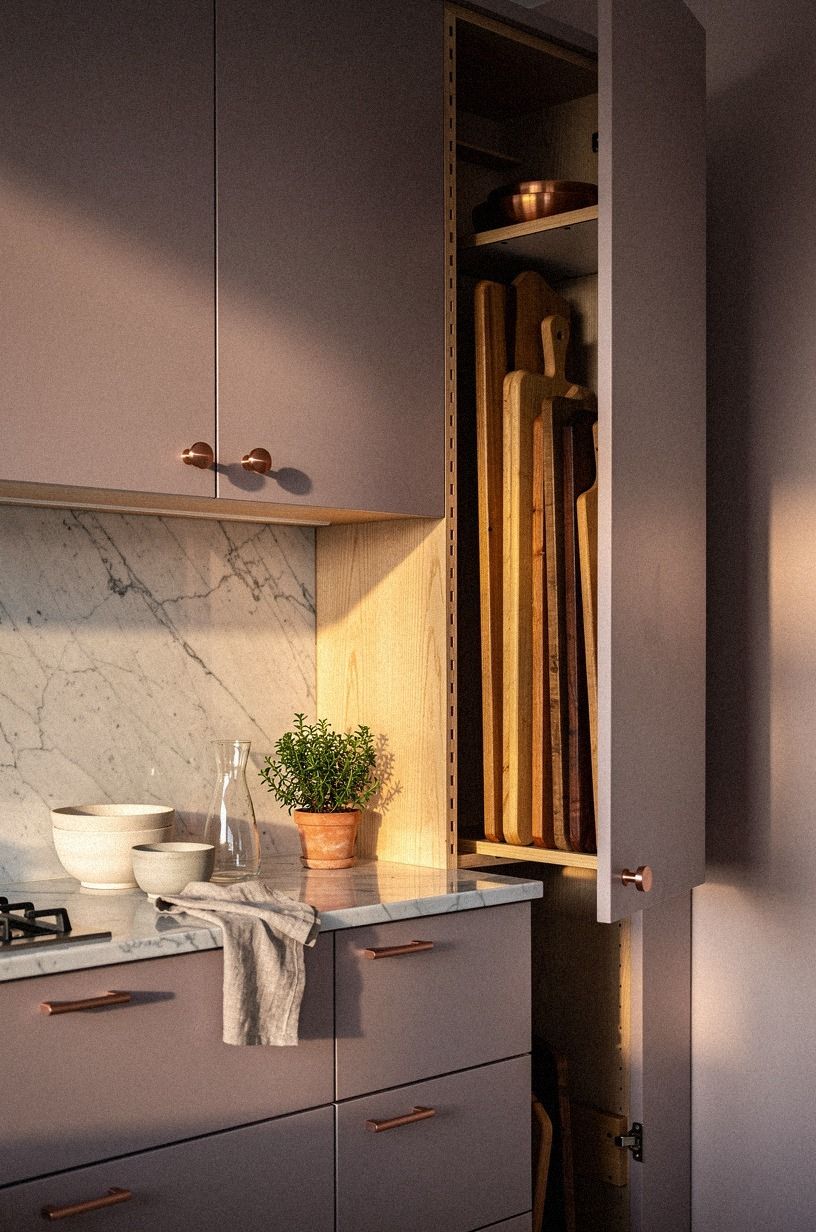
Cutting boards deserve a home that doesn't scratch them up or make you dig behind the roasting pan. Slim side racks turn a forgotten cabinet wall into vertical storage, which is why they are so useful in a Carrara marble kitchen where every exposed surface already has enough to say.
You don't need thick hardware here. Thin wins.
Mount one or two narrow rails so boards slide in from the top and stay separated by size. I like wood boards in front and the plastic prep boards in back, because the pretty ones are the ones you'll keep grabbing if they're easiest to reach. A run with Carrara marble counters and a plum-grey palette benefits from storage that disappears visually while still working hard.
If your boards are heavy, mount the rail into studs with blackened steel L-brackets so the load doesn't creep. If you're planning the cabinet finish too, two tone kitchen cabinet ideas that add instant depth is a strong companion.
14Round Canisters vs Square Canisters: The Shelf-Space Verdict
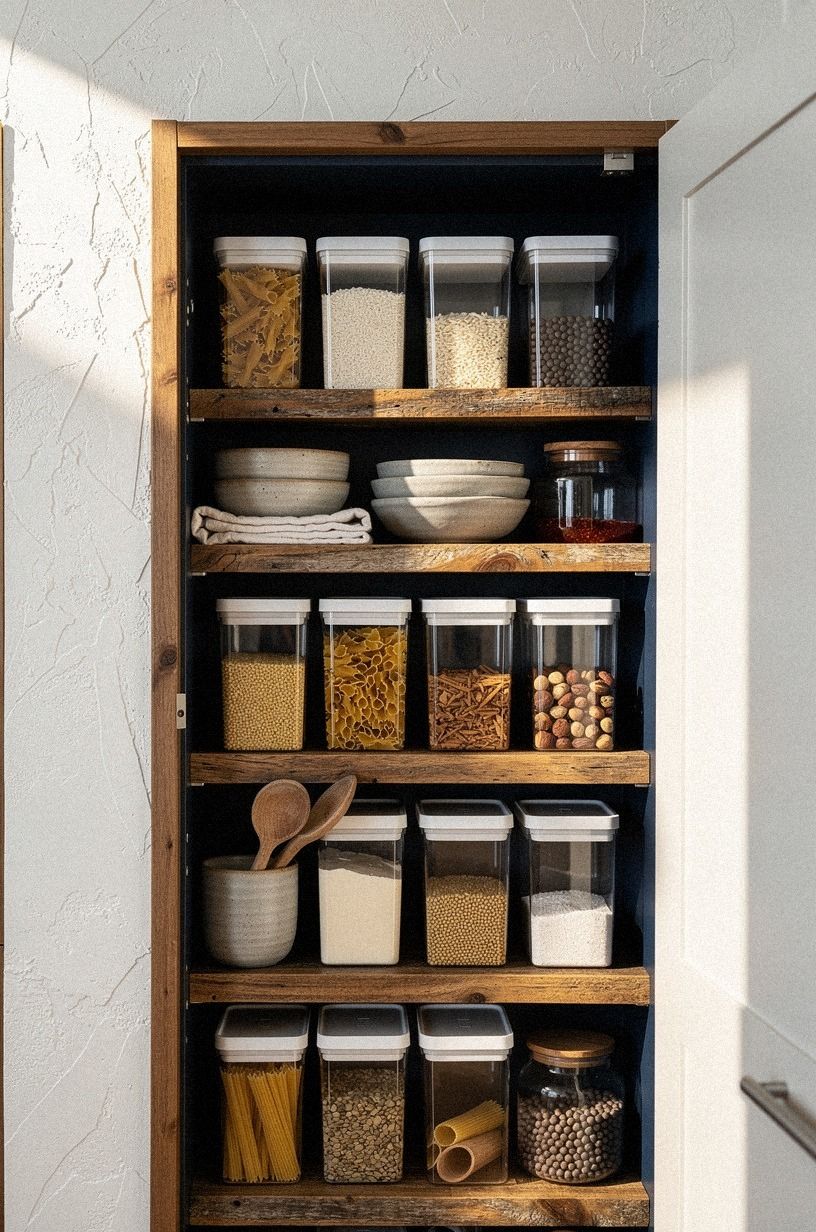
Round containers waste shelf width. That's the whole argument for square canisters, and honestly, it's enough.
In a navy, white, and walnut pantry with reclaimed teak shelves, lined-up clear containers make the cabinet feel roomier because every edge reads clean. You don't need dozens.
You need the right repeat.
Start with flour, sugar, rice, pasta, cereal, and snacks your family reaches for daily. Keep the heights consistent on each shelf so the cabinet doesn't turn choppy.
I like airtight square pantry canisters with low-profile lids, because tall rounded tops steal usable space fast. Round ones still win for things you scoop by hand (cereal, oats) where the wide mouth helps.
The honest answer: square saves about 20% shelf width over round when lined up tight. A clear Anthropologie Apothecary jar set looks intentional without going precious. If you are trying to stretch every inch inside pantry organization cabinets, kitchen pantry cabinet ideas for smart storage goes deeper on shelf planning and refill zones.
15Add toe-kick drawers for flat linens
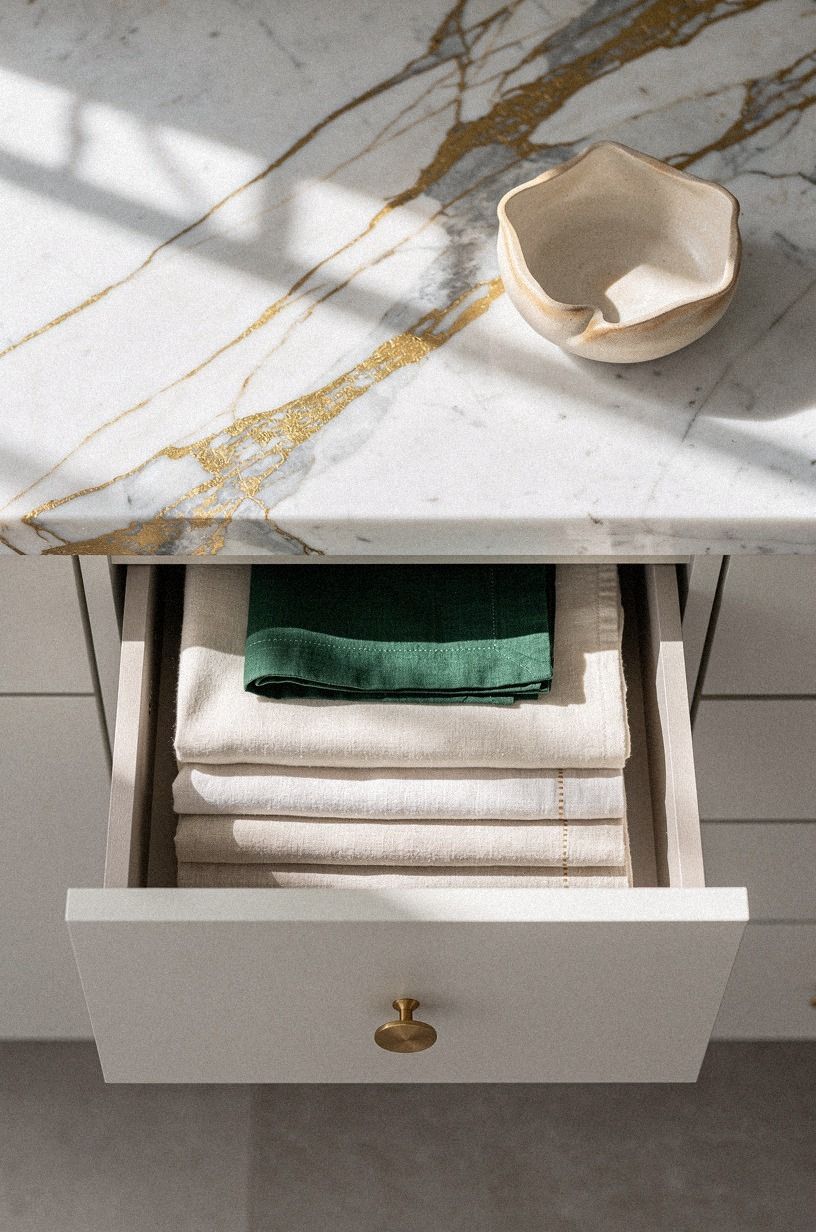
Toe-kick drawers are the move nobody believes until they see them open. That skinny strip under the cabinet run can hide flat linens, placemats, tea towels, even backup apron strings, and it does it without asking you to give up a full drawer elsewhere. In a lower run with cream linens folded into a narrow slot, the effect is tidy and almost invisible.
Use this for soft, flat things only. I would not waste toe-kick space on tools, because low access should earn its keep. A shallow drawer lined with washed linen towels works because it slides smoothly and closes without bulk pushing back.
I prefer 600gsm Turkish cotton here because the fold stays crisp and the color reads quiet even after years of washes. And if you are squeezing storage from every face of the room, small kitchen cabinet ideas that maximize storage is packed with the same kind of hard-working details.
16Can risers really make canned goods disappear?
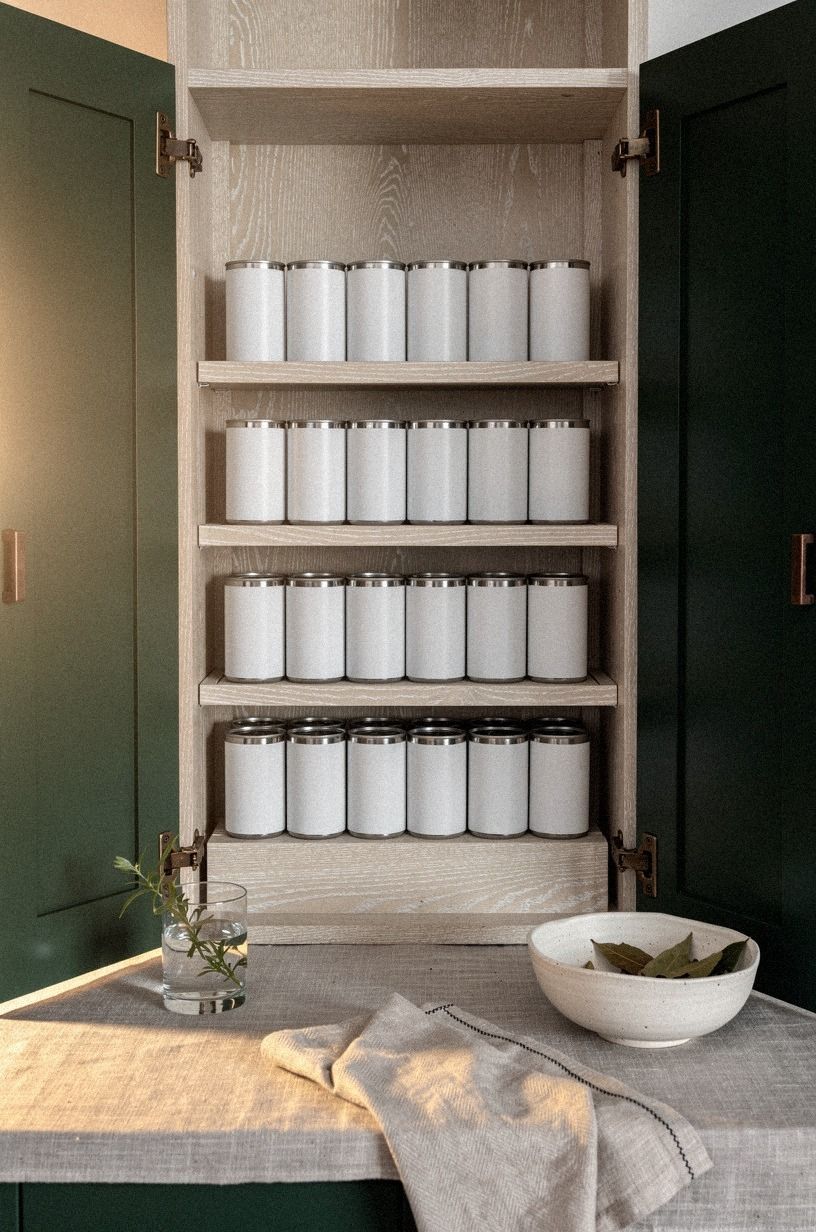
Cans are sneaky clutter because they are useful, heavy, and visually repetitive.
17Install pegboard inserts for pots and pans
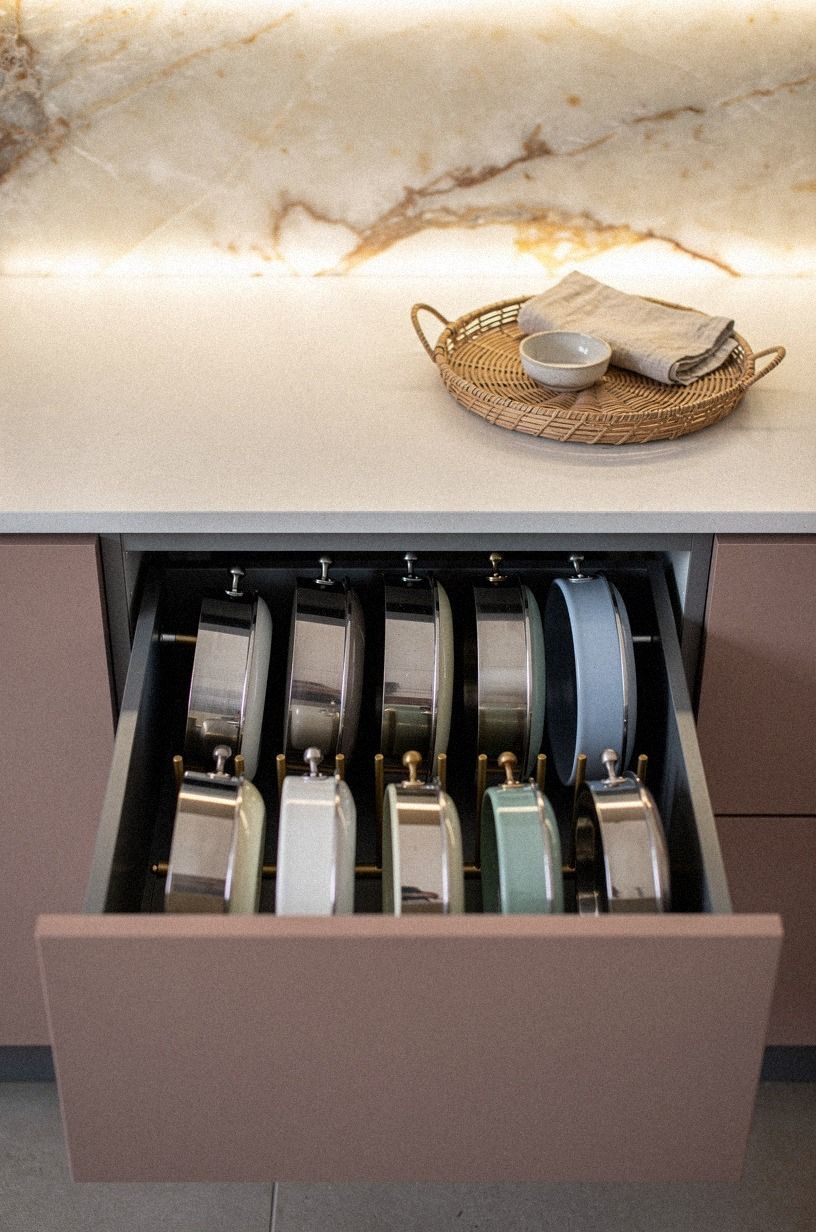
Pots and pans get noisy fast when the drawer has no structure. Pegboard inserts fix that by letting you build custom lanes around each pot, lid, and sauté pan instead of stacking metal on metal and hoping it stays put. In a charcoal drawer with dusty rose fronts and brushed brass nearby, the order looks expensive, but the real luxury is silence.
Measure your drawer before you buy anything, then leave enough room for the handles to sit without crossing. Standard counters land at 36 in high, which is why these deep lower drawers are such prime real estate for heavy cookware. I'd skip flimsy plastic pegs and choose a sturdier maple pegboard insert that won't creep out of place.
The sauté pan lives in the front lane, the stockpot at the back, and lids in a vertical sleeve near the hinge. For more lower-cabinet logic around the prep zone, kitchen sink cabinet ideas to organize under the sink helps balance what lives low and close.
18The Lift-Up Appliance Garage (Why It Beats a Tray)
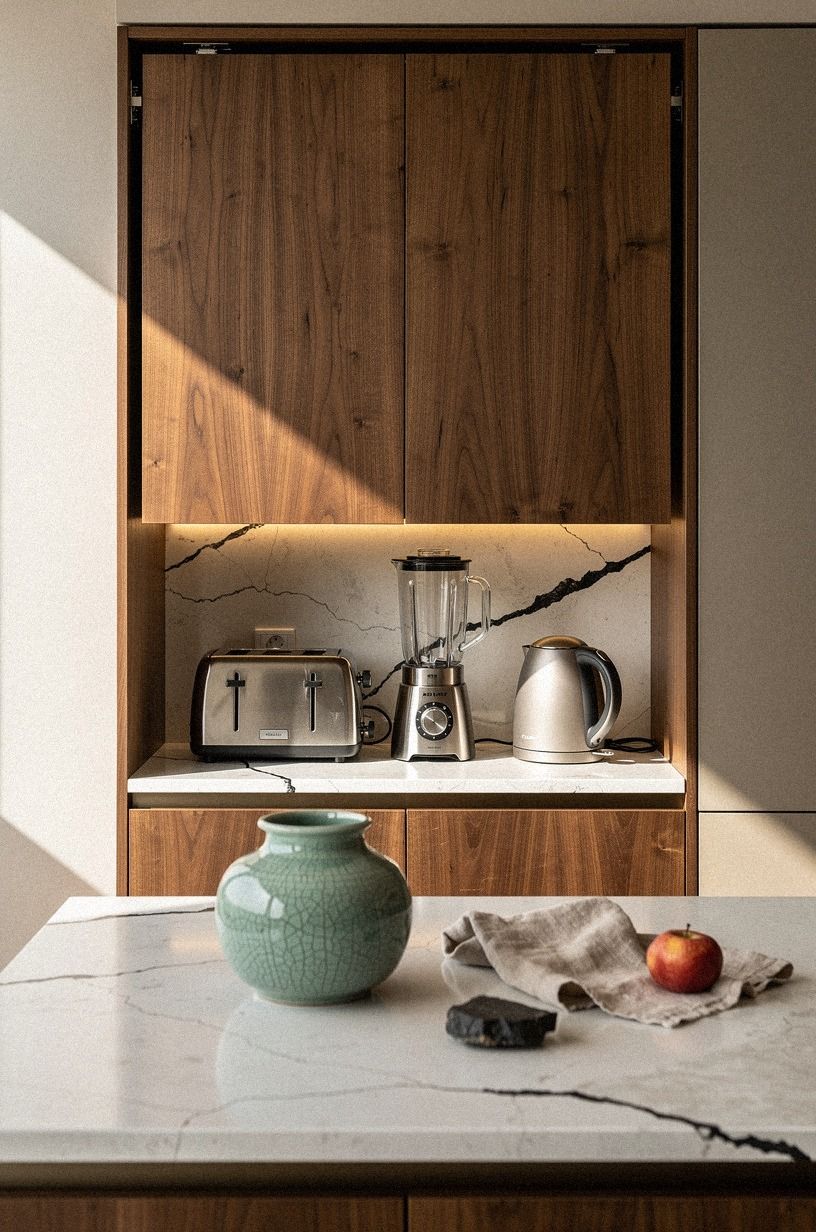
Appliance garages work when they hide the right machines and refuse the rest.
19Build a snack cabinet with pull-out trays
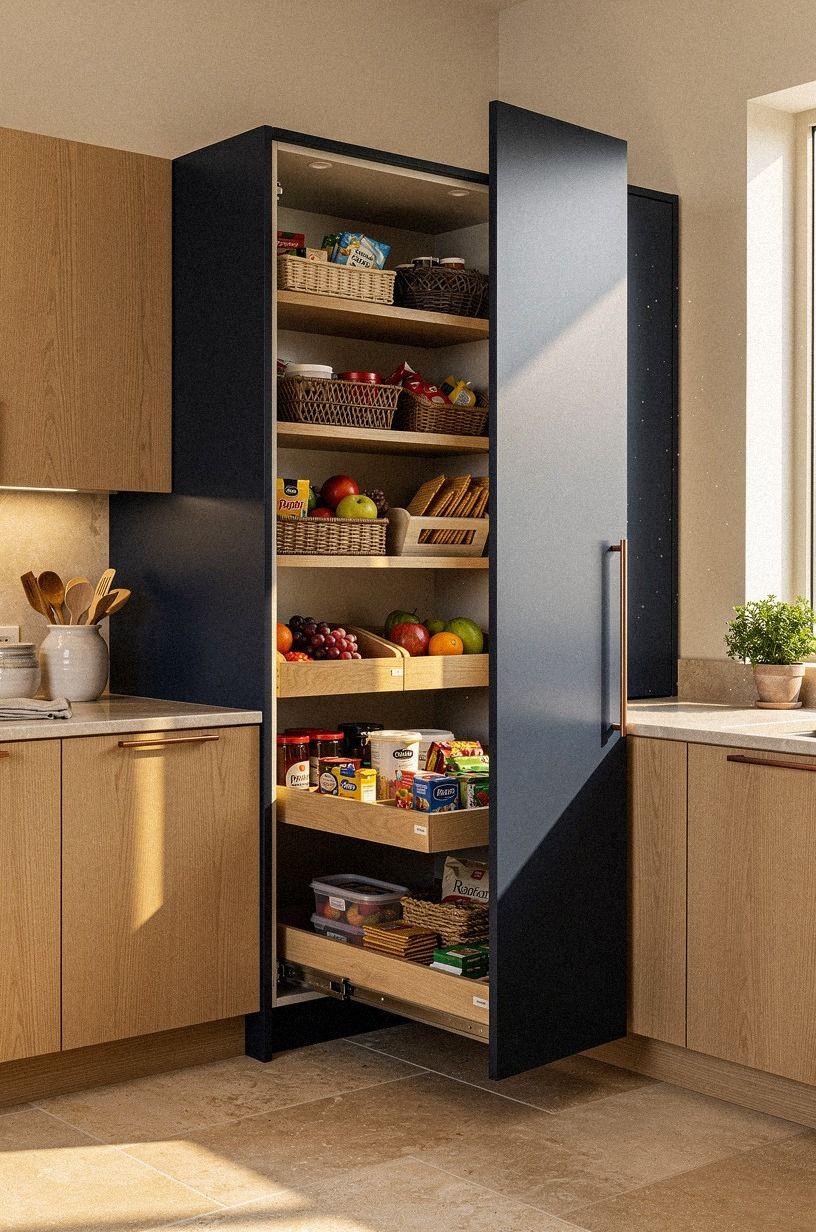
Snack cabinets get messy because they're emotional, not just practical. Kids grab fast, adults toss things wherever there's room, and wrappers multiply at weird angles.
Pull-out trays help because they turn the snack zone into layers you can scan in one second. In a midnight blue pantry with copper pulls and an ivory interior, those stacked trays look sharp and earn their square footage.
Sort by routine, not by brand. Top tray for lunchbox fillers, middle for bars and crackers, bottom for backup bags or refill boxes. If your family can pull a tray forward and see the whole category, you're far more likely to keep the cabinet tidy.
I like durable oak-framed pull-out trays here, because the edge keeps pouches from slipping off when the drawer moves.
Line each tray with cork sheet so snack bags don't slide when the kids yank. For a full snack-wall redo, Pottery Barn pantry cabinets with brass cup pulls tie the zone to the rest of the kitchen. For more ideas on making pantry storage feel intentional, kitchen tall cabinet ideas to use every vertical inch is worth a save.
The Three-Tier Spend Plan
You do not need a full remodel to make cabinet organization feel better. Most of these ideas sit comfortably in the cosmetic tier, which is why they're so useful for renters, older homes, and kitchens that function fine but feel chaotic.
I tell people to spend first on movement and visibility, not on decorative containers. That is the part that changes your mornings.
If you are comparing material swaps at the same time, keep these benchmarks in view. Quartz usually runs $60-$120/sq ft, laminate lands around $10-$40/sq ft, zellige often sits near $15-$35/sq ft, and repainted Shaker fronts can range from $150-$400 per door. But I would not blow the whole budget on a prettier finish if your shelves still hide what you use every day.
A quart of Benjamin Moore Chestertown Buff HC-9 on the cabinet interior is the kind of $40 move that makes a $200 insert feel like a $2,000 upgrade. The same goes for a Farrow & Ball Card Room Green accent panel at roughly $85/gallon. Color carries more weight than people realize, and a quiet warm tone behind the door reads intentional before you even open the cabinet.
The One-Touch Rule That Keeps Cabinets Clear
The best cabinet systems don't ask you to remember twenty rules. They ask for one simple behavior: touch an item once, and it lands in its home.
That is why the prettiest kitchens on Pinterest stay believable when you look closer. The zone is obvious, the reach makes sense, and the container shape matches the item instead of fighting it.
I've learned that cabinet clutter usually comes from three tiny frictions. First, the storage is deeper than your arm wants to reach. Second, categories are mixed, so your brain has to sort before your hand can move.
Third, the daily items live behind the weekly ones, which means you're rebuilding the cabinet every time you make coffee or pack lunch. None of that is dramatic.
It is, however, the reason a kitchen can look lovely at 9 a.m. and chaotic by 6 p.m.
And when you are choosing between a prettier jar and a better pull-out, choose the pull-out. When you are deciding whether a rack should hold six boards or four, choose four and keep the easy grab. And when you're tempted to buy matching bins for every shelf, pause and ask whether the category even needs a bin.
Some things need containment. Some just need a clear lane.
That distinction saves money, saves time, and keeps you from building a system you resent.
My own test is boring, but it works. Can you open the door, grab the thing, and put it back without shifting two other things first?
If the answer is no, the cabinet is not organized yet, no matter how pretty the labels look. That's why I care so much about pull-outs, risers, dividers, and slim racks.
They reduce the shuffle. And once the shuffle is gone, the kitchen starts staying clear on its own.
A Belgian flax linen liner in the snack drawer protects wood and reads soft at the same time, which is exactly the texture you want at eye level. The rule isn't really about rules; it's about removing the moment of decision every time you open a cabinet.
The Questions I Get Asked Most
What is the best Kitchen Cabinet Organization Ideas for a Clutter-Free Kitchen for a small kitchen?
Pull-outs and vertical dividers are the best place to start in a small kitchen, because they give you visibility without bulk. That payoff is immediate! I'd look first at narrow pantry pull-outs and upright tray files, then save small kitchen cabinet ideas that maximize storage for your next round.
Where can I buy Kitchen Cabinet Organization Ideas for a Clutter-Free Kitchen pieces on a budget?
IKEA, Target, and Wayfair are still the easiest places to find budget-friendly inserts and bins without overthinking it. I also check Facebook Marketplace for drawer organizers, baskets, and shelf risers, because secondhand acrylic pieces clean up well and usually cost far less.
How much does a Kitchen Cabinet Organization Ideas for a Clutter-Free Kitchen makeover cost?
Most cabinet organization refreshes cost about $100 to $300 if you're adding bins, risers, hooks, and one or two pull-outs. Free wins matter too: editing duplicates, resetting categories, and moving daily items to the front often change the kitchen before you buy anything.
Can I create a Kitchen Cabinet Organization Ideas for a Clutter-Free Kitchen on a budget?
Yes, and you probably should start there. The highest-value moves are cheap or free: decanting a few staples, adding door hooks, and separating baking sheets vertically. If you want one paid upgrade after that, a single pull-out basket usually beats a dozen small accessories.
Is a Kitchen Cabinet Organization Ideas for a Clutter-Free Kitchen worth it in a small space?
Yes, because a small kitchen rewards every inch you clarify. You have less room to waste, so better access adds real value faster. Keep your most-used items between waist and eye level, and borrow more planning ideas from kitchen corner cabinet ideas to fix that awkward space.
Is Kitchen Cabinet Organization Ideas for a Clutter-Free Kitchen a good idea for a rental?
Yes, especially if you stick to no-damage changes. Think adhesive hooks, freestanding risers, and removable bins instead of drilled-in hardware. I also like tension-rod dividers for wraps and trays, because they give you structure without leaving a mark when you move out.
How do I stop my cabinet organization from sliding back to chaos in a month?
Pick one zone and one rule, then keep that zone clean for 30 days before you touch the next cabinet. That's the part nobody respects, and it's the part that decides whether the system lasts.
The First-Door Test I'd Use
If I had to pick one, I'd start with pull-out pantry baskets. Deep shelves waste more food and patience than almost any other cabinet problem, and you feel the payoff immediately. Pin that idea for later and let the back half of your pantry start earning its keep.