
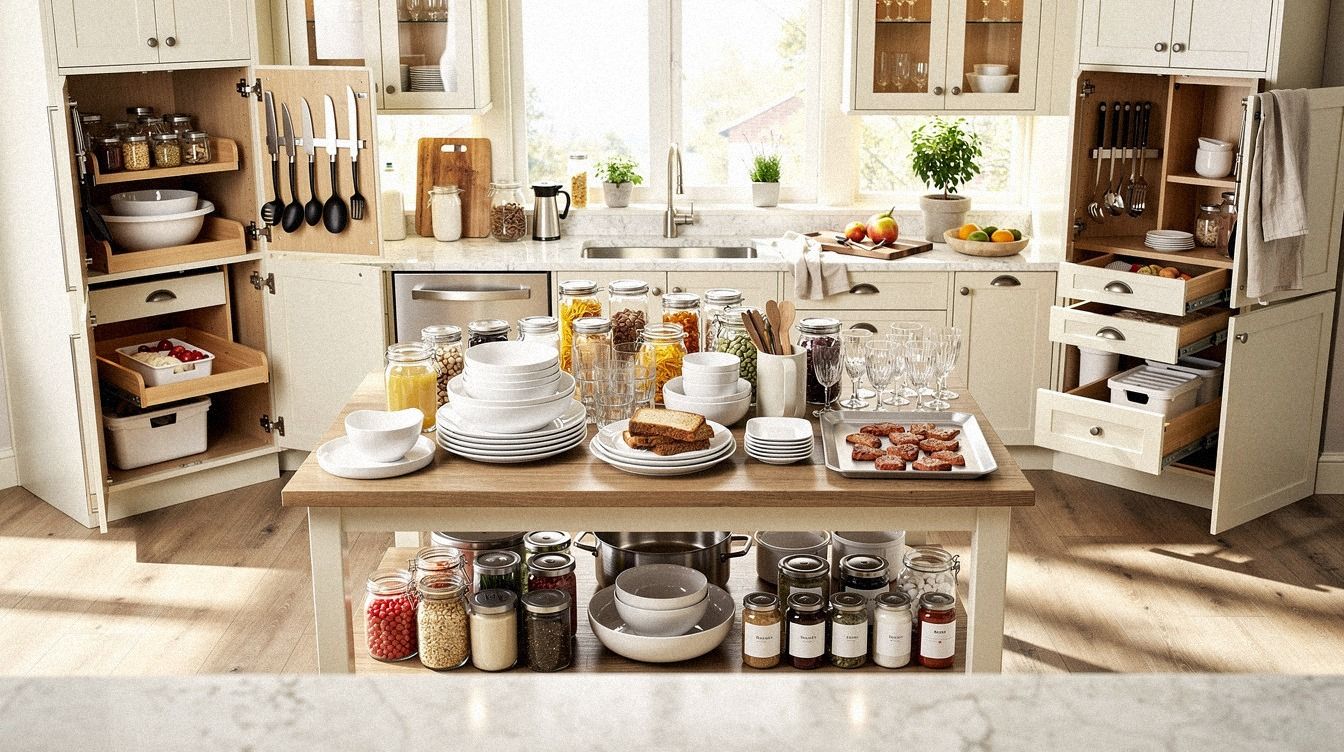
 by
by Kitchen cabinet storage was the part of my remodel that paid off fastest: one weekend, $243, and I stopped doing that irritated half-crouch while hunting for a pan. I did this reset after one too many weeknights in a tight 42-inch walkway kitchen, with groceries on the floor and nowhere sensible to put them. The room still feels warm, lived-in, and layered under the cerused white oak fronts and the new Brass Tone hardware I had been avoiding. But now it works.
Here's what it looked like before
Before this reset, my kitchen had the full slow-burn problem. The cabinets were good quality, finished in cerused white oak, but I was using them like random boxes instead of a system.
Daily plates lived far from the dishwasher, baking pans were split between two cabinets, and the corner unit had become the place where useful things went to disappear. If your morning walk to the coffee machine feels longer than it should, that is a cabinet-plan problem, a real one.
I was not short on storage, not really. I was short on logic.
Every task had one extra step, and in a kitchen that already had to hold a 36 in counter run, a narrow prep zone, and the usual dinner mess, that extra step was enough to make cooking feel longer than it was. If your kitchen feels crowded even when it is clean, that is usually the first quiet clue.
If you want a deeper read on why kitchens feel broken even when they look tidy, my kitchen corner cabinet ideas to fix that awkward space guide covers the same geometry problem from a different angle, paired well with Benjamin Moore White Dove OC-17 on the trim.
- Empty every cabinet onto the kitchen table
- Group baking pans in one lower cabinet
- Move daily plates beside the dishwasher
- Add pullout drawers under the cooktop
- Stand cutting boards in a narrow divider
- Hide spices inside a skinny cabinet door
- Stack glass containers in one labeled drawer
- Turn the corner cabinet into lazy Susan storage
- Park small appliances behind lift-up doors
- Use deep drawers for pots and lids
- Add clear bins above the refrigerator cabinet
- Hang measuring cups inside the baking cabinet
- Store mugs on a shallow upper shelf
- Finish with one open cabinet display
1Empty every cabinet onto the kitchen table
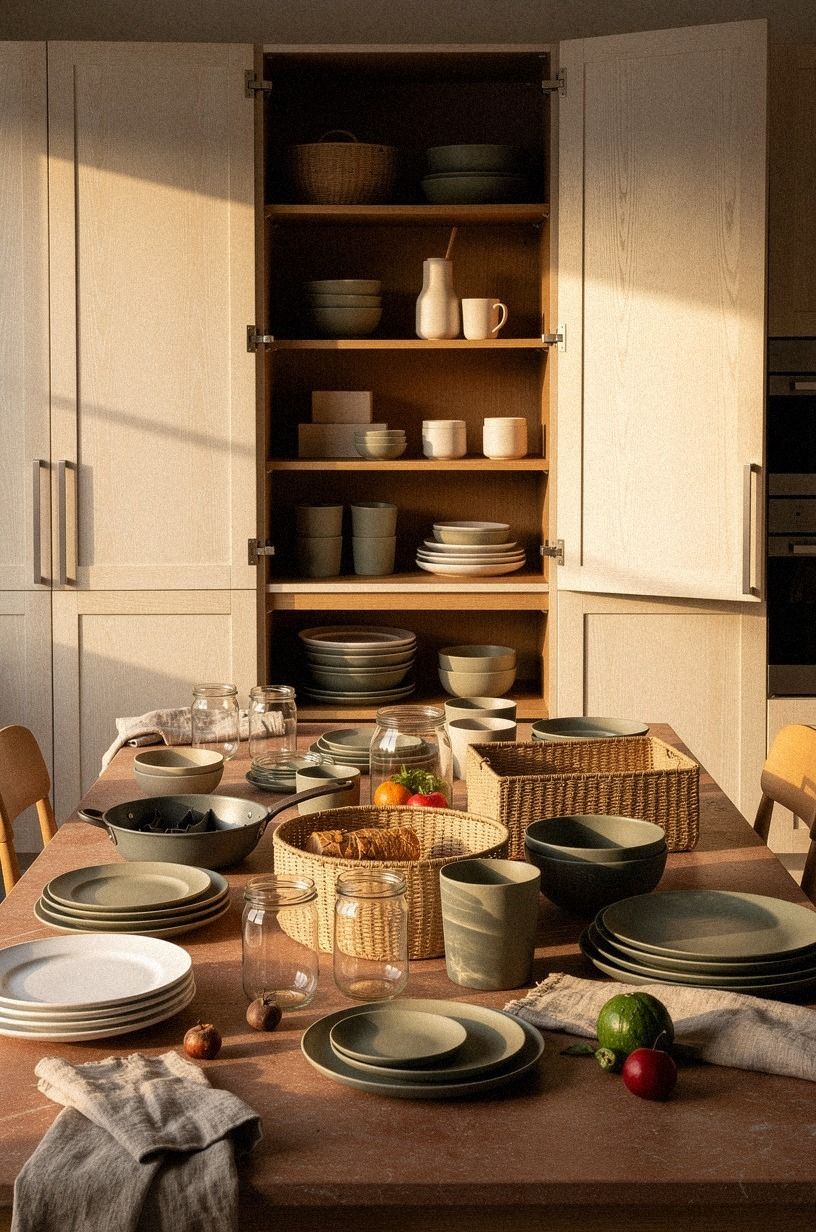
I started by emptying every cabinet onto the table, and yes, it looked a little unhinged for an hour. Plates, pans, jars, baskets, travel mugs, half-used baking paper, all of it spread across the kiln-fired oak table like a yard sale.
Seeing those centered piles against the cerused white oak cabinetry made the problem obvious fast. You cannot fix a cabinet plan while the clutter is still hiding in the dark.
This is where I made my first useful decision: I sorted by task, not by object. Baking with baking. Daily dishwashing with daily dishwashing.
Serving pieces together, even the awkward ones. If you are working with a compact layout, my favorite starting point is still small kitchen cabinet ideas that maximize storage because it forces you to think in zones, not pretty containers.
This first step cost nothing and saved me from buying organizers I did not need.
2Group baking pans in one lower cabinet
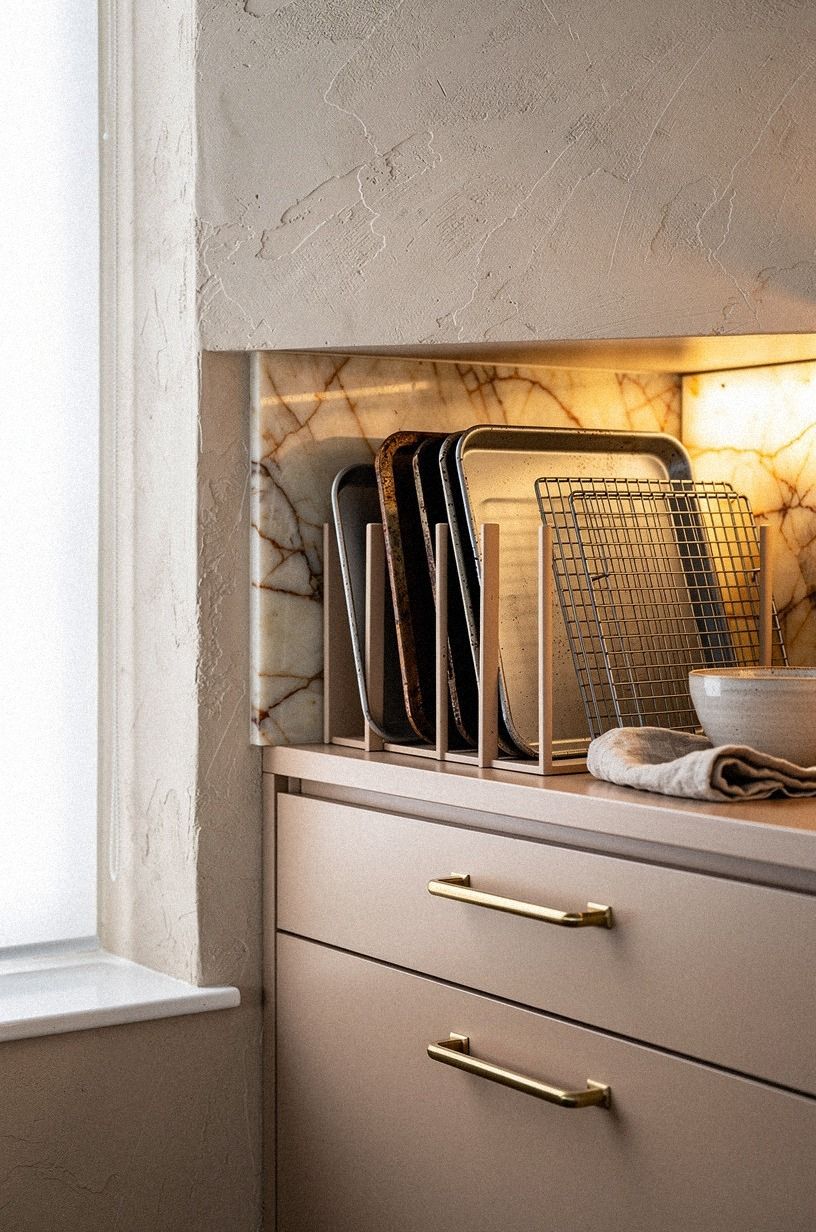
Next, I gave baking pans one lower cabinet and stopped pretending they belonged all over the kitchen.
3Move daily plates beside the dishwasher
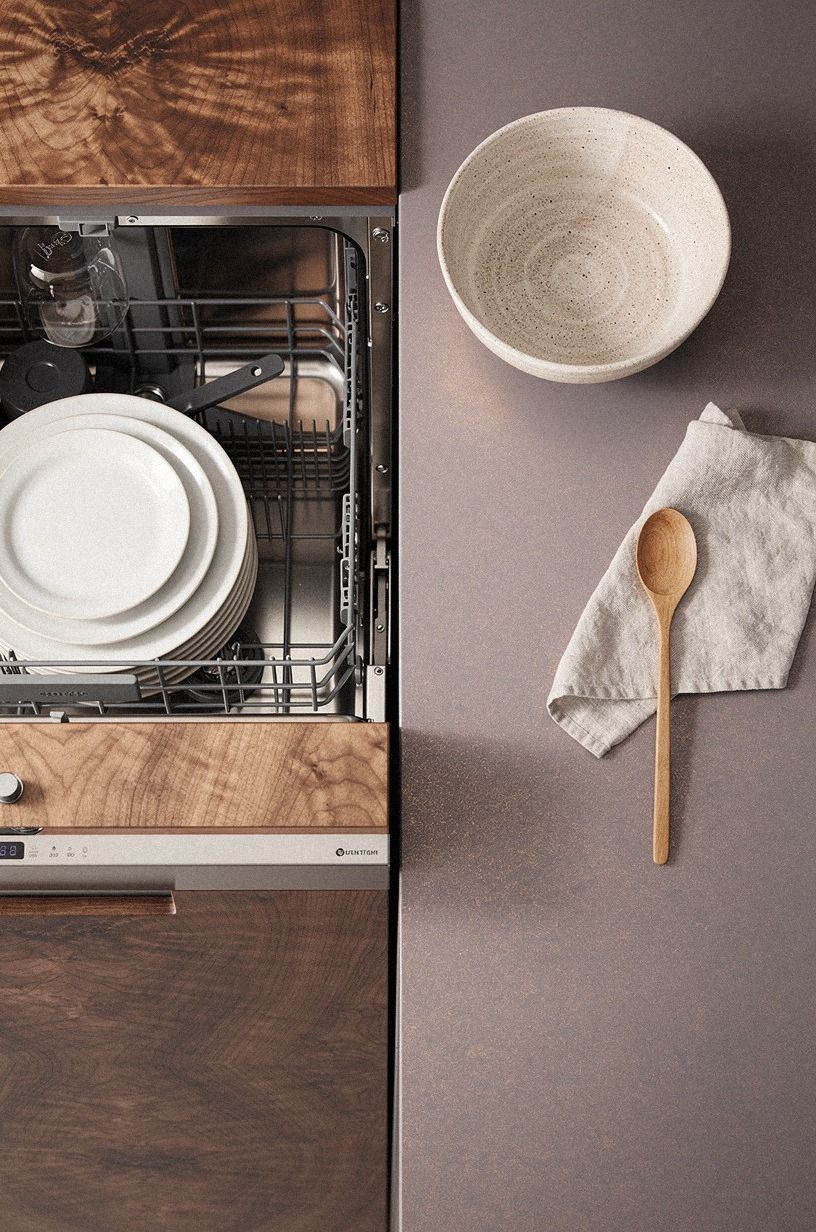
This was the move that made me feel smartest. I shifted our daily plates right beside the dishwasher, stacked in easy overhead reach with those book-matched walnut inserts framing the zone.
If you are unloading the machine and taking three steps across the kitchen every night, you are wasting energy you could keep for dinner. I keep telling friends this is the most underrated kitchen move I have made all year, right behind a real la Canzone leather apron on the hook by the sink.
You want your most-used dishes within one turn of your body, not across the room near the pretty cabinet. That is the difference.
Who wants to unload dinner plates in laps around the room? I measured the reach from the dishwasher drawer to the plate stack, and it was under 24 in after the switch.
Tiny win, huge relief! If your sink and dishwasher area is awkward, kitchen sink cabinet ideas to organize under the sink helps you clean up the same workflow.
For a reset that pairs with this one, you can revisit kitchen tall cabinet ideas to use every vertical inch.
But if you have to choose between symmetry and convenience here, choose convenience every single time. Always.
4Add pullout drawers under the cooktop
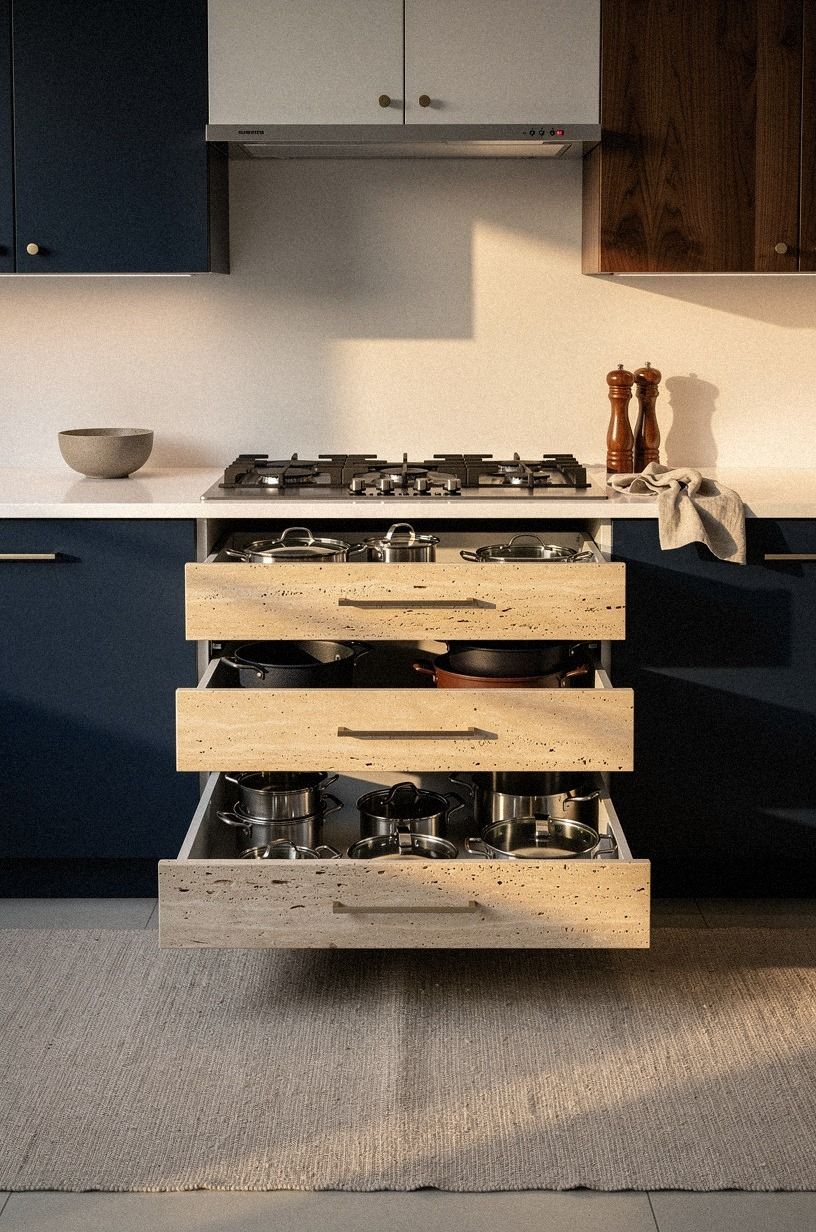
Under the cooktop, I added pullout drawers so the cookware came to me instead of forcing me to kneel and dig. They're full-extension Blum TANDEMBOX slides rated to 100 lb, which sounds excessive until you've stacked three cast-iron pans and want them all to glide.
I sized the openings to fit my largest Le Creuset Dutch oven at the front, so I never have to lift anything heavy off a back shelf. You can feel the difference in your lower back by the end of the month. If you're ready to spec the hardware, kitchen pantry cabinet ideas for smart storage covers drawer hardware math in the same lane.
5Stand cutting boards in a narrow divider
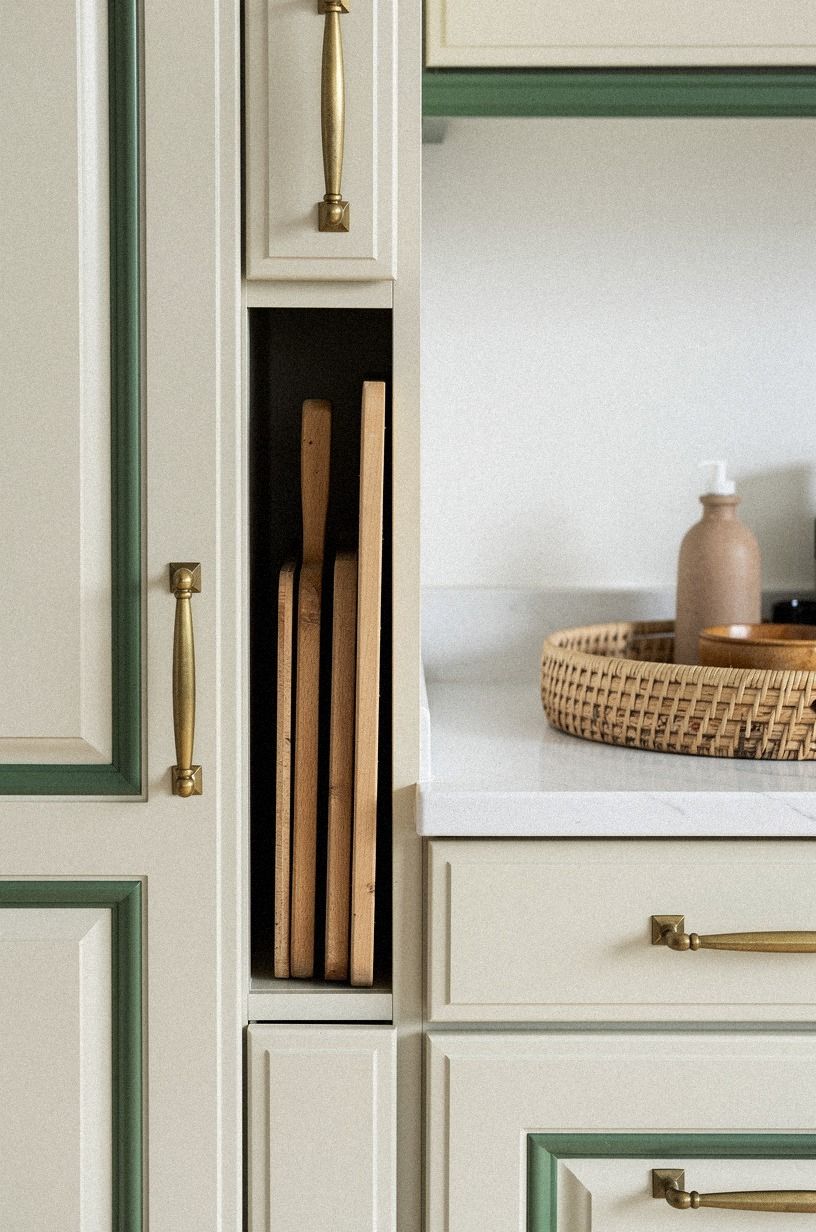
Cutting boards used to live in a horizontal stack, and I hated it every single time I needed the big one. So I carved out one narrow divider and stood them upright, eye-level clean, inside that cream-painted cabinet with the emerald accent nearby. It looks calm because the shapes read clearly.
You are not sorting by feel anymore.
I like a slot that is just wider than the thickest board, usually around 4 to 5 in, because extra width turns into wobble. One John Boos maple board, one walnut board, one lightweight prep board, and that is enough for most kitchens.
If you love that warm wood note, oak kitchen cabinet ideas for a warm modern look shows how to repeat oak without making the room heavy. And yes, this is a small thing.
But when the board you need slides out in one motion, you feel it twice a day. For the broader palette if you are rethinking cabinets, green kitchen cabinet ideas from sage to emerald is a quiet, generous read.
6Hide spices inside a skinny cabinet door
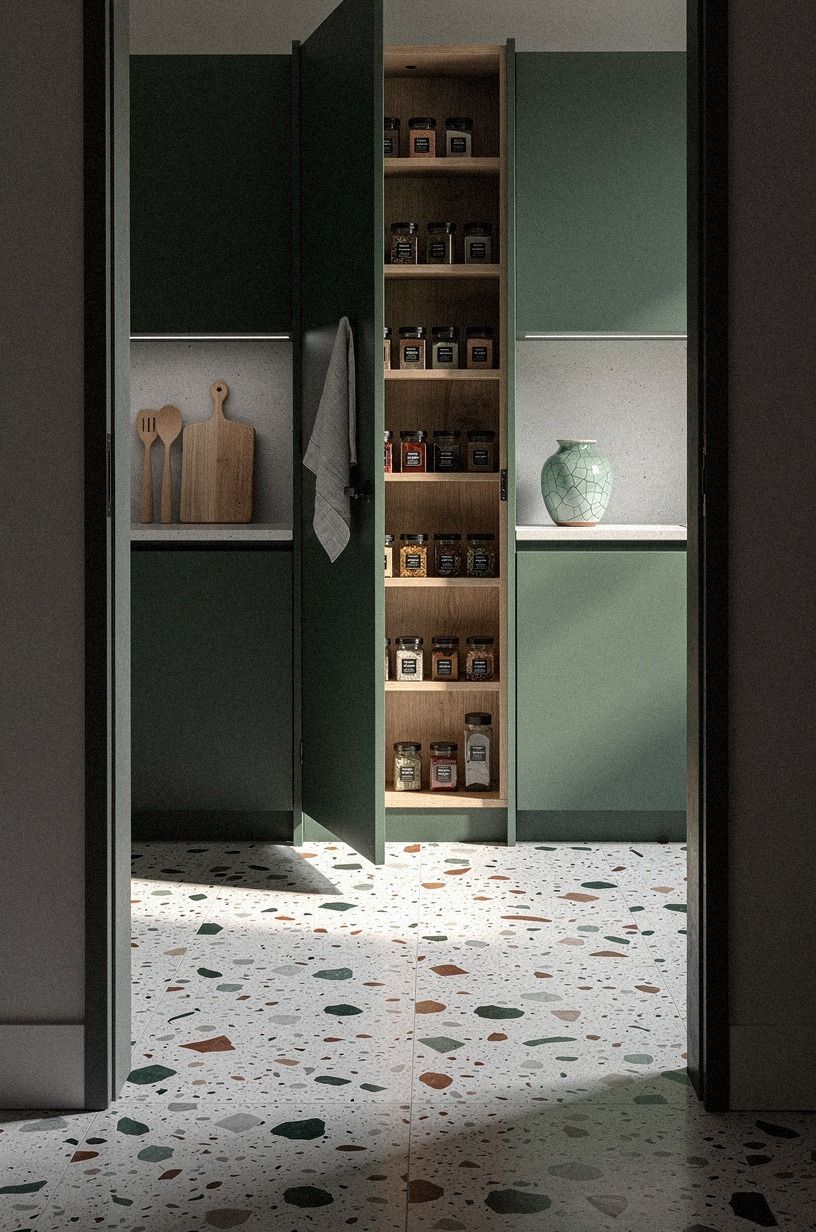
My spices were the messiest category until I used the inside of a skinny door. The photo shows shallow white oak rails tucked into that slim opening, with forest green, rust, and natural oak doing the color work around them.
That's why I like door storage for spices: the jars stay visible, but the visual noise disappears the second the cabinet closes. The setup reads almost editorial, not busy.
I kept only the spices I use weekly here and left backup jars elsewhere. Cumin, chili flakes, cinnamon, flaky salt, smoked paprika.
The rail depth was about 2.5 in, enough to hold standard jars without clipping the shelf when the door shut. If you're hungry for more vertical ideas, kitchen tall cabinet ideas to use every vertical inch solves the same problem in a bigger format. I also painted the surrounding trim in Farrow & Ball Studio Green (No.93), and that deeper color made the oak rails feel intentional, moody, almost quiet-luxury, the kind of green that reads as forest at dusk.
7Stack glass containers in one labeled drawer
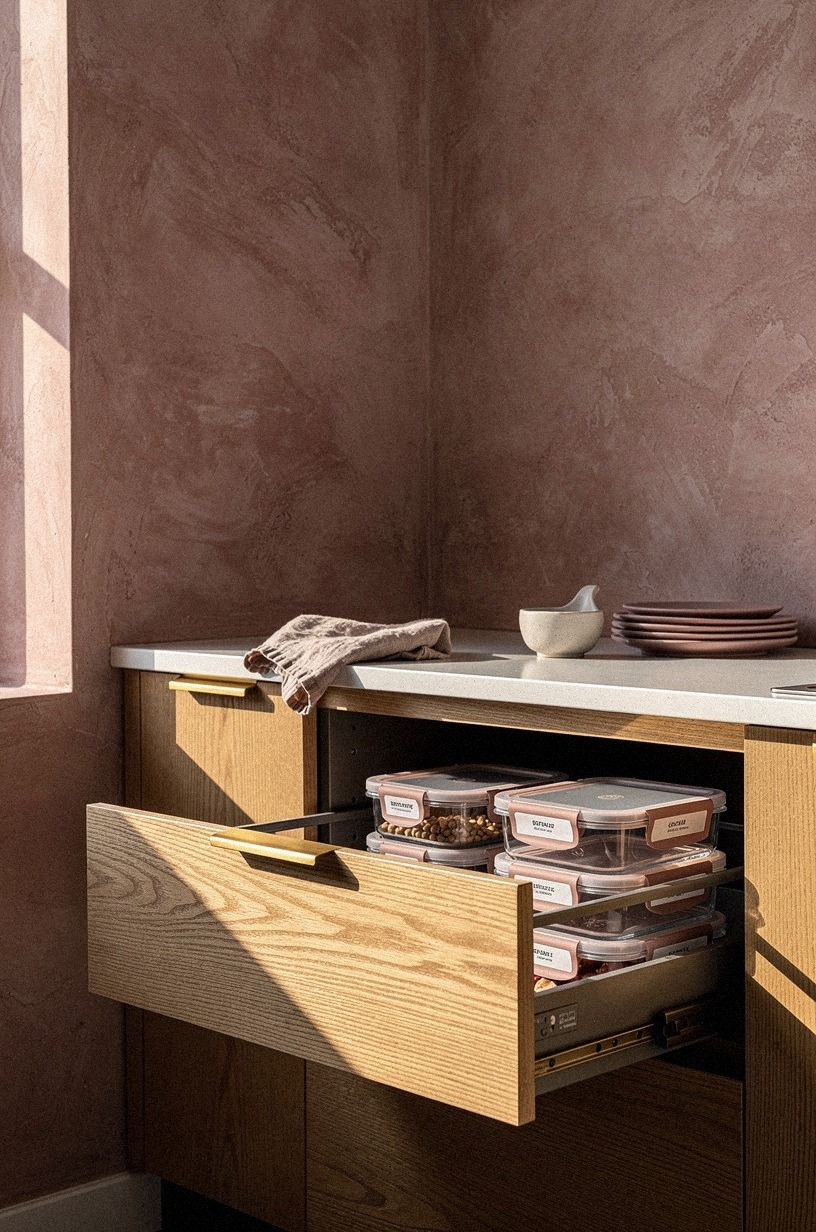
Glass storage containers can turn into a lid graveyard fast, so I gave them one drawer and labeled it. I used a simple Brother P-touch label on the front edge and stopped guessing. The drawer now closes without a fight every single night, and it is the first thing guests ask about.
The biggest unlock here was nesting by lid size, not container size. All the small-round lids together, all the medium-square lids together.
You grab without looking, and the drawer closes without a fight. If you store dry goods nearby, kitchen pantry cabinet ideas for smart storage sits in the same logic lane, paired well with OXO Good Grips pop containers on the counter above.
8Turn the corner cabinet into lazy Susan storage
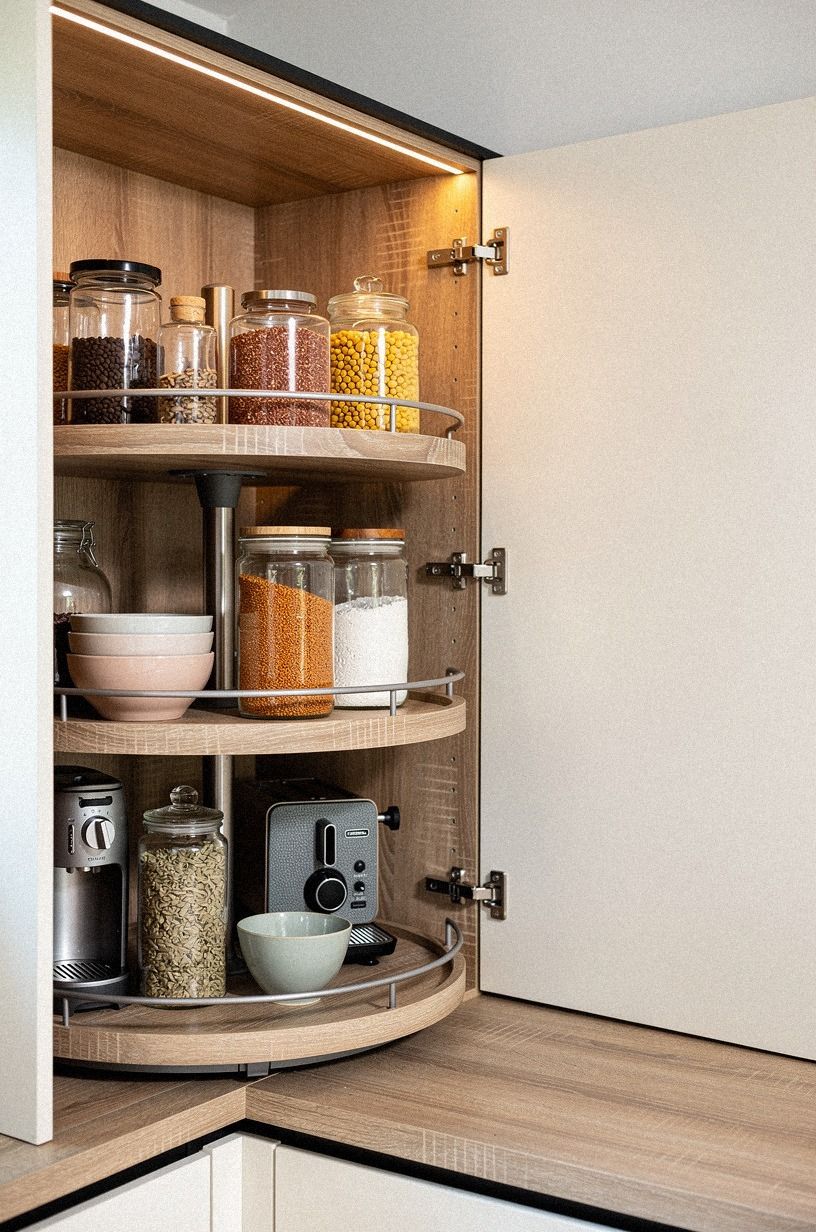
Corner cabinets are where good intentions go to die, so I turned mine into a lazy Susan zone and stopped fighting geometry. The curved shelves in the photo rotate outward with bowls, pantry jars, and one small appliance in view, which is exactly why this setup works. You bring the back forward instead of crawling after it.
I kept heavier items on the lower turntable and lighter serving bowls above, and I left one-third of each shelf empty so rotation stayed smooth. That empty space matters more than people think.
If you cram every inch, the whole thing gets annoying. For a pantry version of the same move, kitchen pantry cabinet ideas for smart storage is worth a save because the same spin-to-see logic applies.
And if you are asking whether the corner cabinet needs custom inserts, not always. A sturdy Rev-A-Shelf chrome lazy Susan solved 90 percent of the issue for me.
For the deeper angle on the corner problem itself, my kitchen corner cabinet ideas to fix that awkward space guide pairs well, and the trim around it wears Benjamin Moore Pale Oak OC-20 beautifully.
9Park small appliances behind lift-up doors
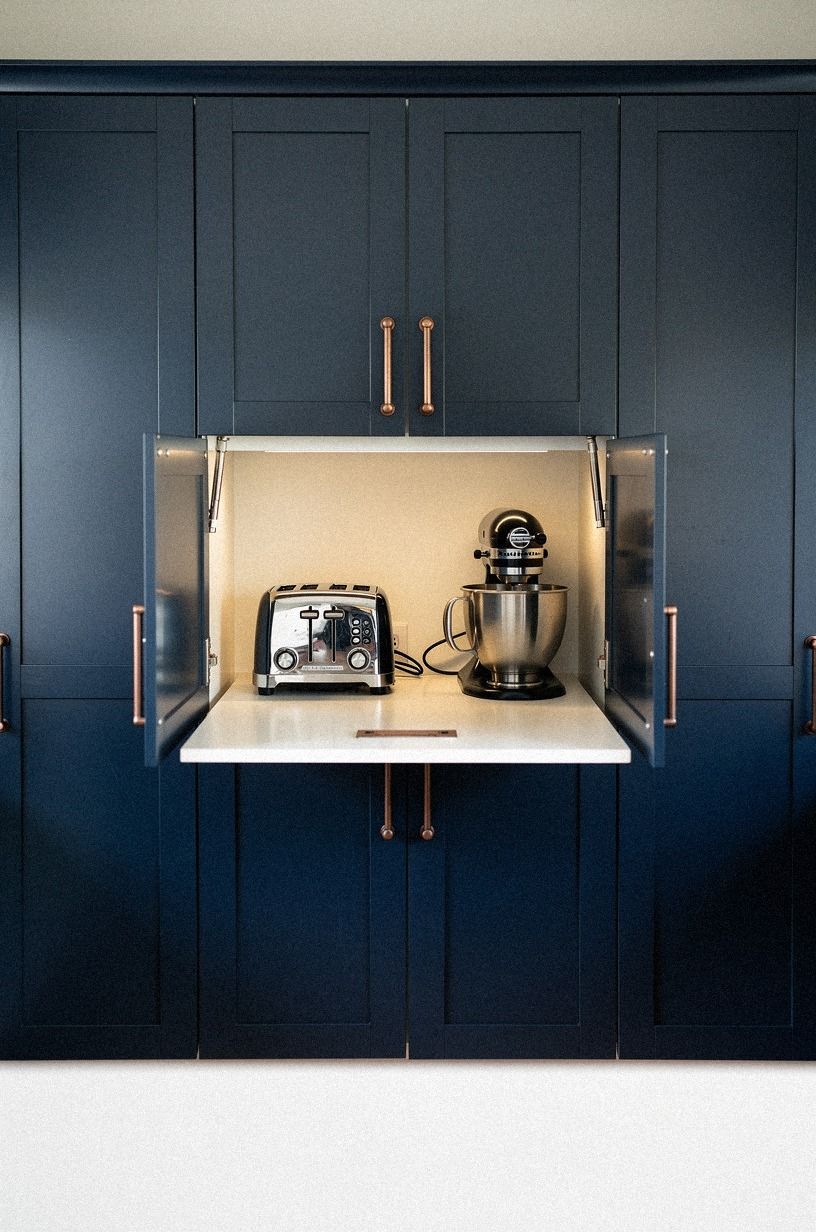
I wanted my counter to feel calmer without pretending we don't own appliances, so I hid the toaster and blender behind lift-up doors.
10Use deep drawers for pots and lids
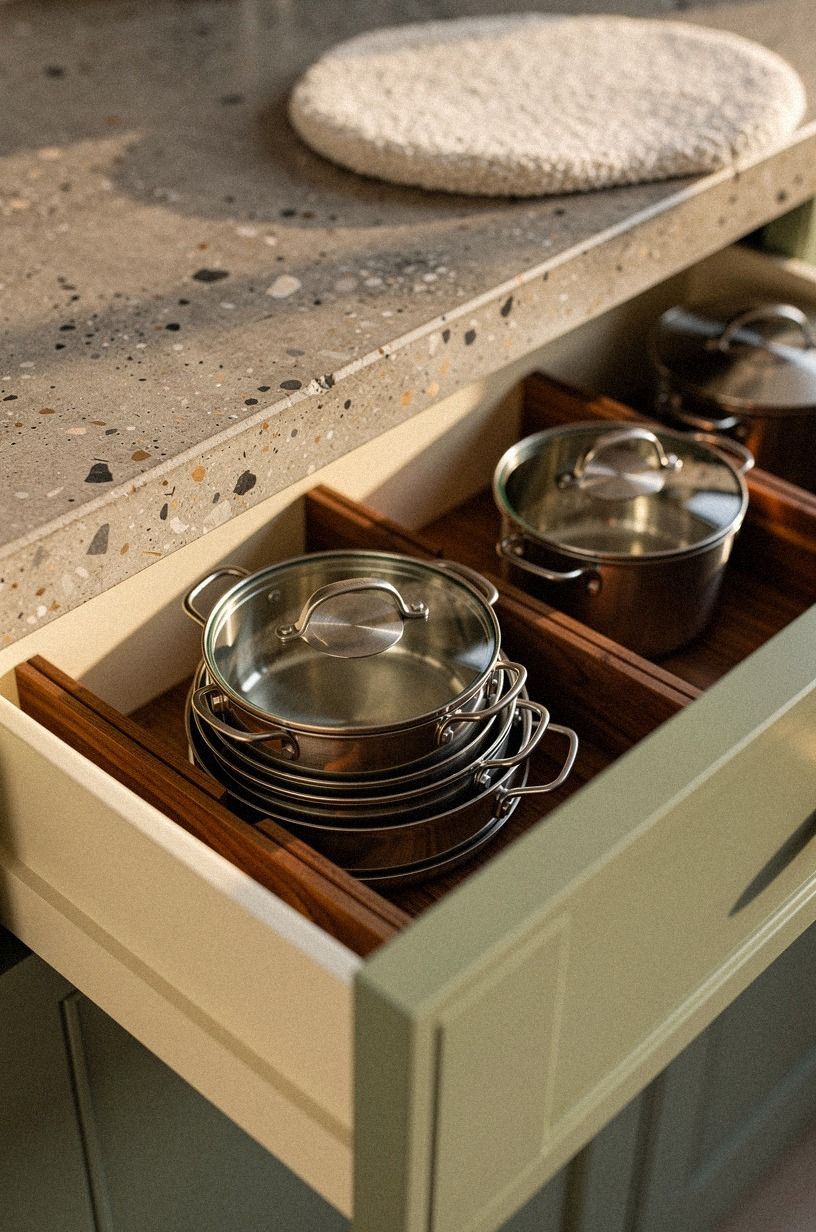
Deep drawers beat lower shelves for pots and lids. I know that's not a thrilling opinion, but after years of clanging through stacks, I mean it.
The close detail in the image shows nested lids sliding into wooden dividers beside sage-painted cabinetry and a warm cream drawer front, and that's the right kind of precision. Each piece has a lane, and so does your hand.
I grouped saucepans by frequency, not size, so the 10 in skillet and the everyday Lodge cast-iron sit closest to the front. Lids slide upright in dividers cut just tall enough to stop wobble.
If you want more of that straight-line cabinetry feel, modern kitchen cabinet ideas for a sleek clean look shows why clean fronts work best when the inside organization is just as disciplined. But don't waste deep drawers on mixing bowls alone. Put the heaviest, most irritating items where your back will thank you.
If color's on your mind too, kitchen cabinet color ideas you'll still love in 10 years is the calmest guide I've seen.
11Add clear bins above the refrigerator cabinet
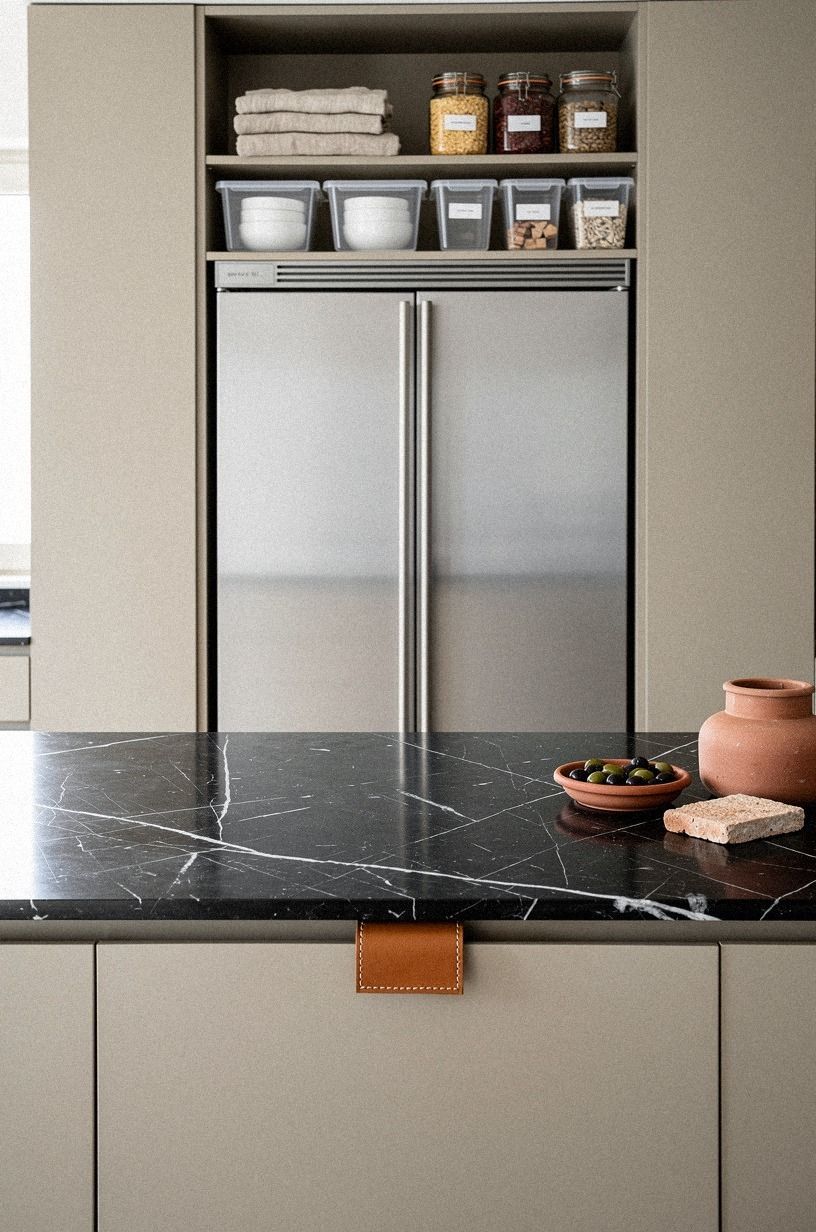
That cabinet above the refrigerator used to hold random things I forgot existed. I fixed it with clear acrylic bins from The Container Store, and now the whole zone earns its height. In the image, you look low across a Nero Marquina marble counter toward those centered upper bins, which is exactly how the area reads in person: elevated, tidy, and finally visible.
I use two bins for paper goods and one for backup pantry stock, with handles facing out so you can pull them down safely from a step stool. Upper cabinets usually run 30 to 42 in tall, and that top refrigerator zone is often the one people never finish organizing. If yours feels wasted, kitchen tall cabinet ideas to use every vertical inch helps you think upward instead of outward.
And yes, clear beats opaque here. If you can't see the backup foil, you'll buy backup foil. That's a quiet pantry leak most of us don't notice until the calendar fills up.
12Hang measuring cups inside the baking cabinet
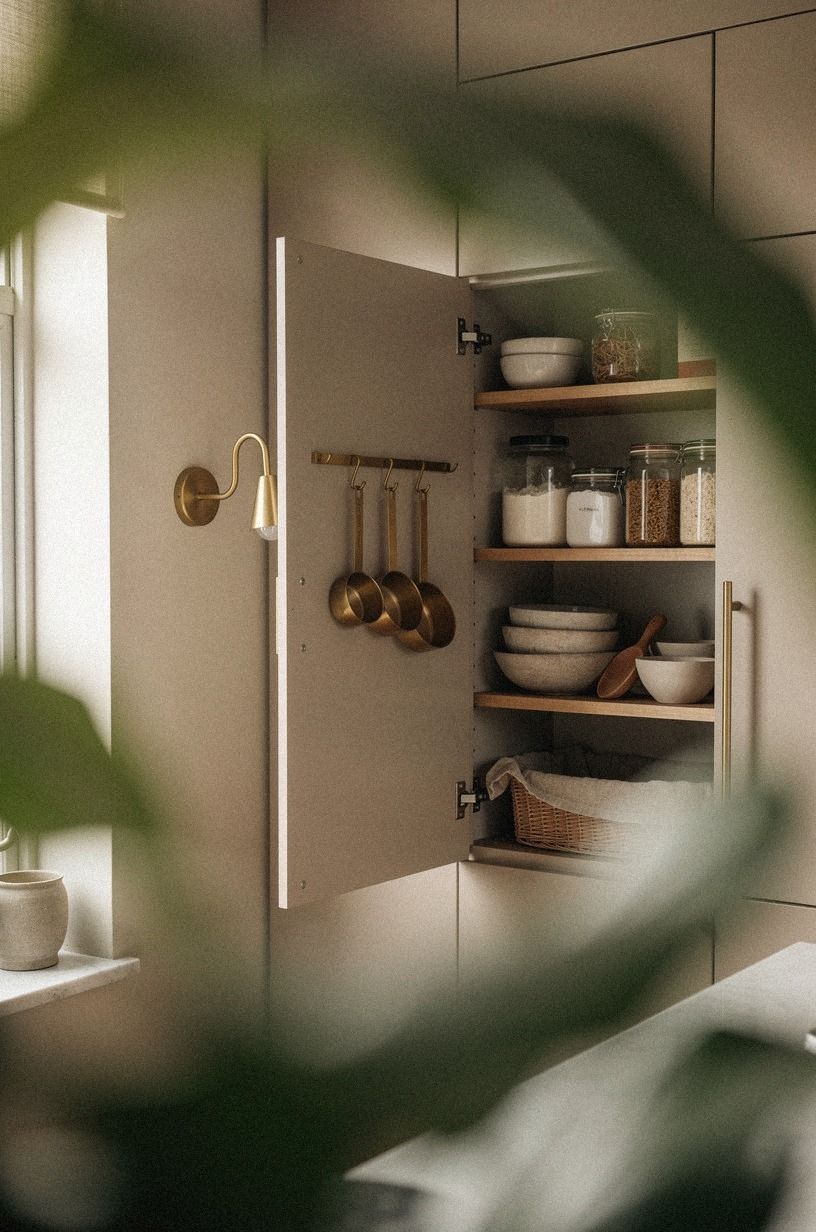
This was one of those tiny shifts that cleaned up three annoyances at once. I hung the measuring cups inside the baking cabinet door, and suddenly the drawer stayed flatter, the cups stayed together, and I stopped fishing for the half-cup while the butter was already melting. In the photo, you catch the open cabinet through leaves, off-center, with that clay-linen and aged-brass palette giving the setup a softer, more living-room feel.
I used small removable 3M Command hooks on the inside panel and kept the spoons below in a shallow Muji acrylic tray. If you're renting, this is one of the best no-damage moves in the room.
Kitchen pantry cabinet ideas for smart storage has the same door-inside logic for dry goods and packets too. I also swapped the surrounding paint to Sherwin-Williams Evergreen Fog (SW 9130), and the muted green made the brass read richer without getting dark.
Worth it.
13Store mugs on a shallow upper shelf
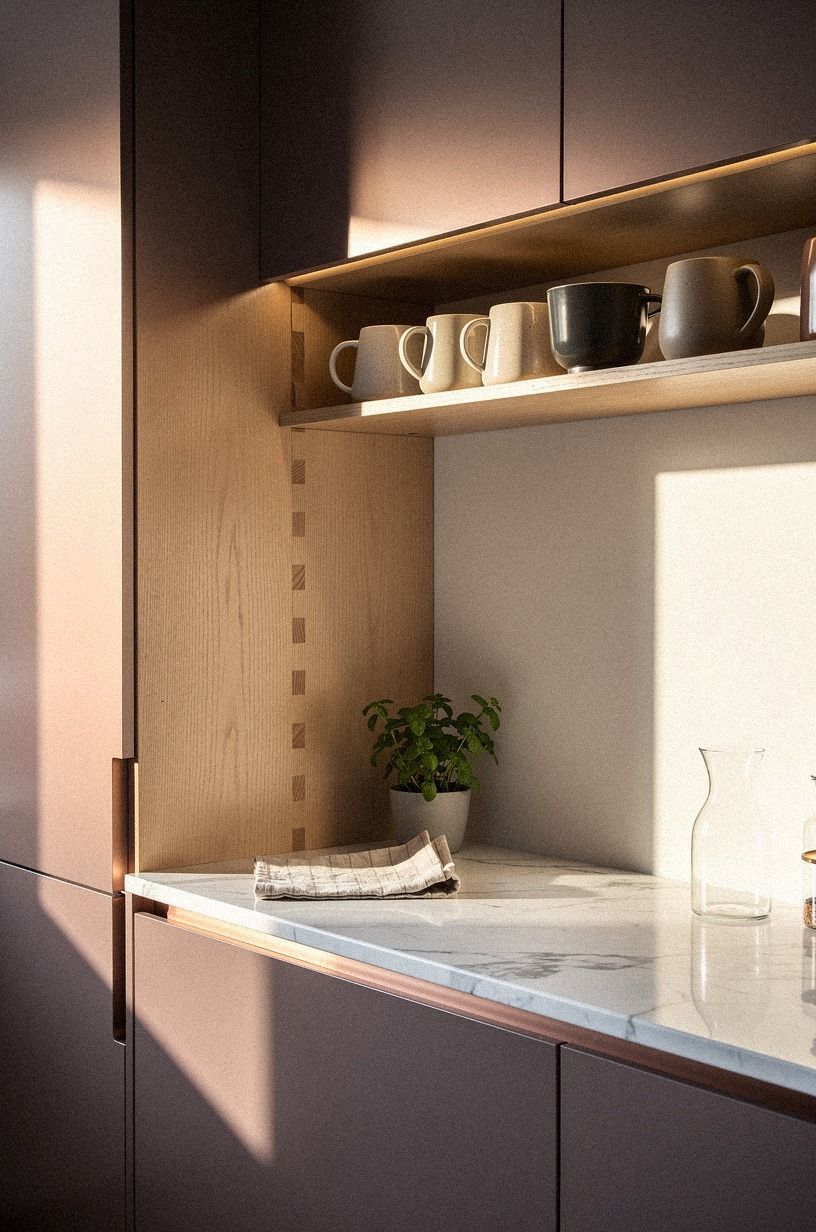
Mugs deserve a shallow shelf, not a deep cave where handles tangle and chips happen. The wide diagonal photo shows plum gray and rose-gold cabinetry, Carrara marble counters, and mugs lined neatly on a slim upper ledge.
That's why this works: the shelf depth matches the object. You aren't wasting six hidden inches behind something that's only four inches wide.
I kept the everyday IKEA FÄRGRIK set there and moved novelty extras out of the main run. If you're styling visible storage, glass front kitchen cabinet ideas for open airy storage is the closest cousin because both ideas rely on editing, not abundance. But don't load this shelf with every mug you own.
Four to six is enough for the room to breathe, and enough for your hand to reach without clinking porcelain before coffee.
14Finish with one open cabinet display
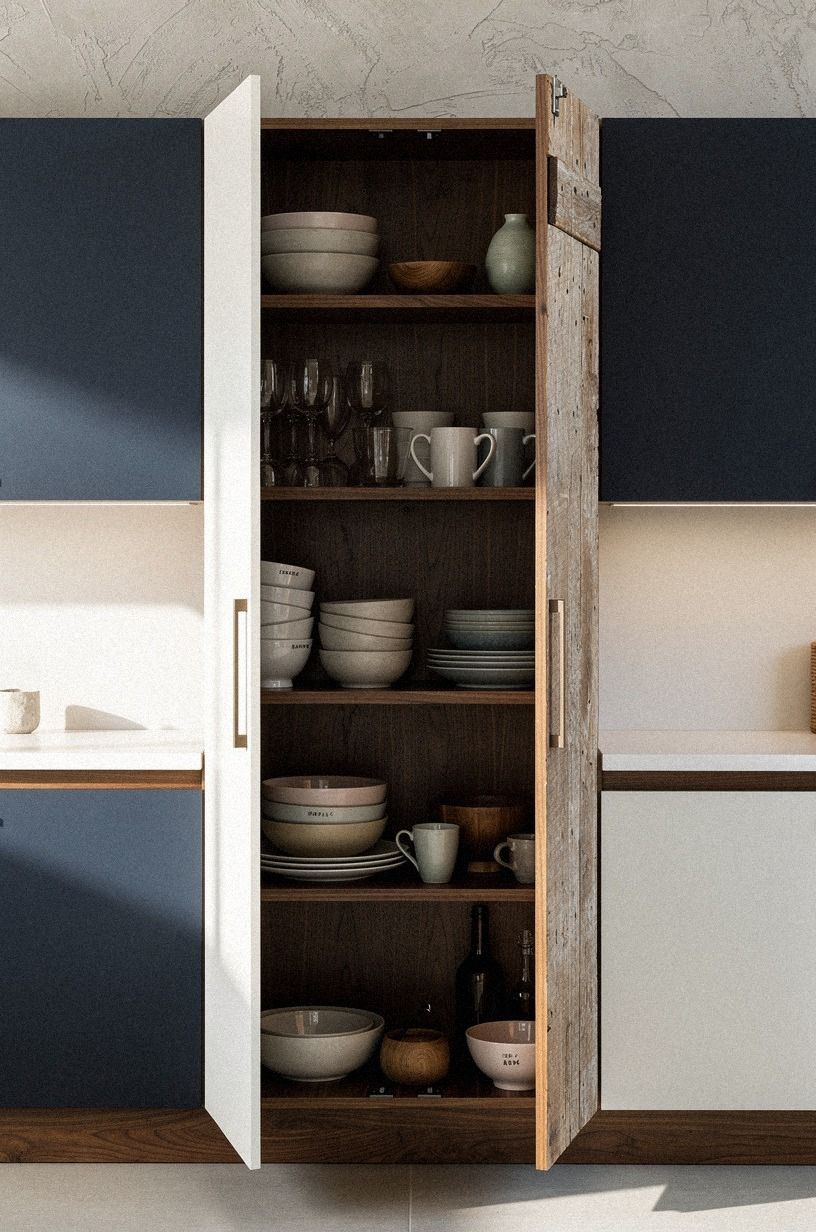
I ended with one open display cabinet because I wanted the wall to feel lived-in, not purely engineered. I kept it styled with three small objects, never twelve.
The display reads as an editorial still-life at breakfast, then disappears into the calm of the room by evening. That's the whole point.
If you're planning a bigger open-shelf moment, open shelving kitchen ideas when to skip upper cabinets is honest about where open storage succeeds and where it grinds you down. I'd pair it with two-tone kitchen cabinet ideas that add instant depth if you're chasing a warm-meets-modern finish, ideally with Farrow & Ball Bone (No.15) on the uppers.
Why did The Reset Table Rule work so much better than buying more bins?
Because the problem wasn't capacity. It was decision fatigue.
I used to think cabinet storage got better when you bought enough acrylic boxes, but what changed the kitchen was seeing every object at once and making harder choices about where it belonged. You can feel the difference when a room stops asking you little questions all day, the kind you used to answer with a shrug and a sigh.
I also think kitchen trends pushed people toward display before they earned function. Open shelves, pretty jars, matching canisters, all nice. But if your daily plate path is awkward or your pans are stacked flat in a dark lower, the style layer arrives too early.
The rooms that hold up are the ones where the workflow got solved first, then dressed in the materials you actually love: a cerused white oak panel, a piece of travertine, a single unlacquered brass pull. I learned that the expensive way, and I'd skip the whole middle step next time.
Here's the philosophy I keep coming back to: cabinet storage should remove friction you notice at 6:10 p.m., not impress someone at 6:10 on a Saturday tour. The best moves weren't glamorous.
They were directional. Plates by the dishwasher.
Heat tools by the cooktop. Baking together.
Heavy items in pullouts. Small appliances hidden, but not buried. Once those decisions were locked, the finishes I loved had somewhere steady to land.
The room got quieter, not louder.
And this is the part I wish more makeover stories said plainly. The warm, layered kitchens you save are rarely bigger than yours. They're just edited harder.
Mine certainly was. I donated duplicate containers, got rid of chipped mugs I never reached for, and stopped trying to make every cabinet do three jobs.
That restraint is what made the walnut, brass, travertine, and painted cabinetry feel richer. The room didn't become more full. It became more sure of itself, almost editorial in its quiet confidence.
That's the texture I want my guests to feel before I ever explain anything.
If you're in the middle of your own reset, start with the cabinet that irritates you most. Not the one that photographs best.
Your annoyance is useful data. Follow it, and the layout starts answering back, one quiet win at a time.
How much it cost
I spent $243 in total, and I wouldn't cut the pullout hardware or the drawer dividers because those two upgrades changed the daily use the most. The cheapest improvements were the ones that moved items into smarter zones. The best paid ones were the parts that saved my knees and my patience.
If you are doing a larger kitchen refresh, quartz usually lands around $60-$120 per sq ft, laminate around $10-$40 per sq ft, and zellige backsplash around $15-$35 per sq ft. I did not need any of that here.
This was a workflow makeover, not a demolition project. For cabinet style references, oak kitchen cabinet ideas for a warm modern look pairs especially well with this kind of practical reset.
Is The Three-Zone Cabinet Test worth it in a small kitchen?
Yes, because a small kitchen punishes bad placement faster. My test is simple: daily use near the dishwasher and sink, heat use near the cooktop, backup stock up high. If a cabinet breaks that logic, I change it first.
You do not need a huge footprint for this to work. In fact, the tighter the room, the more a clean 42 to 48 in pathway and a short unloading reach matter.
That is why these cabinet moves did more for my kitchen than any decorative purchase I considered. The room is not bigger, it is just calmer.
The Questions Worth Answering First
What is the best kitchen cabinet storage move for a small kitchen?
Move your daily plates beside the dishwasher first. It's the fastest effort-to-payoff win in a small kitchen because you unload in one turn instead of three. After that, I'd add one deep pot drawer or an IKEA RAGGISAR lid organizer so heavy items stop eating shelf space.
Where can I buy kitchen cabinet storage pieces on a budget?
Start with IKEA, Target, and Wayfair for rails, bins, risers, and drawer organizers. Facebook Marketplace is still great for solid wood inserts and small step stools. The biggest money saver is buying fewer organizers after you've emptied everything, not before.
How much does a kitchen cabinet storage reset typically cost?
For most kitchens, a light cabinet-storage reset runs about $100 to $300 if you reuse what you own and add only dividers, hooks, or bins. The free part is re-zoning.
Paid parts usually show up in pullout hardware, Rev-A-Shelf turntables, and better shelf inserts from The Container Store. Don't expect a $25 reset to fix a real cabinet problem, that's just rearranging, not resetting.
Can I do a real kitchen cabinet reset on a tight budget?
Yes, and I'd begin with the free moves first. Empty every cabinet.
Group by task. Move daily dishes closer to the dishwasher.
Those three steps create the biggest layout upgrade before you spend a dollar, and then you can buy only the inserts your kitchen truly needs.
Is a kitchen cabinet reset worth it in a small space?
Yes, maybe more than in a big kitchen. Small rooms reward shorter reach paths and punish dead corners, so every smart swap feels bigger. Keep the most-used items between waist and shoulder height, and let the upper cabinets hold backup stock instead of daily tools.
Is a kitchen cabinet reset a good idea for a rental?
Yes, if you stay reversible. Removable 3M Command hooks, tension dividers, freestanding turntables, and peel-and-stick labels give you a real storage upgrade without damage. I'd skip anything that needs drilling into the door unless you know your lease and you're ready to patch neatly later.
The One-Door Display Rule
If I had to pick one, I'd start with moving your daily plates beside the dishwasher. That change cuts the most invisible friction, and you feel it every night.
Pin this idea for later. Then fix the cabinet you touch most.