
 by
by Latex mattresses last longer and sleep cooler than most memory foam, but innerspring hybrids cost less upfront and offer better edge support. For most sleepers, the best pick is a premium innerspring hybrid that gives you coil airflow and support without the high price of pure latex. Our top recommendation is the Saatva Classic, which delivers a dual-coil construction, a Euro pillow top, and a zoned lumbar pad at a price well below most all-latex beds. If you specifically want latex, the Saatva Latex Hybrid stacks 3 inches of GOLS-certified natural latex over pocketed coils, combining both construction types in one mattress.
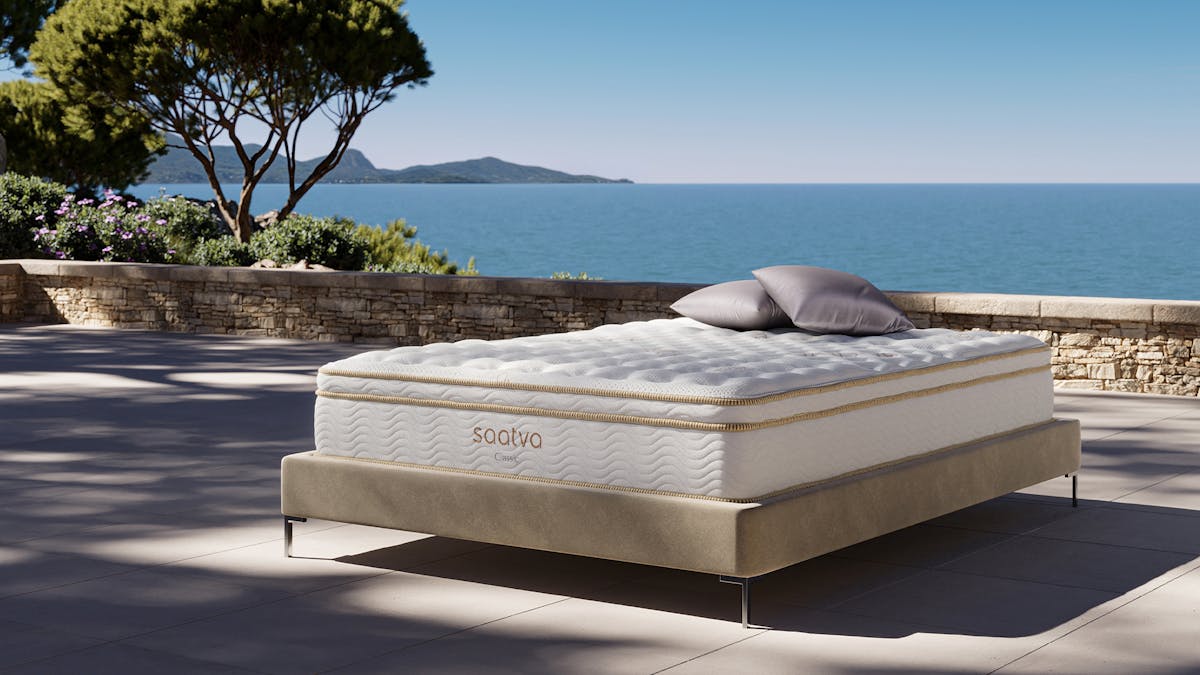
Saatva Classic
9.3/10
- Dual-coil construction (884 pocketed upper coils + 416 tempered steel lower) promotes airflow and responsive support
- Zoned lumbar foam reinforcement in the center third of the mattress
- Outstanding edge support, reinforced with perimeter coils and lumbar foam
- Free white-glove delivery with in-room setup and old mattress removal
- 365-night trial, lifetime warranty, zero off-gassing (ships flat, not compressed)
- Motion isolation is moderate, the bouncy coil system transfers partner movement more than all-foam beds
- Heavy (~110 lb queen) and hard to reposition without help
- $99 fee if you return during the trial period
The Saatva Classic is the strongest innerspring hybrid at this price point. Three firmness options, a lumbar-zoned coil system, and the longest trial in its category make it the default recommendation when shopping innerspring.
Latex vs innerspring: what actually differs
Both mattress types use a support core, but the materials behave differently in ways that matter night after night. Innerspring mattresses use a system of tempered steel coils, either interconnected Bonnell coils in older designs or individually wrapped pocketed coils in modern hybrids. Latex mattresses use a layer of natural or synthetic rubber foam, processed either as Dunlop (denser, firmer bottom) or Talalay (more uniform, slightly softer). Neither type is simply better; they trade off on price, durability, feel, and weight.
The comparison below focuses on specs that measurably affect sleep quality: cooling, motion isolation, edge support, lifespan, and price per year of use.
Head-to-head: latex vs innerspring
| Feature | Latex | Innerspring hybrid |
|---|---|---|
| Feel | Buoyant, responsive, floating on the surface | Bouncy, traditional, slightly firmer underfoot |
| Pressure relief | Excellent, latex conforms to body curves without deep sinkage | Good, depends on the thickness of the comfort layer |
| Cooling | Very good, open-cell structure dissipates heat; natural latex runs cooler than memory foam | Excellent, coil channels push air through the core continuously |
| Motion isolation | Good for natural latex, less so for Talalay | Fair to good, pocketed coils outperform Bonnell but cannot match all-foam |
| Edge support | Moderate, latex compresses near the perimeter | Strong, reinforced perimeter coils keep the edge firm for sitting and sleeping |
| Durability | 12 to 20 years, latex is among the most durable mattress materials | 7 to 12 years, pocketed coil hybrids outlast Bonnell designs |
| Weight (queen) | 90 to 150 lbs, heavy due to dense latex layers | 60 to 110 lbs, lighter than latex but still hard to reposition alone |
| Queen price range | $1,500 to $3,500+ | $800 to $2,500 (premium hybrids up to $3,000) |
| Best for | Eco-conscious shoppers, hot sleepers, allergy sufferers, long-term durability | Budget-to-mid range, traditional feel, couples prioritizing edge support |
What latex actually gives you
Natural latex comes from rubber tree sap and carries a feel that foam cannot replicate: buoyant, responsive, with no slow-sink memory. When you push into latex, it pushes back immediately, which makes it easy to change positions at night. Talalay latex is processed with a vacuum-and-freeze step that creates an even, open-cell structure, slightly softer and more consistent than Dunlop latex, which is poured and gravity-settled into a denser core.
The practical advantages of latex over innerspring are durability and allergen resistance. A quality all-latex mattress can last 15 to 20 years before meaningful sagging occurs. Natural latex is also inherently resistant to dust mites and mold, which matters for allergy sufferers. The trade-off is price: a GOLS-certified natural latex mattress runs $1,800 to $3,500 for a queen, which is 50 to 100 percent more than a comparable innerspring hybrid. Latex is also significantly heavier, rotating a 130-pound latex mattress alone is difficult without a second person.
Synthetic latex costs less and is more widely available, but it does not carry organic certifications, degrades faster than natural latex, and lacks the eco-credentials that make natural latex appealing in the first place. If you are buying latex for durability or sustainability reasons, natural latex is the only version that delivers on both.
What innerspring actually gives you
Modern innerspring mattresses are hybrid designs: a pocketed coil support core topped with foam or latex comfort layers. The coil core does two things especially well, cooling and edge support. Open airflow channels between coils pull heat away from the sleeping surface more effectively than any foam-only design. Reinforced perimeter coils keep the mattress firm to the very edge, which is why innerspring hybrids consistently outscore all-foam and all-latex beds in edge support testing.
The durability gap between latex and innerspring is real but narrowing. A high-quality pocketed coil hybrid using 14.5-gauge steel will hold its shape for 10 to 12 years under normal use, versus 15 to 20 years for natural latex. For most buyers planning a 7-to-10-year ownership cycle, the durability difference is negligible. Where innerspring genuinely loses to latex is motion isolation: coils transmit movement across the bed. Pocketed coils are significantly better than Bonnell coils, but they still cannot match the motion-absorbing properties of a dense latex or memory foam layer.
Price is where innerspring hybrids win clearly. A well-reviewed innerspring hybrid in the $1,400 to $2,000 range offers comparable support and comfort to a natural latex mattress priced $2,000 to $3,000. That gap represents a meaningful argument for most buyers.
Who should choose latex
- Allergy sufferers: Natural latex is hypoallergenic and resistant to dust mites, mold, and mildew without chemical treatments.
- Long-term buyers: If you want a mattress you will own for 15 to 20 years, natural latex justifies the higher upfront cost through a lower cost-per-year of use.
- Eco-conscious shoppers: GOLS-certified latex, GOTS-certified cotton, and organic wool combine to produce a mattress with minimal synthetic materials.
- Hot sleepers who also want contouring: Latex sleeps cooler than memory foam while still conforming to the body, hitting a middle ground that innerspring coils and memory foam both struggle to match simultaneously.
Who should choose innerspring
- Budget-to-mid shoppers: A premium innerspring hybrid at $1,400 to $1,800 delivers performance at 40 to 60 percent less than comparable latex.
- Hot sleepers on a budget: Coil-core airflow outperforms latex at the same or lower price for temperature regulation.
- Edge sleepers or couples who want firm edges: Innerspring hybrids with reinforced perimeter coils consistently outperform latex on edge stability.
- Buyers who want a traditional bouncy feel: Latex is responsive, but innerspring coils have a distinct spring-back feel that some sleepers strongly prefer.
The hybrid middle ground
Modern latex hybrids eliminate much of the trade-off. They use a 2-to-4-inch natural latex comfort layer over a pocketed coil support core. You get the pressure-relieving, buoyant feel of latex on top, with the edge support, airflow, and lower weight of a coil base underneath. Most are priced between $1,800 and $2,800 for a queen, still more expensive than an innerspring hybrid, but meaningfully less than an all-latex bed.
Saatva Latex Hybrid
9.1/10
- 3 inches of GOLS-certified organic natural latex, buoyant and responsive in a way that foam and coils alone cannot match
- 789 individually wrapped pocketed coils with 5-zone ergonomic support and firmer edge coils
- Natural breathability from latex open-cell structure plus coil airflow, runs cooler than virtually any foam hybrid
- GOTS organic cotton cover and organic New Zealand wool, no synthetic flame retardants
- Same 365-night trial and lifetime warranty as the Saatva Classic
- Motion transfer is slightly higher than all-foam beds, latex is responsive, which means movement crosses more easily
- At ~120 lb, among the heavier queens in any category, setup requires two people
- One firmness option (medium firm 6/10), less flexibility than the Saatva Classic's three choices
The Saatva Latex Hybrid is the clearest answer for buyers who specifically want latex but do not want to sacrifice the edge support and airflow of a coil base. It bridges the two construction types without reaching the price of an all-latex bed.
If you want all-latex
All-latex mattresses, with no coils and just latex layers, are the most durable option in any category. The PlushBeds Botanical Bliss uses multiple rearrangeable Dunlop latex layers with GOLS, GOTS, and GREENGUARD Gold certifications, priced around $1,449 for a queen during sales. It carries a 25-year warranty and a 100-night trial. The trade-off versus a latex hybrid is reduced edge support and a heavier overall weight. If organic certification and maximum durability matter more than edge performance, it is the right choice.
See more: Best latex mattresses (2026) | Best innerspring mattresses
Thinking about cost per year, not just sticker price
Sticker price comparisons understate the value of a durable mattress. A $2,400 natural latex bed lasting 18 years costs about $133 per year. A $1,400 innerspring hybrid lasting 10 years costs about $140 per year. The numbers are closer than the upfront prices suggest. The case for either option depends mostly on budget flexibility and how much you value organic materials and longevity.
The math shifts toward innerspring if you plan to replace the mattress within 7 to 10 years, or if you are buying for a guest room. It shifts toward latex if you sleep hot, have allergies, or want a buy-once-use-for-decades purchase.
Frequently asked questions
Is latex or innerspring better for back pain?
Both work well for back pain when they keep the spine in a neutral position. Medium-firm is the firmness level that most research points to. The Saatva Classic in Luxury Firm and the Saatva Latex Hybrid both hit that range and include zoned lumbar support, a reinforced center zone that adds targeted lower-back support regardless of sleep position.
Does latex sleep cooler than innerspring?
Innerspring coils move air more efficiently and run cooler overall. Natural latex sleeps cooler than memory foam but not quite as cool as a coil-dominant design. Latex hybrids, which combine coils with a latex comfort layer, score among the highest for temperature regulation in independent testing and get the best of both worlds.
How long do latex mattresses last compared to innerspring?
Natural latex typically lasts 15 to 20 years before sagging below the 1.5-inch threshold that signals replacement. Premium innerspring hybrids with 14.5-gauge pocketed coils last 10 to 12 years. Synthetic latex is closer to innerspring in lifespan. The extra durability of natural latex is real, but you only realize the value if you keep the mattress for 12-plus years.
Is natural latex worth the extra cost?
If you have latex allergies, even a mild sensitivity, natural latex is an obvious no. For everyone else, it depends on priorities. Natural latex delivers superior durability, genuine eco-credentials, and a feel that synthetic materials cannot exactly replicate. If those things matter and you have a 15-plus-year outlook, the premium is defensible. If you want to spend less now and reassess in a decade, a premium innerspring hybrid offers competitive performance at a meaningfully lower price.
Can I get both latex and coil support in one mattress?
Yes. Latex hybrid mattresses use a natural latex comfort layer over a pocketed coil support core. The Saatva Latex Hybrid does this at approximately $2,324 queen with GOLS-certified latex and a 365-night trial, which is the most practical middle ground between the two construction types.