
 by
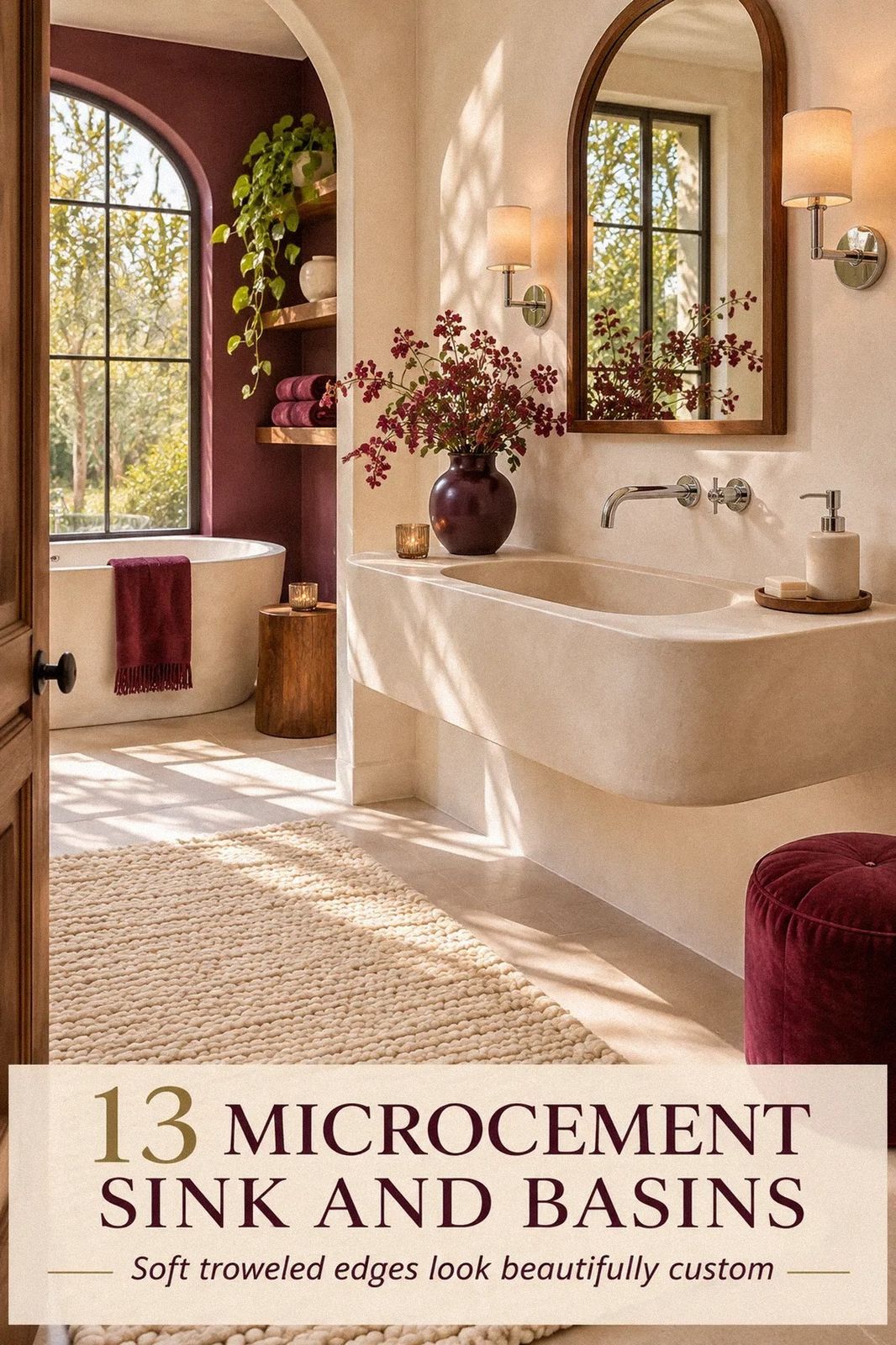
Microcement sink and basin designs can make a bathroom feel organic and monolithic without demanding a full renovation. I once sealed a basin too late, and the first splash left a dull ring around the drain. The fix was simple, but the lesson wasn't: the finish, slope, and wall color matter as much as the basin itself. These ideas keep maintenance low while giving you a warm, sculptural room.
- ✓ Float a Continuous-Curve Basin
- ✓ Build the Floating Monolith
- ✓ Layer the Three-Texture Stack
- Float a Continuous-Curve Basin
- Build the Floating Monolith
- Layer the Three-Texture Stack
- Anchor a Travertine Basin Beside Microcement
- Paint the Ceiling Sea Salt
- What Should Frame the Drain?
- Frame the Sink With a Warm Wood Niche
- Vessel Bowl or Recessed Sink?
- Layer Soft Light Over the Basin
- Pair the Basin With the Two-Wood Rule
- Hague Blue and Pale Microcement: A Deep Contrast
- What Will the Bathroom Actually Cost?
- Keep the Organic Bathroom Easy to Clean
1Float a Continuous-Curve Basin
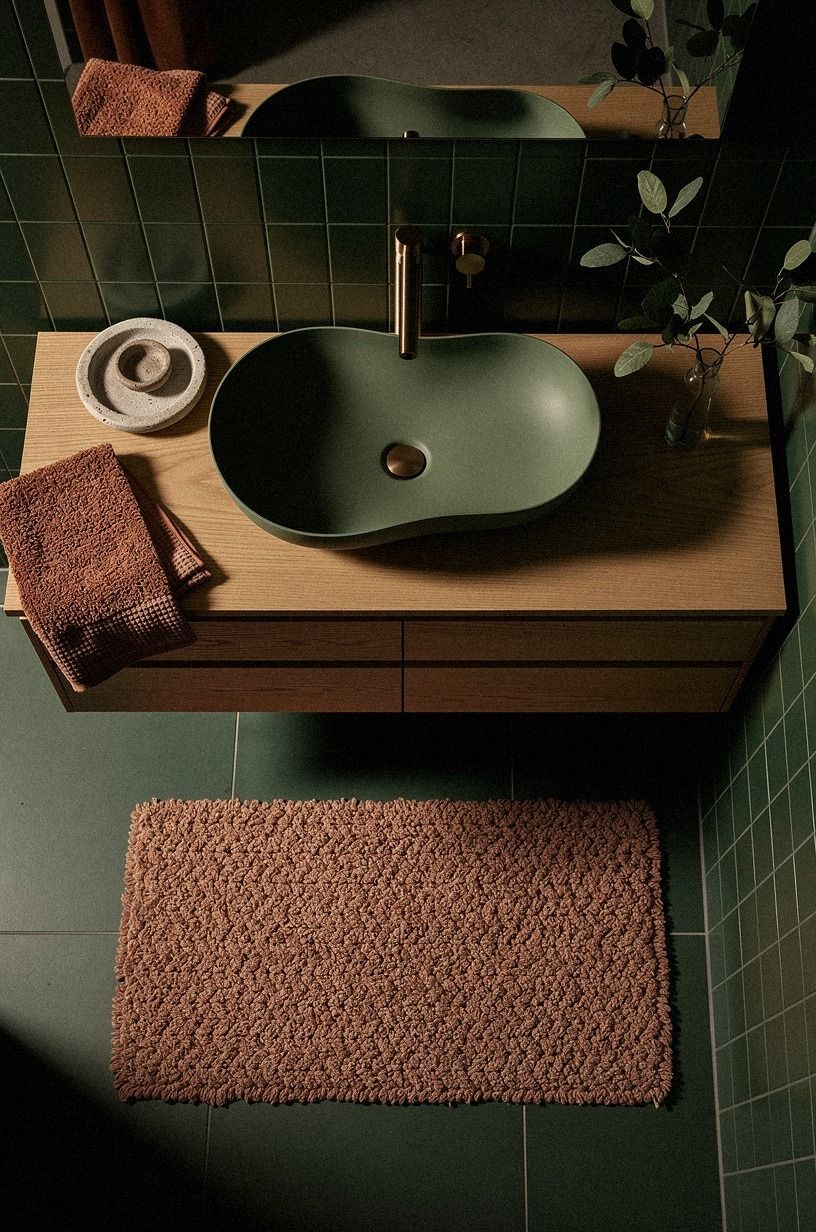
A molded basin with one soft curve from counter to bowl is the cleanest way to create a monolithic bathroom. You won't have a harsh rim collecting soap, and your eye can travel across the surface without stopping at a separate vessel.
Choose a microcement countertop with a honed finish, then bring in forest green, rust, and natural oak around it. An organic bouclé stool or small upholstered bench adds the right softness.
I prefer a shallow front edge over a thick waterfall profile because it feels lighter in a small room. A 32 to 36 inch vanity height keeps the basin comfortable for most adults, and you'll still have enough room for a folded hand towel. If you're pairing it with a small round mirror, leave visible wall around the curve so the room doesn't feel packed.
The practical detail is the sealant. Ask for a bathroom-grade polyurethane or compatible protective coat, and follow the manufacturer's cure time before you use the sink.
A surface that looks dry may not be ready for toothpaste, hot water, and daily wiping. For another soft, sculptural direction, browse these white microcement bathroom ideas for a bright seamless look. You can also compare the proportions with these modern travertine bathroom ideas for an organic luxe look.
Typical cost by tier (US averages):
2Build the Floating Monolith
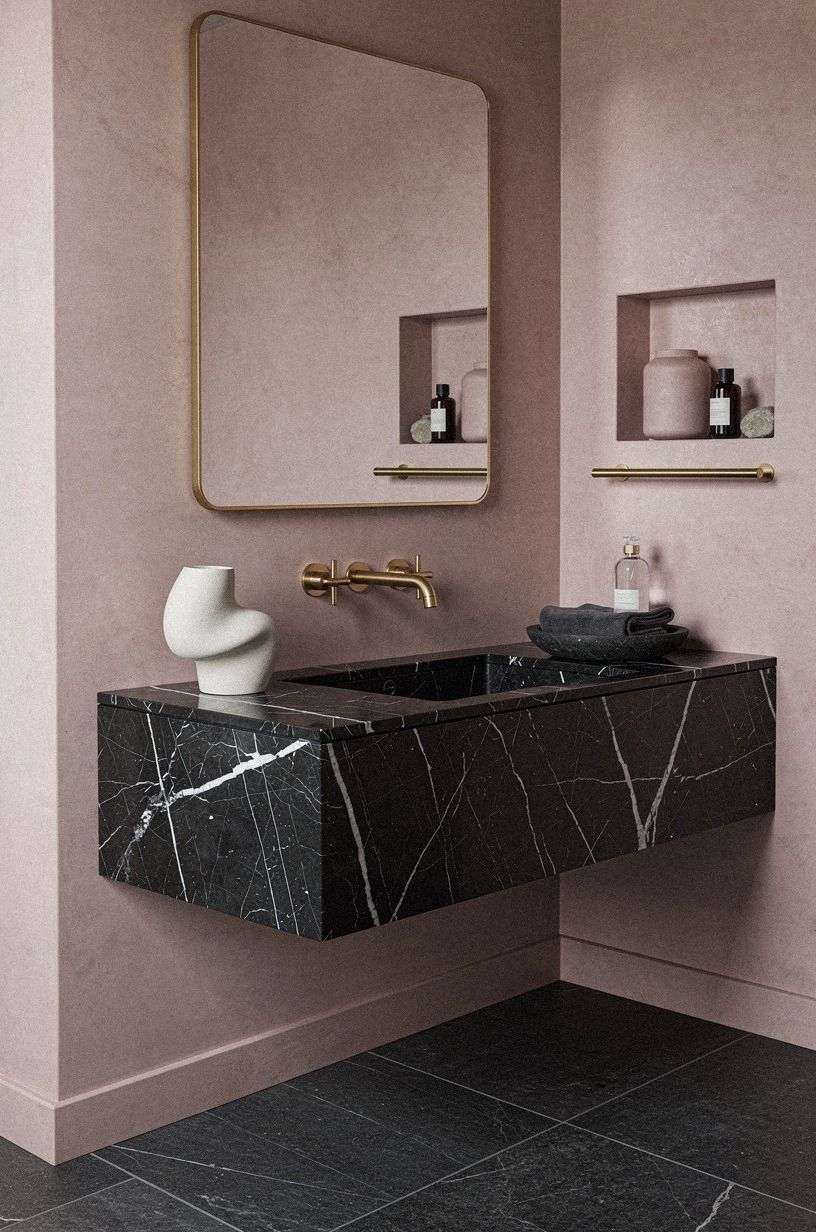
A floating vanity makes a microcement sink look carved from the wall. Mount the cabinet high enough for your cleaning brush to pass underneath, then use Nero Marquina black marble across the top and short backsplash. The white veining gives the dark surface movement, while a thin shadow line keeps the heavy material from looking clumsy.
I’d skip a chunky freestanding cabinet here. It interrupts the quiet shape and gives dust one more ledge to collect. A wall-mounted vanity with discreet brass details brings warmth without competing with the basin, especially when the marble remains the dominant surface.
Keep the plumbing tidy. Your P-trap should sit inside the cabinet or close against the wall, and your wall-mounted faucet needs enough reach to land water near the center of the bowl. And if you're working around a toilet, preserve at least 21 inches of clearance in front, so your sculptural vanity doesn't make the room annoying to use.
3Layer the Three-Texture Stack
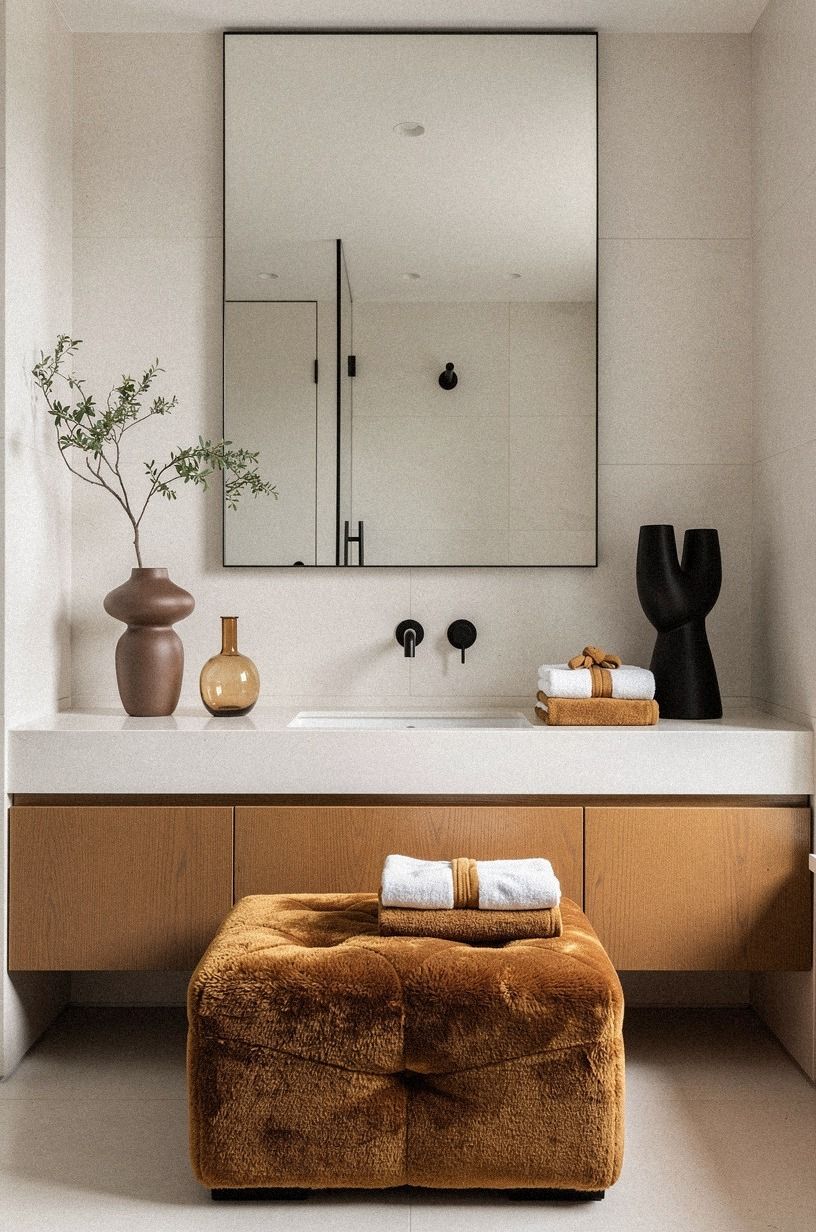
Microcement can feel flat if every nearby surface is smooth. The Three-Texture Stack solves that with a warm white basin, a tactile wall, and one natural fiber.
I’d use a lightly textured wall finish, a deep-pile mohair velvet stool or cushion in camel, and one black metal accent. Your hand should meet a different texture at every point.
This is where a modern beige bathroom sink gains depth. Pair warm white microcement with Benjamin Moore White Dove on the ceiling or adjacent wall. The paint won't compete with the mineral finish, and the camel textile will keep the room from feeling clinical.
Skip polished chrome if your goal is a grounded look. It reflects too much light and makes the basin feel more commercial.
Unlacquered brass or aged bronze will develop a quieter surface over time, and you won't need every accessory to match. A single aged bronze faucet is enough.
For a broader palette, these green limewash bathroom ideas for an earthy organic vibe show how the same mineral mood can work beyond the vanity.
4Anchor a Travertine Basin Beside Microcement
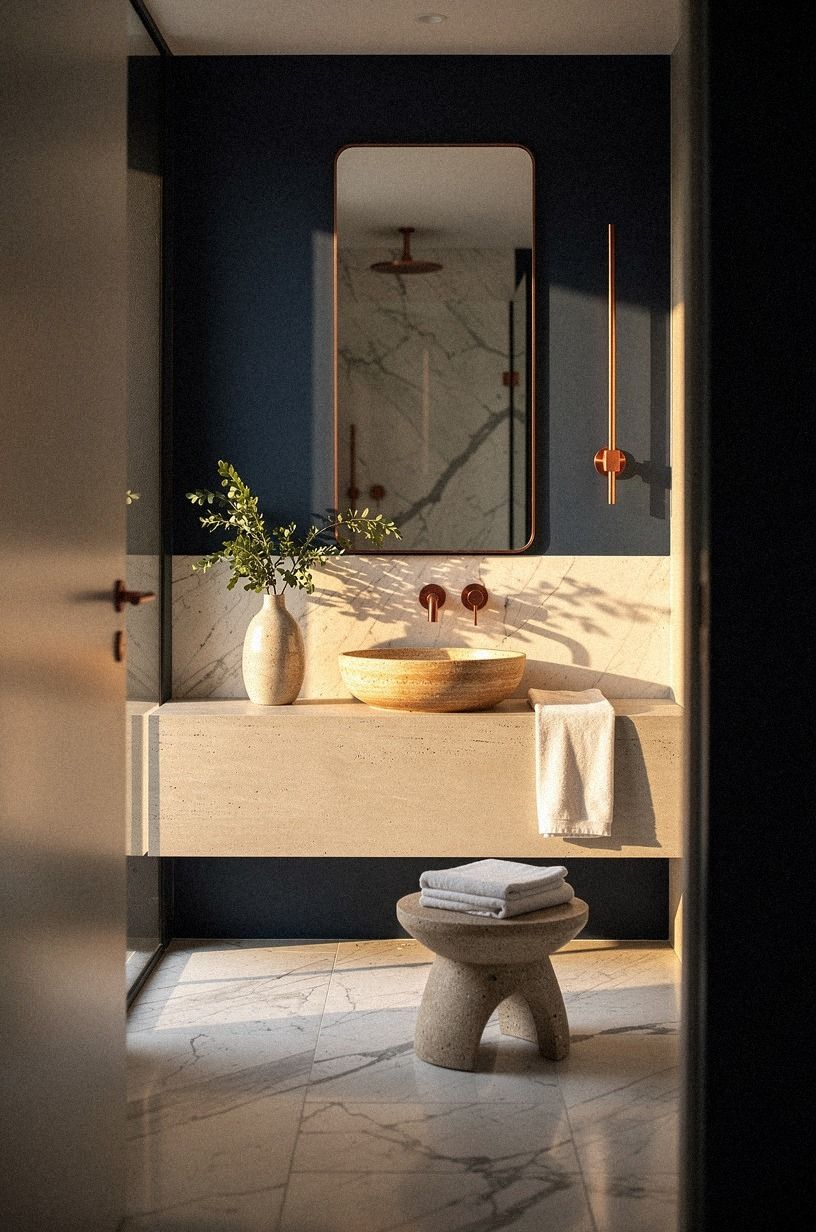
A Carrara marble basin beside a microcement counter gives you contrast without losing the organic mood. Choose marble with subtle gray veining rather than a glossy bowl with perfect uniform color. Your sink will look more like a piece of carved stone, and the gentle variation will keep the pale surface from feeling sterile.
I tested a similar pairing with a pale mineral counter and a Carrara vessel basin, and the stone felt warmer once the room lights came on. It wasn't dramatic in daylight. At night, the gray veining gave the wall enough movement to feel almost hand-plastered.
Use a narrow copper faucet, leaving enough space behind the bowl for cleaning. You’ll want at least a few inches between the basin and backsplash so your cloth can reach the seam.
If you're building an artisan bathroom, this guide to why microcement is the heart of the organic modern bathroom explains how the material works across more than one surface. You can also borrow warmth from these modern travertine bathroom ideas.
5Paint the Ceiling Sea Salt
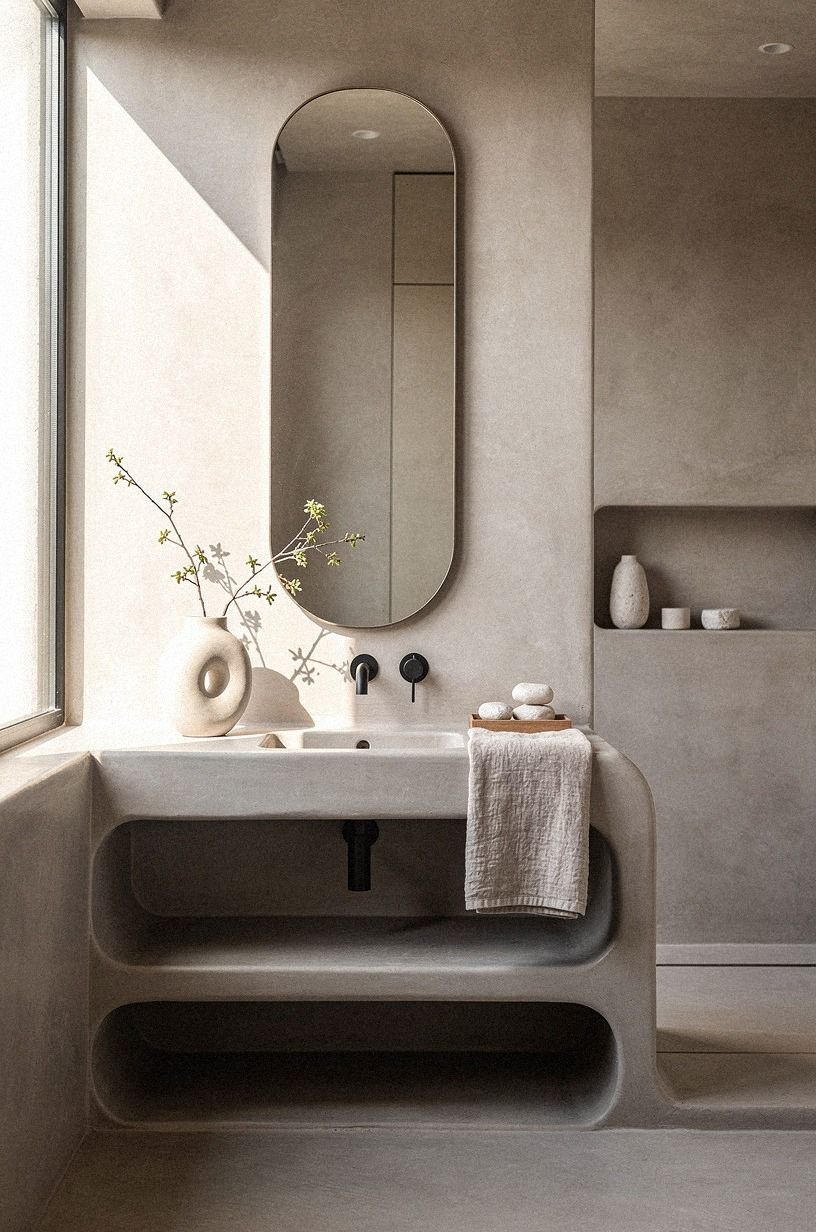
A microcement sink doesn't need a white ceiling above it. Sherwin-Williams Sea Salt SW 6204 adds a soft sage-green cast that works with warm cream and pale mineral microcement. Your ceiling becomes part of the palette instead of disappearing into a bright white rectangle.
I’d use this move when the bathroom has limited daylight. Sea Salt can keep the room airy, while a deep green or charcoal ceiling may make a narrow space feel lower. Add a small piece of reclaimed weathered teak if the room needs natural warmth.
Its worn grain works better here than a highly polished wood.
Use a low-sheen bathroom paint and keep the trim simple. A plain painted skirting board will look more intentional than ornate molding beside a sculptural sink.
You can repeat the color in one Belgian flax linen hand towel, but don't build a matching set. One quiet echo is enough!
6What Should Frame the Drain?
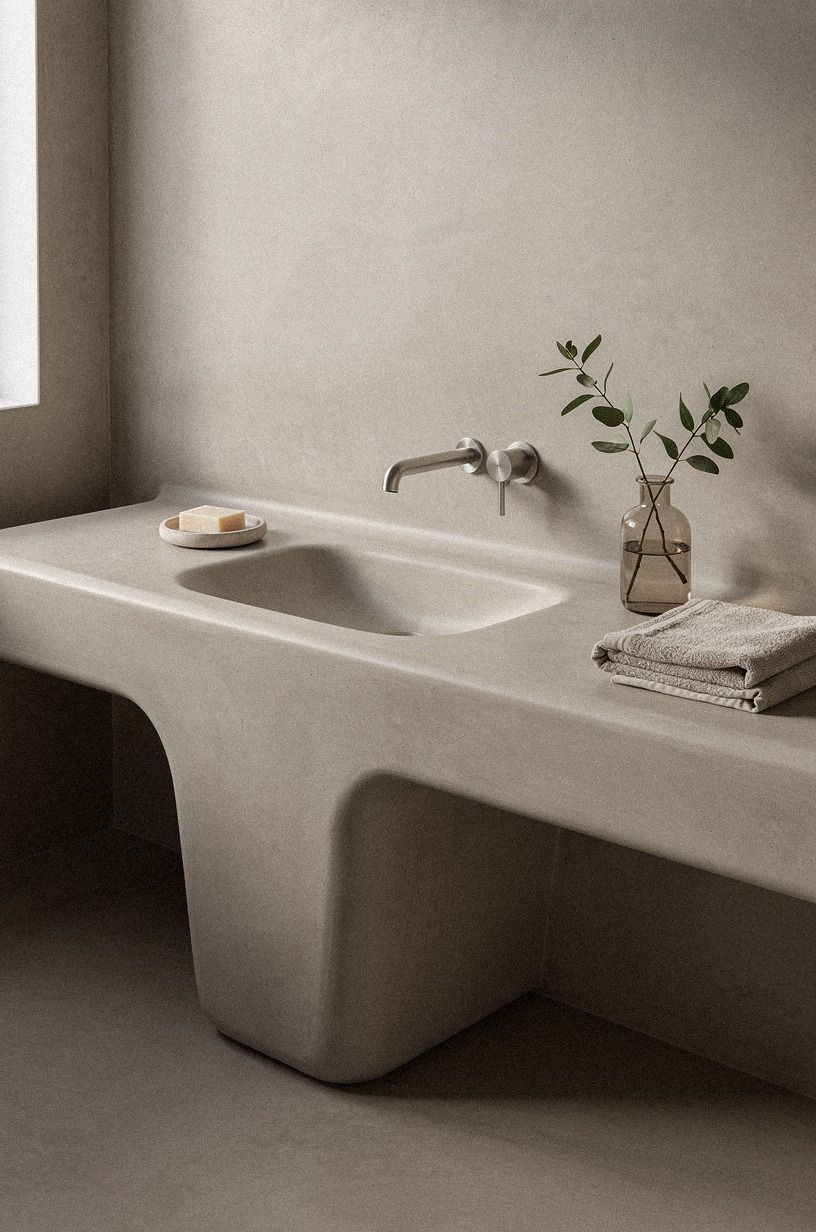
The drain is small, but your eye notices it because it sits at the lowest point of the basin.
Use a restrained Calacatta marble detail around it if the design needs a little warmth. Its subtle gold veining can connect the drain area to terracotta, stone, and olive accents without turning the smallest part of the sink into a feature wall.
7Frame the Sink With a Warm Wood Niche
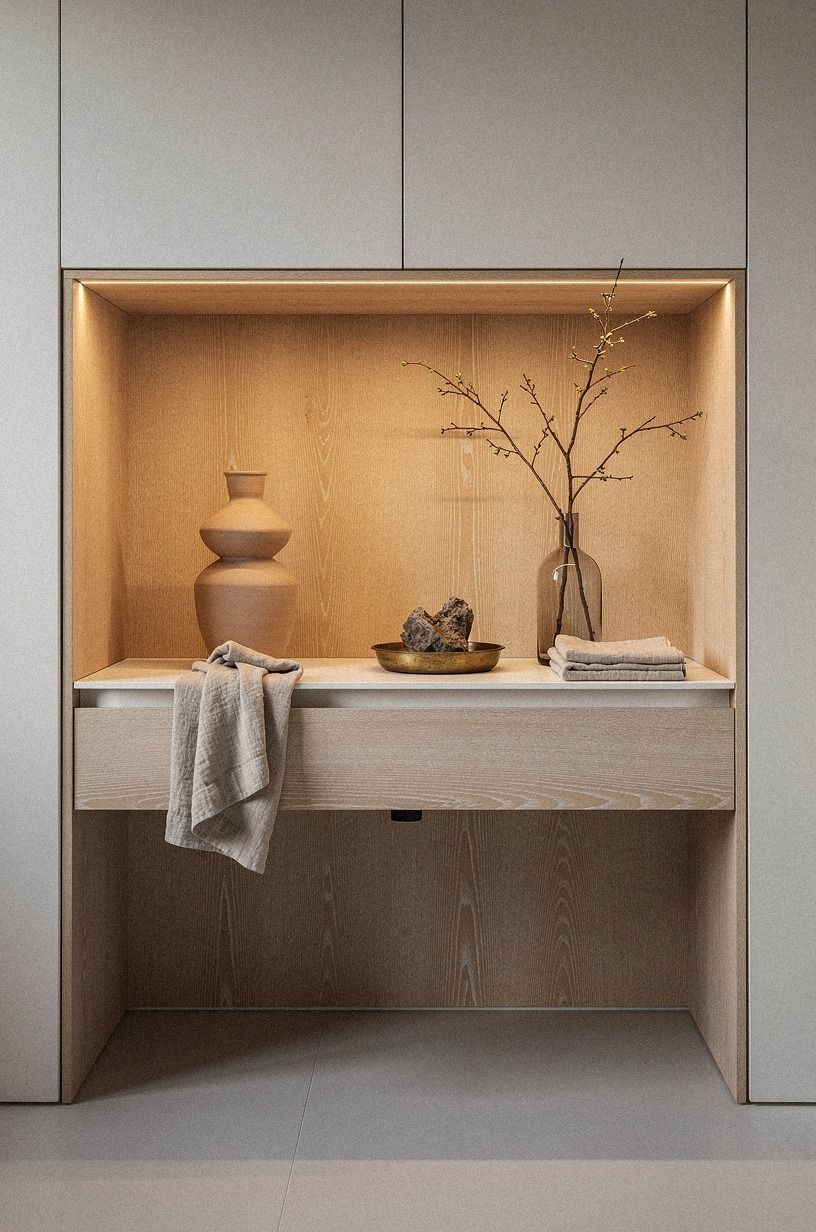
A shallow wood niche behind the basin gives you storage without adding another cabinet. Keep it just deep enough for soap, a small glass, and one folded cloth. You'll see the microcement continue around the opening, while the cerused white oak niche adds a dry, tactile note.
I’d avoid open shelving directly above the faucet. Steam, splashes, and toothpaste will make the lower edge messy, and you’ll be wiping it constantly. A niche at shoulder height works better because your hand can reach it without leaning over the basin.
Use a water-resistant wood finish and seal the joint where it meets the microcement. Your installer should leave a neat flexible seam instead of forcing rigid material against wood that may move slightly.
Keep the surrounding palette in clay, linen, and aged brass so the niche feels integrated. If you're planning a larger organic palette, these green limewash bathroom ideas show how a painted mineral wall can soften the same materials.
8Vessel Bowl or Recessed Sink?
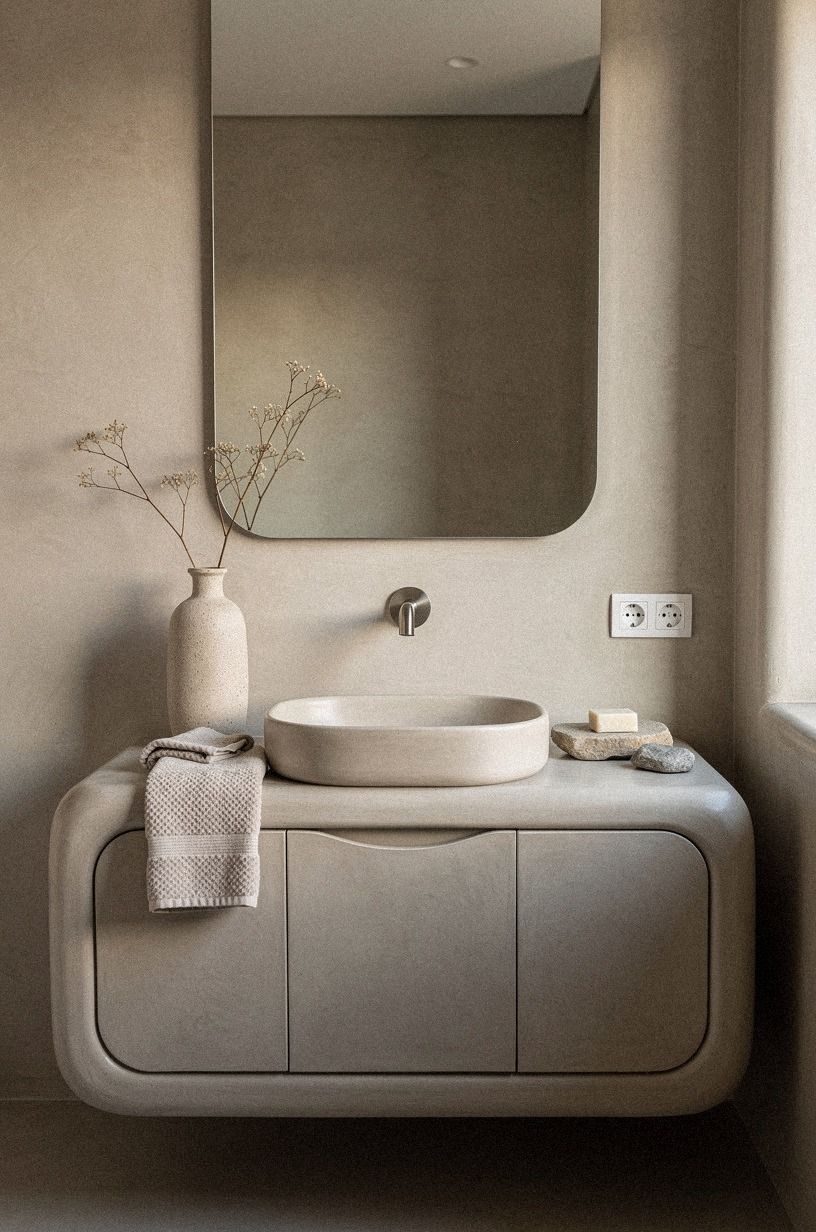
A recessed basin is easier to live with than a tall vessel if your bathroom is tight. Your sightline stays low, the mirror can begin closer to the counter, and you won't bump your hip against a protruding bowl. Choose an integrated recessed microcement sink with a modest inner radius so the corners are easy to wipe.
The tradeoff is installation precision. The counter, bowl, and drain must align before the finish goes on, so measure twice and confirm the faucet position with the actual basin. I’ve seen a beautiful counter ruined by a faucet that landed too close to the wall and splashed the backsplash every morning.
For a more dramatic vessel version, use backlit translucent onyx against plum, gray, and rose-gold accents. Keep the lighting soft and concealed so the stone remains calm rather than theatrical.
For a rental-friendly version, use a standard vanity with a removable vessel bowl and add a microcement-look surface treatment only where allowed. You won't get the same seamless form, but you'll keep the proportions.
9Layer Soft Light Over the Basin
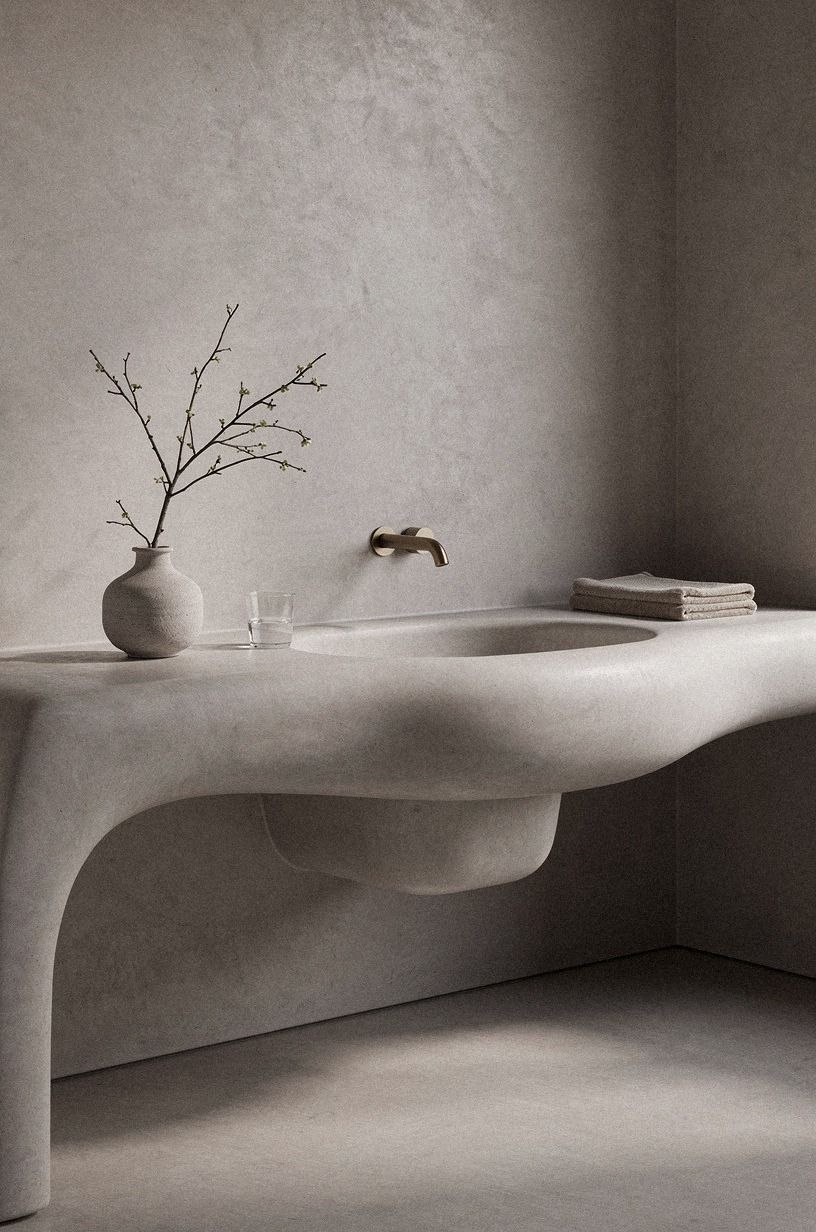
Microcement changes character under light. A cool ceiling fixture can make it look flat and blue, while a warm wall sconce brings out the subtle variation in the finish. Install two opal glass sconces at face height if your wall allows, then use a dimmable ceiling light for general visibility.
You’ll want the light to reach your face without throwing a sharp shadow under your brow. Place the sconces beside the mirror rather than directly above it, and choose 2700K warm bulbs that don't turn the pale surface orange. A navy-and-white palette keeps the room crisp, while book-matched walnut adds depth around the mirror or vanity.
I’d skip a single pendant hanging over a narrow sink. It looks dramatic in a styled photo, but it can block the mirror and create uneven light.
A simple linen-shaded wall fixture is calmer, and it keeps the room serene when you're brushing your teeth at 6 a.m. For more earthy color direction, see these green microcement bathroom ideas for an earthy organic vibe.
The material reads differently when paired with a limewashed bathroom wall.
10Pair the Basin With the Two-Wood Rule
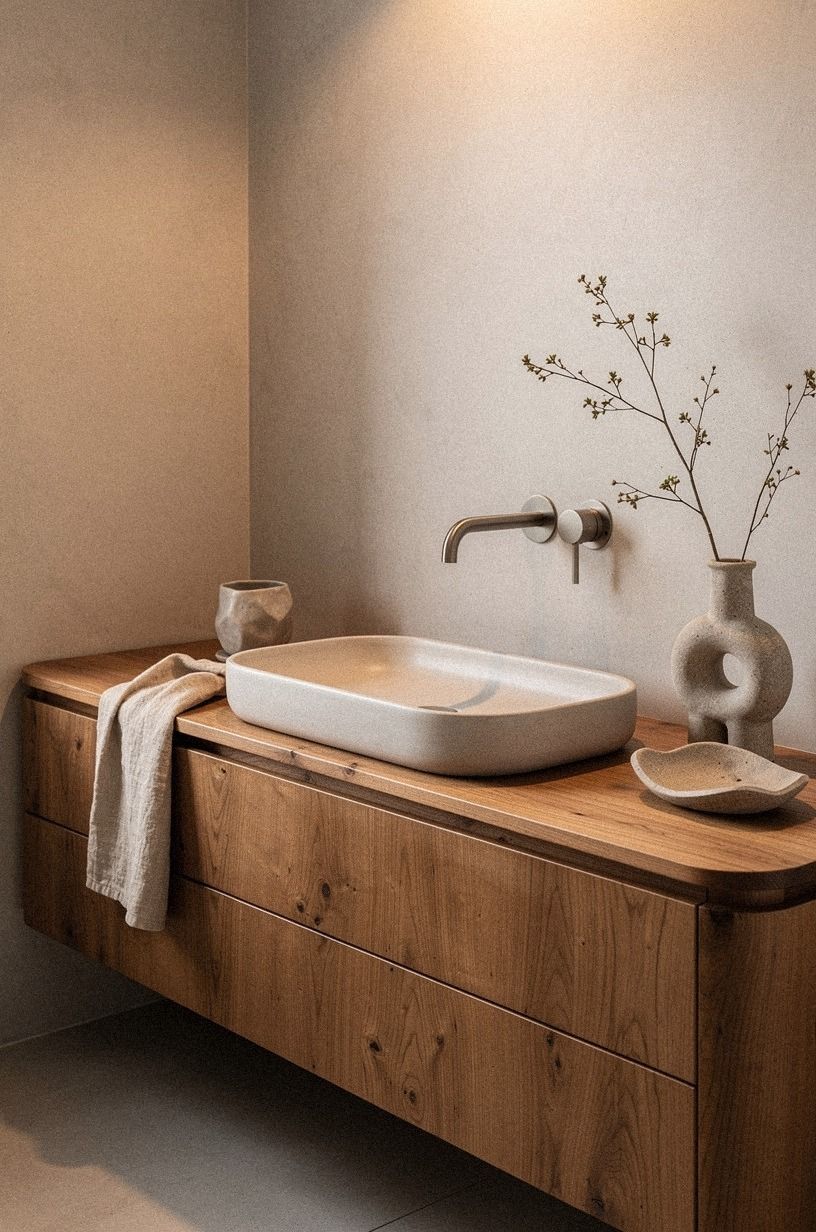
The Two-Wood Rule keeps an organic bathroom from becoming visually busy. Use one wood for the vanity and a second, related wood for a stool or framed mirror. Your warm travertine surface remains the quiet background, while the timber adds warmth in two controlled places.
Try walnut veneer on the vanity with pale oak around the mirror, or choose oak for both pieces and bring in a darker teak stool. Add small emerald and gold accents through the wall color, mirror hardware, or faucet finish.
I wouldn't mix three or four wood tones in a small room. The grain starts competing with the basin, and your eye loses the shape that made the design appealing.
Keep the wood grain running horizontally on the vanity if the room is narrow. You'll make the cabinet feel wider without adding bulk.
A West Elm Anton solid wood mirror can work as a reference point, but a secondhand frame may give you a better finish for less money. Your best piece doesn't need a showroom label.
11Hague Blue and Pale Microcement: A Deep Contrast
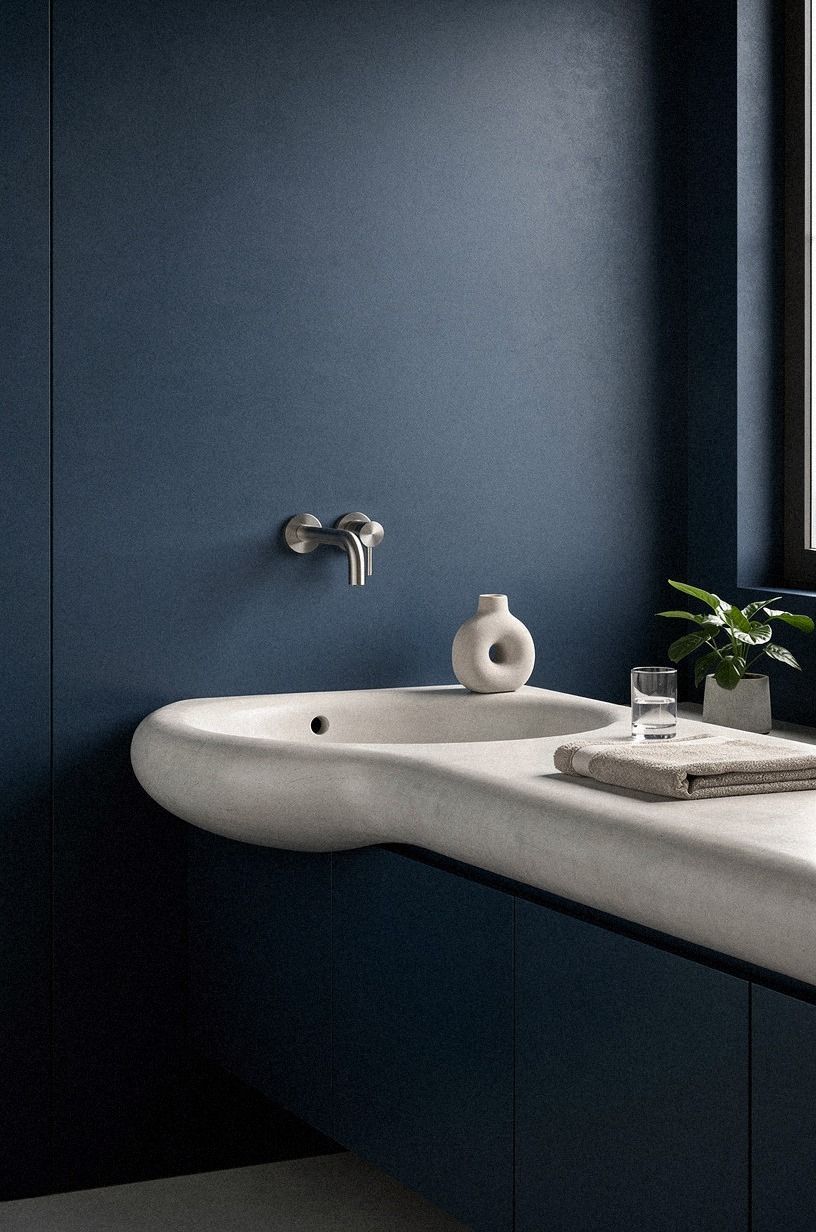
A dark forest-green wall can make pale microcement look richer, especially when the basin has a warm undertone. Farrow & Ball Hague Blue No.30 is a useful reference for that deep green-blue family, turning the mineral surface into the lightest object in the room. Add a touch of rust and natural oak to keep the contrast from feeling cold.
Would I use it in a windowless powder room? Yes, if you have layered lighting and a pale ceiling.
The deep color can feel intimate instead of cramped when the mirror reflects warm light across it. But if you're trying to make a very small bathroom appear larger, Benjamin Moore White Dove will give you more visual breathing room.
Your accessories should stay restrained. One unlacquered brass hook, a pale stone tray, and a small oak frame are plenty.
The brass will develop patina over time, adding a quieter note than shiny metal. Cream cotton will make the whole room feel more peaceful. For a related tonal approach, compare the darker wall with these green microcement bathroom ideas.
12What Will the Bathroom Actually Cost?
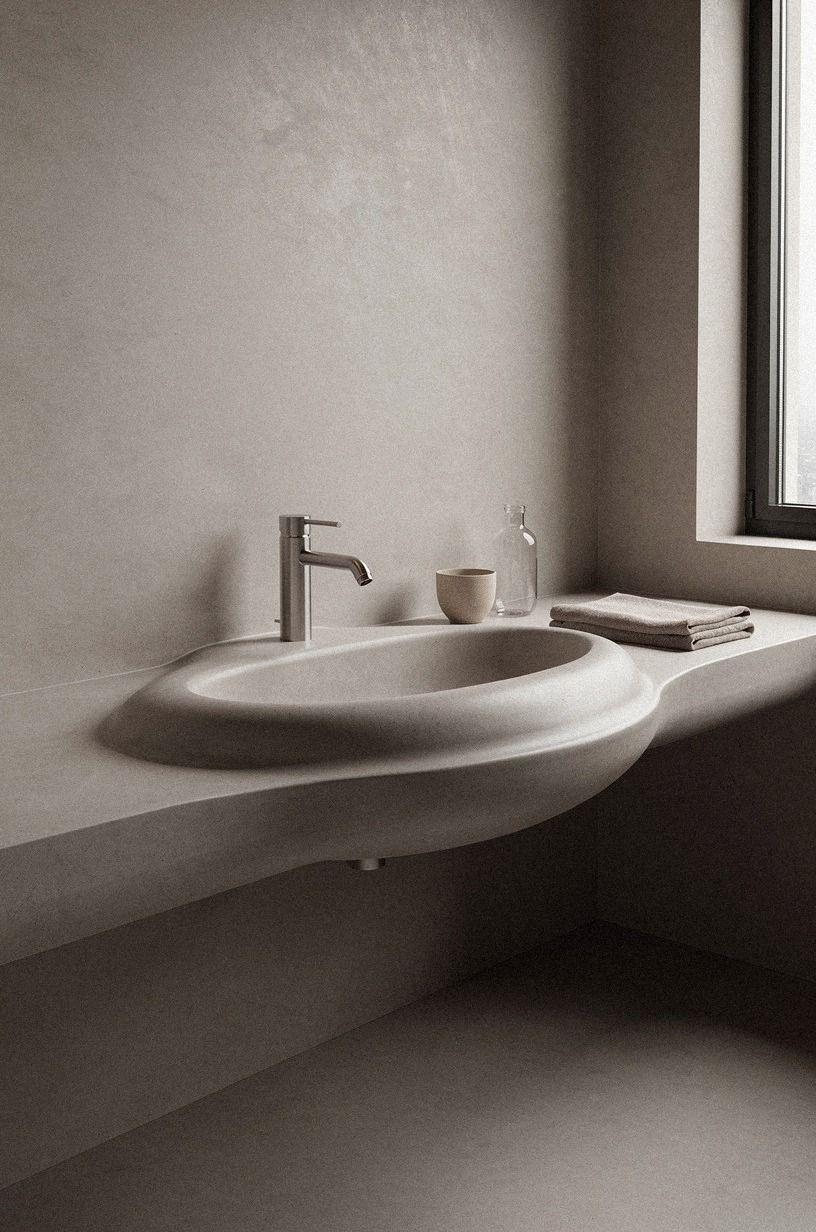
Microcement is only one part of the project, and your total cost changes quickly once plumbing, lighting, and tile enter the room.
If you bring in oversized-chip terrazzo, price the slab or poured surface separately from installation. The chips add visual character, but they can also affect cutting, edge finishing, and matching between pieces. A simple microcement counter will usually keep the labor easier to control.
13Keep the Organic Bathroom Easy to Clean
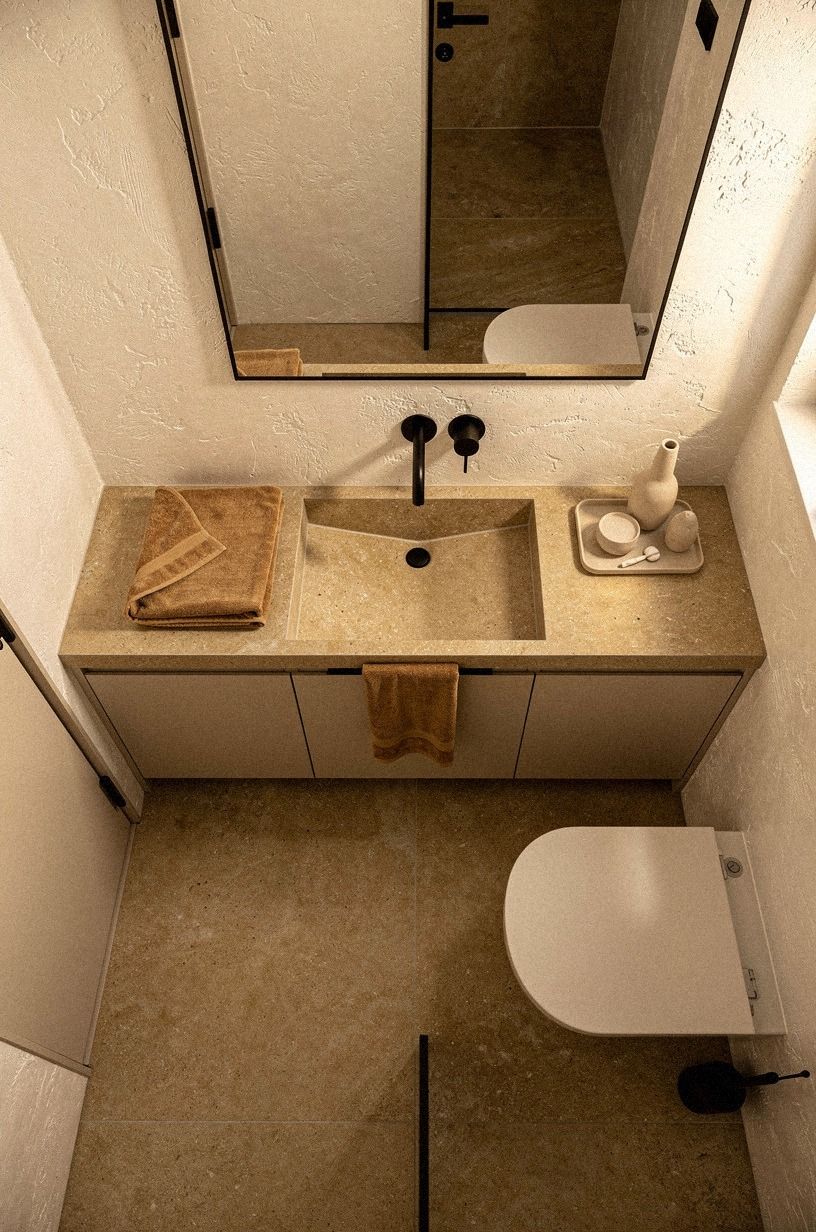
Low maintenance starts with fewer joints. A broad sealed microcement surface has fewer grout lines than a tiled counter, so you can wipe the vanity in one pass. Your cleaning cloth should move from the backsplash to the bowl without catching on a raised edge.
Use a pH-neutral cleaner and a soft cloth, then dry the area around the faucet. Don't let harsh bleach, abrasive powder, or standing water become part of the routine. The finish may be durable, but it isn't indestructible, and you’ll protect it better with gentle habits than with aggressive scrubbing.
A wall-mounted faucet can reduce clutter on the counter, but it needs careful installation and access for repairs. If you're choosing between that and a standard deck-mounted faucet, I’d choose the standard option for a busy family bathroom. The floating version looks refined, yet simple access wins when your sink is used twenty times a day.
For a low-effort cleaning routine, keep one soft cotton cloth in the vanity and wipe the splash zone after brushing your teeth. That small habit does more than a harsh weekly scrub.
If you're comparing finishes, revisit why microcement works in an organic modern bathroom before choosing a sealer. A hand-applied Venetian plaster wall can add movement without creating another hard surface to polish.
What I’d Change After Living With Microcement
I used to think the smoothest possible bathroom would be the easiest one to maintain. That assumption cost me time.
A completely uniform surface shows every splash, every hair, and every faint ring near the drain, especially when the finish is dark. Now I prefer a softly mottled mineral surface with enough movement to make ordinary use disappear into the material.
The best microcement sink is also the one that respects your habits. If you leave a toothbrush beside the basin, build in a small ledge.
If your children splash water everywhere, choose a deeper bowl and a wipeable wall behind it. Design isn't successful because it looks calm for one photograph.
It earns its place when you can use the room without apologizing for the evidence of living.
I’d also resist copying a hotel bathroom too closely. Hotels can replace fixtures quickly and clean them between guests. Your home needs warmth, storage, and materials that forgive a rushed morning.
That’s why I like microcement with oak, cotton, and aged metal. The combination feels earthy and inviting, but it still gives you a clear surface to clean.
The trend is moving toward rooms that feel less polished and more tactile. A basin with gentle variation, a limewashed wall, and a quiet wood cabinet can look current without becoming disposable.
And if your budget is limited, paint and lighting will do more than another expensive accessory. Start with the surface you touch most, then let the rest follow!
The Questions Worth Answering First
What is the best microcement sink and basin idea for a small bathroom?
An integrated recessed basin with a floating IKEA HEMNES vanity is a strong choice because it keeps the sightline low and leaves floor space visible. Choose a pale mineral finish, a round mirror, and one warm sconce. You’ll get a calmer footprint without sacrificing daily storage.
Where can I buy microcement sink and basin pieces on a budget?
Look at IKEA, Wayfair, Target, Facebook Marketplace, and local thrift stores for vanities, mirrors, and stools. You don't need every piece to be microcement. A secondhand solid wood cabinet can carry the organic look while a professional surface treatment handles the basin area.
How much does a microcement sink and basin makeover cost?
A small makeover can fit inside the $200-$1,200 budget tier when you keep the plumbing, paint the room, replace the mirror, and update the faucet. A mid-range renovation with a new vanity, lighting, and partial tile typically reaches $3,000-$9,000. Your labor and surface condition will affect the final quote.
Can I create a microcement sink and basin look on a budget?
Yes, and you can start without replacing the whole vanity. Paint the wall, change the mirror, use a stone-look counter coating approved for bathrooms, and add Turkish cotton towels. Shop secondhand for the cabinet, keep the existing plumbing, and spend your first dollars on preparation and sealing.
Is a microcement sink and basin worth it in a small space?
Yes, especially when your room has too many grout lines or bulky furniture. A continuous surface can make the vanity read as one shape, while a floating cabinet exposes more floor. Keep the vanity between 32 and 36 inches high, and choose a shallow basin so your walkway stays comfortable.
Is a microcement sink and basin a good idea for a rental?
It can be, if you use reversible pieces rather than changing the fixed counter. Try a removable peel-and-stick wall finish, a tension mirror, a freestanding wood vanity, and adhesive towel hooks. Your landlord may allow paint or a removable counter panel, but always confirm before applying a permanent coating.
Where I’d Start First
If I had to pick one, I’d start with the recessed microcement basin. It eliminates the rim that collects grime, keeps the room visually quiet, and makes a small vanity feel custom without moving plumbing.
Pin the idea for later and compare it with these organic modern bathroom ideas. For a brighter direction, pair that plan with white microcement bathroom ideas.