
 by
by Quick answer: The right weighted blanket cover matches the blanket’s actual footprint and attachment points, feels comfortable at your usual sleep temperature, and has care instructions you can realistically follow.
Updated for 2026 |
My verdict: a weighted blanket cover is worth buying when the inner blanket is still sound and you want easier cleaning, a different texture, or better temperature control. Skip the purchase if the blanket is leaking, badly bunched inside its stitched pockets, or uncomfortable because of its weight. Fabric wrapped around a structural problem won’t solve it.
I judge these covers from the inside out. The soft exterior gets attention in product photos, but compatibility, anchor placement, seam construction, and zipper finishing determine how well a cover behaves after repeated use. A luxurious fabric is frustrating if the blanket slides into one corner every night.
| The Nut’s shortcut: check fit and attachment compatibility first, fabric second, and color last. That order prevents most expensive mismatches. |
What a cover can protect, and what it cannot
The filled inner blanket carries the difficult laundry load. Its stitched pockets, shell, and fill all move through a wash cycle together, so unnecessary laundering places wear on more than the surface that touches your skin. A removable cover takes much of the routine contact from body oils, pet hair, and everyday grime.
That doesn’t make the cover a repair layer. It may catch a stray particle temporarily if it has a substantial lining, but it should not be relied on to contain an actively leaking blanket. Escaping fill calls for an inspection of the inner shell and pocket seams, not a thicker cover.
A cover can also change the blanket’s surface feel. Smooth woven fabric produces a different experience from stretchy jersey or plush pile, even though the inner blanket hasn’t changed. Seasonal swapping makes sense here: use a less insulating surface during warm weather and a plush one when the room is colder.
- A cover can help with: routine cleaning, surface texture, color, and some temperature management.
- A cover cannot correct: unsuitable blanket weight, torn pocket stitching, active fill leakage, or damaged shell fabric.
- A cover may expose: poor compatibility if its ties do not align with the blanket’s loops.
Keep the cover decision separate from the bigger question of weighted bedding itself. If you’re still deciding whether you like that type of pressure, read our guide to whether weighted blankets actually help sleep before spending money on accessories.
Start with the blanket, not the cover’s size label
A size name is less useful than a seam-to-seam match. Terms such as twin, full/queen, king, and universal fit can describe slightly different footprints across sellers. Lay the inner blanket flat, smooth its edges without stretching them, and compare its measurements with the cover listing.
Fit should be close enough to control movement without forcing the blanket into a smaller shell. Too much spare fabric gives the fill room to migrate and fold. A cover that is too tight can pull at the zipper, anchor points, and perimeter seams.
Thickness matters even when the footprint appears correct. A lofty or heavily quilted blanket occupies more internal space than a flatter one. Product photos rarely communicate that difference well, so look for compatibility language tied to the specific blanket or ask the seller how much internal depth the cover accommodates.
| Compatibility check | What to compare | Why it matters |
|---|---|---|
| Footprint | Blanket edges against the listed cover dimensions | Excess room encourages shifting; too little room strains seams |
| Attachment layout | Blanket loops against the cover’s interior ties | Misaligned anchors twist the blanket instead of stabilizing it |
| Blanket profile | Flat construction against lofty or deeply quilted construction | Two blankets with a similar footprint may occupy different internal space |
| Care compatibility | Cover instructions against your normal laundry routine | A removable cover is less useful if its required care is impractical |
Also inspect how the inner blanket is meant to connect. A cover with ties needs corresponding loops in sensible positions. If the blanket has no loops, a purpose-built cover may still shift even when its dimensions match perfectly.
Fabric construction sets the temperature and texture
A smooth cotton weave and a plush pile do not manage air in the same way. Pile holds a layer of air around its raised fibers, which tends to feel more insulating. A lighter woven surface generally feels less enveloping, though the fabric’s weight, weave, and finishing matter alongside its fiber label.
Cotton is a practical starting point for sleepers who want a familiar sheet-like hand. Woven cotton tends to hold its shape better than a very stretchy knit, while jersey offers softer drape and more give. That stretch can feel comfortable, but it may also provide less resistance when a heavy inner blanket starts moving.
“Bamboo-derived” describes the source material more than the finished construction. The resulting fabric can feel smooth and fluid, but the label alone doesn’t tell you how dense, breathable, or durable the cover will be. I’d compare the actual weave, surface, and care label instead of treating the fiber name as a cooling promise.
| Cover type | Surface feel | Temperature tendency | Construction tradeoff |
|---|---|---|---|
| Woven cotton | Smooth or crisp | Usually less insulating than plush pile | Stable shape, but wrinkles may be more visible |
| Bamboo-derived weave | Fluid and smooth | Often chosen by warm sleepers | Finished weave and care requirements vary |
| Jersey knit | Soft and stretchy | Moderate | Easy drape, but stretch may allow more internal movement |
| Minky or fleece | Fuzzy and plush | Warm | Comforting texture for some sleepers, potentially too insulating for others |
For a hot sleeper, I’d avoid judging the cover in isolation. The inner shell, fill, room temperature, and bedding layered above it all contribute to warmth. Our guide to weighted blankets for hot sleepers explains why changing only the outer fabric may not be enough.
Texture is personal too. A seam, zipper ridge, or fuzzy nap that one person barely notices may be distracting to someone else. If tactile predictability is important, favor a uniform surface, flat seams, and a closure that stays away from exposed skin. Our discussion of weighted blankets for autism explores the broader sensory considerations without assuming one fabric suits everyone.
| Material reality check: fiber names are only the headline. Weave, knit structure, pile, fabric weight, and finishing have a direct effect on how the cover feels and handles. |
Interior anchors prevent the worst bunching
The outside closure keeps the opening shut; the inside anchors keep the blanket spread out. Confusing those jobs is how buyers end up with a neatly zipped cover and a dense lump of blanket gathered at one end.
Corner ties establish the basic footprint. Additional attachment points along the edges can give the cover more control over the blanket between corners, provided the loops line up correctly. More ties are not automatically useful if they pull diagonally or attach to weak points.
Inspect the tie material as closely as the count. Narrow ribbons can twist, slippery ties may loosen, and short ties can be awkward to secure. A tie should make a stable connection without forcing you to cinch the blanket so tightly that its edge puckers.
- Confirm that the cover’s tie positions correspond with loops on the inner blanket.
- Check whether attachment points are sewn into reinforced seams rather than unsupported fabric.
- Look for clear interior photos instead of assuming “secure fit” means internal anchoring.
- Avoid improvising attachments that could snag, loosen, or damage the blanket shell.
Closure choice comes next. A long zipper usually makes the opening easier to access, while snaps can be simple to replace if the construction allows it. An envelope or elastic opening has fewer hard components, but it needs enough overlap and tension to keep a heavy insert from working its way toward the opening.
For zippers, focus on the ends and the fabric guard. Those are stress areas, especially when someone pulls the cover closed around an insert that has not been fully seated. A covered zipper also reduces direct contact between the slider and the sleeper.
Install the cover without creating a hidden twist
Most bunching begins before the blanket reaches the bed. If one anchor is tied to the wrong loop or an edge is folded inside the cover, the weight magnifies that error as soon as the blanket moves.
The cleanest method is to turn the cover inside out, place it over the flattened blanket, and line up every matching anchor before enclosing the insert. Secure the ties without crushing the blanket’s perimeter, then work the cover over the blanket gradually rather than dragging the entire weight through the opening.
- Lay the inner blanket flat and identify its top, bottom, and attachment loops.
- Turn the cover inside out and align its corresponding edges.
- Connect matching anchors while checking that no edge crosses diagonally.
- Turn the cover around the insert in controlled sections.
- Smooth the perimeter before closing the zipper or snaps.
After closing it, lift and settle the blanket from its edges rather than shaking it aggressively from one corner. If the fill consistently migrates, open the cover and check the anchor map. Repeatedly tugging the exterior only hides an internal alignment problem.
| Fit diagnosis: bunching in one corner often points to a loose or mismatched anchor. Rippling around the entire edge suggests excess cover space. A strained closure suggests the cover may be too small or the insert too lofty. |
Care instructions matter more than “machine washable”
The cover should take routine wash wear, but “machine washable” is only the beginning of the care decision. The manufacturer’s label should specify the appropriate wash and drying method for that exact fabric, closure, and finish. Follow those instructions instead of applying one universal routine to every cover.
Close zippers before washing if the care label allows, secure loose ties so they do not tangle, and inspect the seams when the cover comes out. High dryer heat can be hard on some elastic parts, zipper components, and plush surfaces, so use only the drying method stated by the manufacturer.
Wash frequency depends on how the blanket is used. A cover in nightly contact with skin needs more routine attention than one used occasionally over a top sheet. Pets, spills, and illness can also change the schedule. The practical standard is simple: the cover should be cleaned often enough that you are not tempted to wash the filled blanket unnecessarily.
|
Before laundering, check:
|
Do not wash the cover while it is still attached to the weighted insert. That defeats the purpose of having a removable layer and may exceed what your machine can handle. If the inner blanket itself needs cleaning, use its separate care instructions.
Durability shows at seams, anchors, and zipper ends
Zipper ends and anchor points reveal more about expected wear than a soft showroom surface. These areas repeatedly absorb pulling force, so loose thread, puckering, or ties attached only to a thin fabric panel deserve scrutiny.
Flat, even perimeter seams are a good sign because they let the cover lie around the insert without creating pressure ridges. Reinforcement at the opening matters too. The user naturally pulls there while inserting and removing a heavy blanket, even when the cover is correctly sized.
Fabric durability is not simply a contest between natural and synthetic fibers. A loosely made weave can snag, a stretchy knit can lose shape, and a plush pile can change texture with unsuitable care. Construction and maintenance determine the outcome alongside the fiber itself.
| Area to inspect | Promising sign | Possible concern |
|---|---|---|
| Interior ties | Secure attachment within a seam | Loose thread or ties sewn to a thin panel |
| Zipper ends | Reinforced finishing and a fabric guard | Puckering, exposed hardware, or strained stitching |
| Perimeter seams | Even stitching and a flat edge | Skipped stitches or a twisted hem |
| Surface fabric | Consistent weave, knit, or pile | Thin spots, snags, or uneven finishing |
Recent verified-purchase photos can help if a retailer provides them. Look at seams and surface texture after use rather than relying on a staged product image. I give more weight to a repeated construction pattern than to vague comments that a cover simply feels “cheap” or “premium.”
If you find loose particles inside the cover, stop and identify the source before continuing to use the blanket. Our guide to what's inside weighted blankets explains the common internal constructions and why the source of the leak matters.
When replacing the cover is the wrong repair
A split pocket seam remains split beneath new fabric. The same is true of uneven fill distribution, a damaged inner shell, or a blanket that feels unsuitable to the user. A cover can make the exterior cleaner and more comfortable, but it does not alter the underlying load or rebuild internal stitching.
Remove the existing cover and inspect the blanket laid flat. Look for escaping fill, opened seams, hard concentrations inside pockets, or areas that no longer spread evenly. Follow the manufacturer’s guidance if damage is visible, especially before attempting any home repair that could affect the shell.
- Buy a replacement cover when the inner blanket is intact but the outer fabric is worn, uncomfortable, difficult to clean, or too warm.
- Investigate the blanket itself when fill escapes, pocket seams open, or distribution stays uneven after the anchors are corrected.
- Reconsider the setup when the blanket’s pressure or heat is the main source of discomfort.
That distinction keeps this purchase on target. A shopper searching for a cover should not be pushed toward an unrelated blanket merely because the accessory needs replacement.
A practical weighted blanket cover checklist
Before checkout, compare the listing with the blanket in front of you. Do not assume a familiar size name or attractive material label proves compatibility.
| Question | What a useful listing should show |
|---|---|
| Will it fit? | Actual cover dimensions and compatible blanket information |
| Will it stay aligned? | Interior photos showing tie locations and attachment construction |
| Will the surface suit me? | The finished weave, knit, or pile rather than a fiber name alone |
| Can I maintain it? | Complete manufacturer care instructions |
| Are the stress points built well? | Clear views of seams, ties, zipper ends, and the closure guard |
If those details are missing, ask before ordering. A vague “universal” claim tells me less than a plain cover listing that clearly shows its measurements, anchor map, closure, and care requirements.
The bottom line
Fit, fabric construction, and interior anchoring decide whether a cover becomes useful maintenance or nightly frustration. Match the actual footprint, confirm that every tie has somewhere sensible to attach, choose a surface you want against your skin, and follow the exact care label. The right cover should be easier to replace and wash than the weighted insert it protects.
ONE OPTION WORTH COMPARING
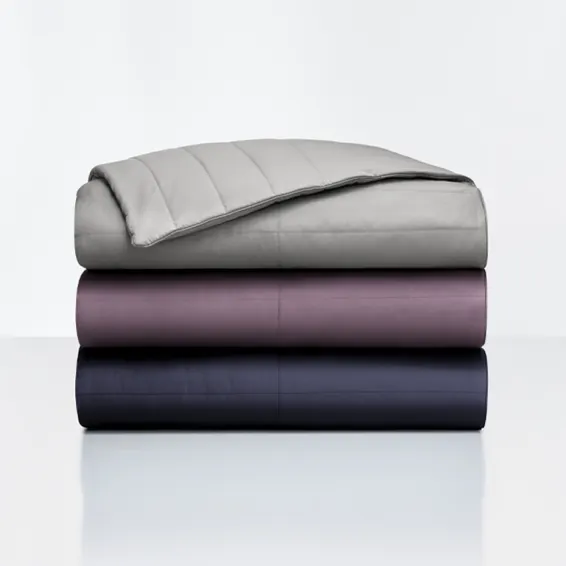
Shopping as well as reading? Here is one current option worth comparing: the True Temp™ Weighted blanket. Check today’s price, sizing and return terms on the official product page before you order.
True Temp™ Weighted blanket
- The same is true of uneven fill distribution, a damaged inner shell, or a blanket that feels unsuitable to the user
FAQ
Can I use a weighted blanket without a cover?
You can if the manufacturer permits it, but direct use puts skin oils, spills, and everyday dirt on the inner shell. A removable weighted blanket cover makes routine cleaning simpler and can reduce how often the filled blanket itself needs laundering.
Do weighted blanket covers fit every blanket?
No. Size labels vary, and the cover’s anchor positions must also correspond with loops on the blanket. Compare the actual dimensions, blanket profile, opening style, and attachment layout before buying.
Which cover fabric is better for a hot sleeper?
Start with a smooth, less insulating woven surface rather than plush minky or fleece. Do not rely on a fiber name alone, because weave, fabric weight, finishing, the inner blanket, and the rest of the bedding all affect warmth.
How often should I wash the cover?
Wash it according to use and the manufacturer’s care label. Nightly skin contact, pets, or spills usually call for more frequent cleaning than occasional use over another layer. Remove the weighted insert first and follow the stated washing and drying method.
Can I use a regular duvet cover, and will it change the weight?
A duvet cover may fit the footprint, but many lack attachment points aligned for a heavy insert. That makes shifting and bunching more likely. The fabric can change texture and warmth, but it does not meaningfully correct a blanket whose underlying weight already feels unsuitable.