
 by
by Best Mattress by Sleeping Position
Your sleep position determines which mattress firmness, support type, and pressure-relief depth will actually work for your body.
Side sleepers need softer comfort layers (3–4/10 to 5/10) to cushion the shoulder and hip. Back sleepers need medium to medium-firm (5/10 to 6.5/10) for lumbar support without sinkage. Stomach sleepers need firmer support (6.5/10 to 8/10) to keep the pelvis from rotating. Combination sleepers need responsive foam or a hybrid that transitions easily. The Amerisleep AS3 covers back, side, and most combination sleepers at a medium 5.5/10 with five-zone HIVE support.
Amerisleep AS3
9.1/10
- HIVE 5-zone technology provides firmer support under the lumbar and softer cushioning at shoulders and hips
- Partially plant-based Bio-Pur foam sleeps cooler than standard memory foam
- CertiPUR-US certified, manufactured in the USA
- Medium firmness suits back sleepers, most side sleepers, and light combination sleepers
- Dedicated stomach sleepers over 180 lb may prefer the firmer AS2
- Softer edge support than coil hybrids
The AS3 hits the medium sweet spot that works for the majority of sleep positions. The HIVE zoning targets lumbar support for back sleepers and pressure relief at the shoulder for side sleepers, making it the most versatile single pick across position types.
Why sleep position drives mattress choice
Sleep position changes which body parts carry the most weight and at what angles. A back sleeper distributes weight across the full spine; a side sleeper loads the shoulder and hip at narrow contact points; a stomach sleeper compresses the lumbar and cervical spine. Each scenario demands different firmness, different pressure-relief depth, and different responsiveness.
Matching position to mattress is not about comfort preference alone. A stomach sleeper on a soft mattress will wake with lower back pain within weeks because the pelvis sinks past the neutral position and pulls the lumbar into hyperextension. A side sleeper on an extra-firm mattress develops shoulder and hip pressure points that cut off circulation and trigger micro-awakenings. Getting the match right is one of the highest-leverage sleep interventions available without a prescription.
The firmness scale most reviewers use runs from 1 (softest) to 10 (firmest). Most adults sleep best between 4 and 7. Where you fall on that range depends almost entirely on your dominant sleep position and body weight.
How to pick your firmness by sleep position
| Sleep position | Recommended firmness | Key need | Best material |
|---|---|---|---|
| Back | Medium to medium-firm (5–6.5/10) | Lumbar support, spinal neutral | Zoned foam or hybrid coil |
| Side | Medium-soft to medium (4–5.5/10) | Shoulder + hip pressure relief | Memory foam or plush hybrid |
| Stomach | Firm to extra-firm (6.5–8/10) | Pelvis elevation, anti-hyperextension | Innerspring or firm hybrid |
| Combination | Medium (5–6/10) | Responsive transition, bounce | Latex or hybrid coil |
Back sleepers: support over softness
Back sleeping is the position most consistently linked to spinal alignment research. The lumbar spine has a natural inward curve (lordosis) that a mattress must support without forcing the lower back into extension. A medium-firm surface at roughly 5 to 6.5 out of 10 keeps the pelvis level, fills the lumbar gap, and prevents the shoulders from pushing the torso upward. Zoned mattresses that specifically reinforce the lumbar zone outperform uniform-firmness beds for back sleepers.
Heavier back sleepers (over 230 lb) should move toward the firmer end of that range or consider a hybrid with strong coil support, since body weight amplifies sinkage in all-foam beds.
Explore the full back-sleeper guides:
- Best mattress for back sleepers — our tested top picks with lumbar-support scoring
- Mattress for back sleepers — construction guide covering what to look for in support layers
- Best mattress for stomach and back sleepers — split-firmness options for those who shift between the two
Side sleepers: pressure relief is the priority
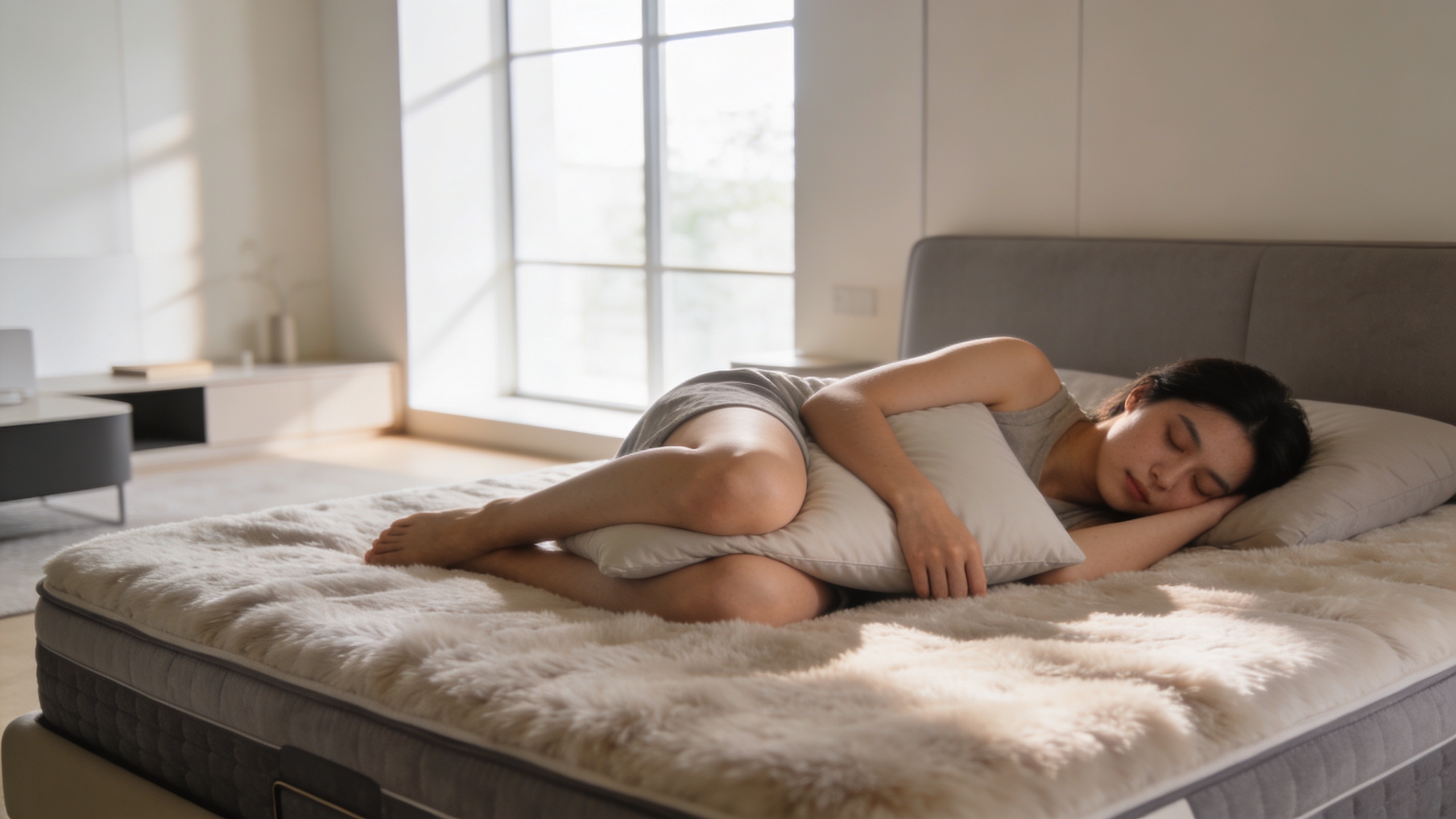
Side sleeping places the entire body weight on a narrow shoulder-to-hip line. Pressure points at the shoulder tip and the greater trochanter of the hip are the two most common causes of pain and circulation interruption for side sleepers. A comfort layer between 2.5 and 4 inches of softer foam or latex absorbs this pressure so the underlying support core can still keep the spine level.
Mattress firmness for side sleepers should sit in the medium-soft to medium range (4 to 5.5 out of 10). Lighter sleepers can go softer; heavier side sleepers need more support underneath the cushioning layer to prevent the spine from bowing laterally.
Full side-sleeper resources:
- Best mattress for side sleepers — ranked picks with pressure-map testing data
- Best mattress firmness for side sleepers — how to find your ideal firmness number by body weight
- Soft mattress for side sleepers — top picks for petite or pressure-sensitive side sleepers
Stomach sleepers: firmness prevents pain
Stomach sleeping is the hardest position on the spine. When the pelvis sinks below the ribcage, the lumbar spine goes into hyperextension and the neck rotates sharply to one side. A firm to extra-firm mattress (6.5 to 8 out of 10) is non-negotiable: it keeps the pelvis elevated and prevents the spinal angle that causes morning lower-back pain.
Stomach sleepers should avoid thick pillow tops, plush foam comfort layers, and anything marketed as pressure-relieving for side sleepers. Those features let the hips sink, which is exactly what a stomach sleeper cannot afford. A flat or very thin pillow further reduces cervical strain in this position.
Full stomach-sleeper resources:
- Best mattress for stomach sleepers — firm picks that keep the pelvis level through the night
- Best mattress stomach sleepers — model-by-model comparison with firmness ratings
Combination sleepers: responsiveness over everything
Combination sleepers change position at least once during the night. The mattress has to respond quickly when they move from side to back or from back to stomach, without creating a body impression that makes repositioning feel like effort. This is why dense memory foam, which conforms slowly and holds a shape, is often the wrong call for combination sleepers despite its pressure-relief benefits.
The best combination sleeper mattresses use responsive materials: latex, hybrid coil systems, or open-cell foam with a faster recovery than traditional memory foam. Firmness sits in the medium range (5 to 6 out of 10) so neither shoulder relief nor back support gets fully sacrificed.
Full combination-sleeper resources:
- Best mattress for combination sleepers — responsiveness-ranked picks tested across position transitions
- Best mattress for combination sleepers 2026 — updated for current models and pricing
- Best mattress for combo sleepers — budget to premium options for position-switchers
- Best mattress combination side-back — hybrid-specific guide for those who split between side and back
- Best mattress for different sleep styles — couples and households with mixed sleep positions
Body weight modifies all of this
Every firmness recommendation above assumes a sleeper in the average weight range (130 to 230 lb). Body weight acts as a multiplier on sinkage. A 150 lb side sleeper on a medium mattress will feel appropriate cushioning; a 280 lb side sleeper on the same mattress will sink deeper into the support core and need either a firmer rating or a thicker, denser comfort layer to achieve the same effective feel.
Light sleepers (under 130 lb) often find medium-firm beds feel harder than the rating suggests and benefit from moving one step softer than the chart above. Heavy sleepers (over 230 lb) typically need to move one step firmer or switch to a hybrid coil for adequate support under load.
Couples with different positions
If you and your partner sleep in different positions, medium firmness is the safest shared starting point. Zoned mattresses that provide firmer lumbar support and softer shoulder zones work across positions better than uniform-firmness beds. A medium (5 to 6/10) zoned hybrid or the Amerisleep AS3 covers most mixed-position couples without requiring a split firmness or a separate bed.
For couples with significantly different positions and weight ranges, a split-king or a mattress with dual-zone firmness options is worth considering.
Sleep position is the single most reliable predictor of which mattress will work for you. Match side sleeping to medium-soft comfort layers, back sleeping to medium-firm lumbar support, stomach sleeping to firm to extra-firm construction, and combination sleeping to responsive hybrid or latex. The Amerisleep AS3 covers the majority of back, side, and combination sleepers at a medium firmness with active lumbar zoning on a 100-night trial.