
 by
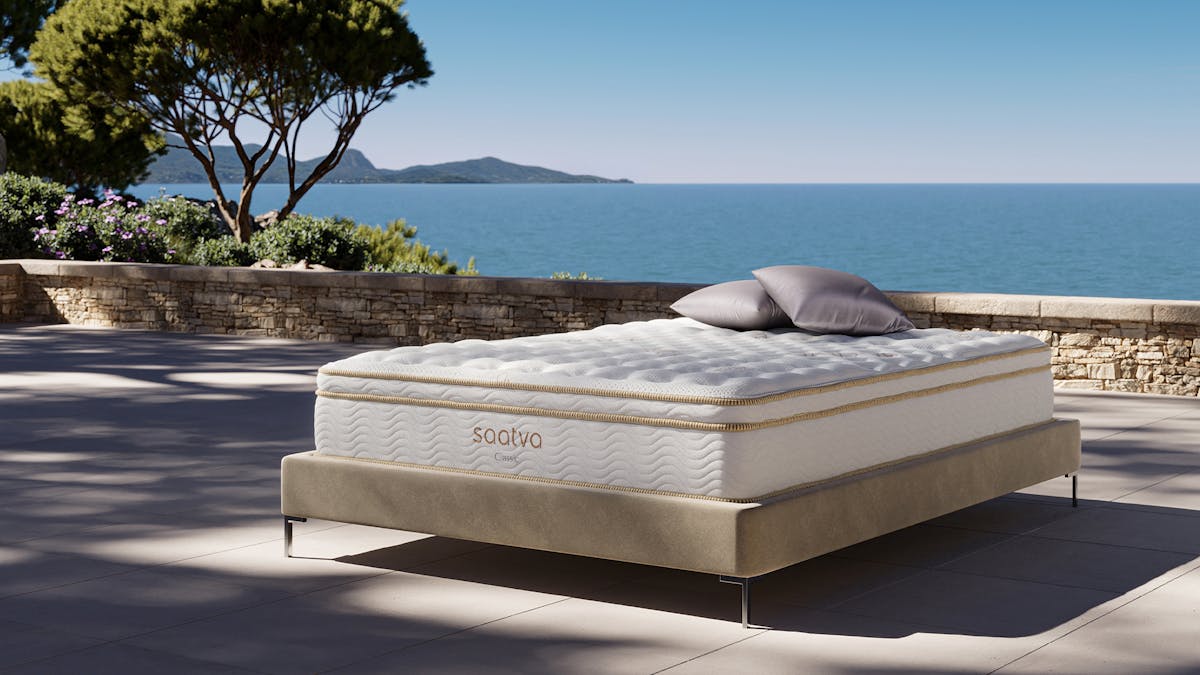
by Morning back stiffness is almost always a mattress support problem. The Saatva Classic (Luxury Firm) is our top pick: its dual-coil construction with a dedicated Lumbar Zone Quilting pad targets L3 to L5 directly, keeping the spine neutral overnight so you wake without that classic stiffness window. The Amerisleep AS3 is the best all-foam alternative, with HIVE 5-zone lumbar reinforcement and a 100-night trial.
Saatva Classic
9.2/10
- Lumbar Zone Quilting: denser foam pad sewn into the center third, supporting L3 to L5 directly where morning stiffness originates
- Dual-coil construction provides active push-back rather than passive foam compression
- Free white-glove delivery, setup and old-mattress removal included
- 365-night trial and lifetime warranty, chiropractor-endorsed design
- Heavy at approximately 110 lb queen, not compressed in a box
- $99 return fee if returned during the trial period
For morning back stiffness, the Saatva Classic in Luxury Firm is the most direct engineering answer: the lumbar zone pad targets the exact disc levels where overnight stiffness originates, and the dual-coil system provides responsive push-back that keeps the spine neutral through every position change.
Why morning stiffness is a mattress problem
Morning back stiffness is rarely just an aging issue. When you sleep, your spinal discs rehydrate, your paraspinal muscles relax, and your sacroiliac joints settle into whatever position your sleep surface dictates for 7 to 9 hours. If that surface fails to support the lumbar curve, the multifidus and erector spinae muscles spend the night contracting isometrically to hold the spine in alignment. You wake with lactic acid, joint capsule tightness, and fascial adhesions that produce that classic stiffness window before things loosen up.
A mattress that has lost its lumbar support, or never had it, is the single most common reversible cause of recurrent morning stiffness in adults. Replacing the surface resolves the problem within 14 nights in most cases. The two causes are identical mechanically: either the bed is too soft (pelvis sinks lower than the lumbar, creating a reverse arch) or too firm (lumbar gap is not bridged and the paraspinal muscles brace all night).
What specs actually prevent morning stiffness
| Feature | Target value | Why it matters |
|---|---|---|
| Zoned lumbar reinforcement | Yes | Prevents L3 to L5 sag during the night |
| Firmness | Medium to medium-firm, 5 to 7 out of 10 | Balances contour against the hips and shoulder support under the lumbar |
| Surface response speed | Quick-recovery foam or coils | Slow-response foam traps you in one position, maximising static loading |
| Edge support | Reinforced perimeter | Easier sit-to-stand transitions reduce morning disc compression |
| Mattress age | Under 8 years | A worn mattress loses 20 to 30 percent of support without visible sag |
The combination matters more than any single feature. A soft pillowtop on a solid support core still sags under the lumbar. A firm core under a flat quilted surface still leaves a gap under natural lordosis. You need zoned reinforcement under the lower back specifically, paired with quick-recovery materials that do not trap you in a single sleep position overnight.
How the top picks compare
| Mattress | Type | Firmness | Lumbar support | Trial | Queen price |
|---|---|---|---|---|---|
| Saatva Classic | Innerspring hybrid | Luxury Firm 6/10 | Excellent, Lumbar Zone Quilting | 365 nights | ~$1,395 |
| Amerisleep AS3 | All-foam (Bio-Pur) | Medium 5/10 | Excellent, HIVE 5-zone lumbar | 100 nights | From $1,049 |
| WinkBed | Hybrid Euro-top | Luxury Firm 6/10 | Very good, zoned + strong edge | 120 nights | ~$1,599 |
| Helix Midnight Luxe | Hybrid | Medium 6/10 | Very good, zoned lumbar | 100 nights | ~$1,874 |
| DreamCloud Premier | Hybrid | Medium-firm 6.5/10 | Good, strong edge support | 365 nights | ~$1,100 |
Common mistakes that make morning stiffness worse
The most frequent mistake is buying softer to chase comfort. A plush bed feels good for ten minutes and then lets the pelvis sink while the shoulders and feet stay propped, creating a hammock shape that loads the lumbar facet joints for hours. Going extra firm is the opposite error: it leaves a gap under the natural lordotic curve and forces the paraspinal muscles to splint the spine all night.
Mattress age is the silent culprit. A bed past 8 years has often lost 20 to 30 percent of its original support without any visible sag. Cheap memory foam toppers placed on a worn mattress amplify the existing dip rather than correcting it. Side sleepers using a thin pillow rotate the cervical spine, radiating tension down the entire posterior chain by morning.
Amerisleep AS3
8.9/10
- HIVE 5-zone support reinforces the lumbar zone (zone 3) where morning stiffness originates
- Plant-based Bio-Pur foam runs cooler than petroleum memory foam
- CertiPUR-US certified, GREENGUARD Gold, made in the USA
- Strong pressure relief and motion isolation for couples
- Softer edge support than a coil hybrid
- Sleepers over 230 lb may prefer the firmer AS5 Hybrid for better push-back
If you prefer foam over coils, the AS3 hits the medium sweet spot with active lumbar zoning via the HIVE system. The best all-foam option for morning stiffness, with a 100-night trial to confirm fit.
Sleep position and morning stiffness
Your sleep position shapes how much work the mattress has to do:
- Back sleeping: place a pillow under the knees, not under the lumbar. This flattens the natural curve into the surface and reduces disc pressure. Combined with a medium-firm mattress, back sleeping produces the best lumbar outcomes for morning stiffness.
- Side sleeping: draw the knees slightly toward the chest and use a pillow between them to keep the hips and spine level. A medium mattress works better than firm for side sleepers because the shoulder needs to compress.
- Stomach sleeping: increases lumbar lordosis and disc compression and is the worst position for morning stiffness. If unavoidable, place a flat pillow under the pelvis to reduce the lumbar arch.
Two small habits accelerate results regardless of position. First, do 90 seconds of supine knee-to-chest rocking before sitting up. This rehydrates the lumbar discs gradually rather than shocking them with immediate vertical loading. Second, avoid sitting on the edge of the bed for more than 30 seconds before standing.
How quickly will a new mattress help?
Most people report measurable improvement within 2 to 4 weeks of switching to the right mattress, with full adaptation closer to 12 weeks. If stiffness has not reduced by half after 4 to 6 weeks on a new medium-firm bed, the cause may be postural or may warrant medical evaluation. This is why trial windows of 100 nights or more matter: adaptation takes time, and a short trial window can cause premature returns of an actually appropriate bed.
For morning back stiffness, choose medium-firm with active lumbar zoning. The Saatva Classic in Luxury Firm is our top pick with dedicated Lumbar Zone Quilting and a 365-night trial. The Amerisleep AS3 is the best all-foam alternative with HIVE 5-zone support on a 100-night trial.
Frequently asked questions
Is a firm or soft mattress better for a stiff back in the morning?
Medium-firm, rated 5 to 7 out of 10, consistently outperforms both soft and extra-firm for morning back stiffness. Soft beds let the lumbar sag; extra-firm beds prevent the pelvis from settling, creating a lumbar gap that compresses the facet joints overnight.
Can your mattress cause stiffness every morning?
Yes. A worn mattress or one without lumbar zoning is one of the most common and most reversible causes of chronic morning stiffness. If your back feels worse after sleep and loosens up within 15 minutes of moving around, the mattress is almost certainly a contributing factor.
Memory foam or innerspring for morning stiffness?
Zoned construction matters more than material type. A coil hybrid with a lumbar pad like the Saatva Classic and a zoned all-foam mattress like the Amerisleep AS3 both perform well. Pick the feel you prefer: coils for responsiveness and edge support, foam for contouring and motion isolation.
How long is the adjustment period for a new mattress?
Allow at least 30 days and ideally 60 to 90. The body needs time to re-pattern around better spinal alignment. This is why trials of 100 nights or longer are worth prioritising when you are shopping for a stiff-back fix.
This guide is part of our Best Mattress for Pain Relief hub.