

 by
by I'll be honest with you. I hung my first set of breakfast nook curtains at 11 p.m. on a Tuesday, with a step stool propped against the bench and a half-drunk cup of tea going cold on the table. The brackets were crooked. The panels were an inch too long. And when I finally stepped back, the whole corner of the kitchen looked like someone had whispered a different frequency into the room. That was three years ago. I've hung eleven sets of curtains in that nook since then, and I'll tell you exactly which moves earned their place and which ones I'd skip if I were starting over.
Here's what it looked like before
It was the standard 2005 starter-home package. Sliding glass on one side, two small windows flanking the banquette, and the kind of corded vinyl blinds that go yellow at the corners by year three.
The walls were the beige that every builder in the country apparently buys by the pallet. There was a butcher-block table with two mismatched chairs and a wicker basket holding mail that nobody wanted to deal with. Morning light came in harsh and flat, and by five p.m. the nook felt like a waiting room.
I'd look at it over my coffee and feel nothing. That's the part nobody tells you about a bad nook. It's not that it looks terrible. It's that it gives you nothing back.
- Measured the curtain drop to table height
- Hung café curtains just below the apron
- Chose oatmeal linen to keep the glow
- Lined panels with washed cotton for softness
- Pinned cottage sheers with vintage sashes
- Layered sheers behind the linen pair
- Ran the rod wider than the window frame
- Threaded brass rings onto a slim pole
- Mounted tension rods inside the casing
- Tucked rattan holdbacks beside the pane
- Pulled back gingham tiers at lunchtime
- Swapped in striped ticking for mornings
- Steamed every pleat before hanging
- Hung a scalloped valance above the bench
- Let the linen puddle an inch on the floor
- Added a low-cost editorial move I didn't expect
1Measured the curtain drop to table height
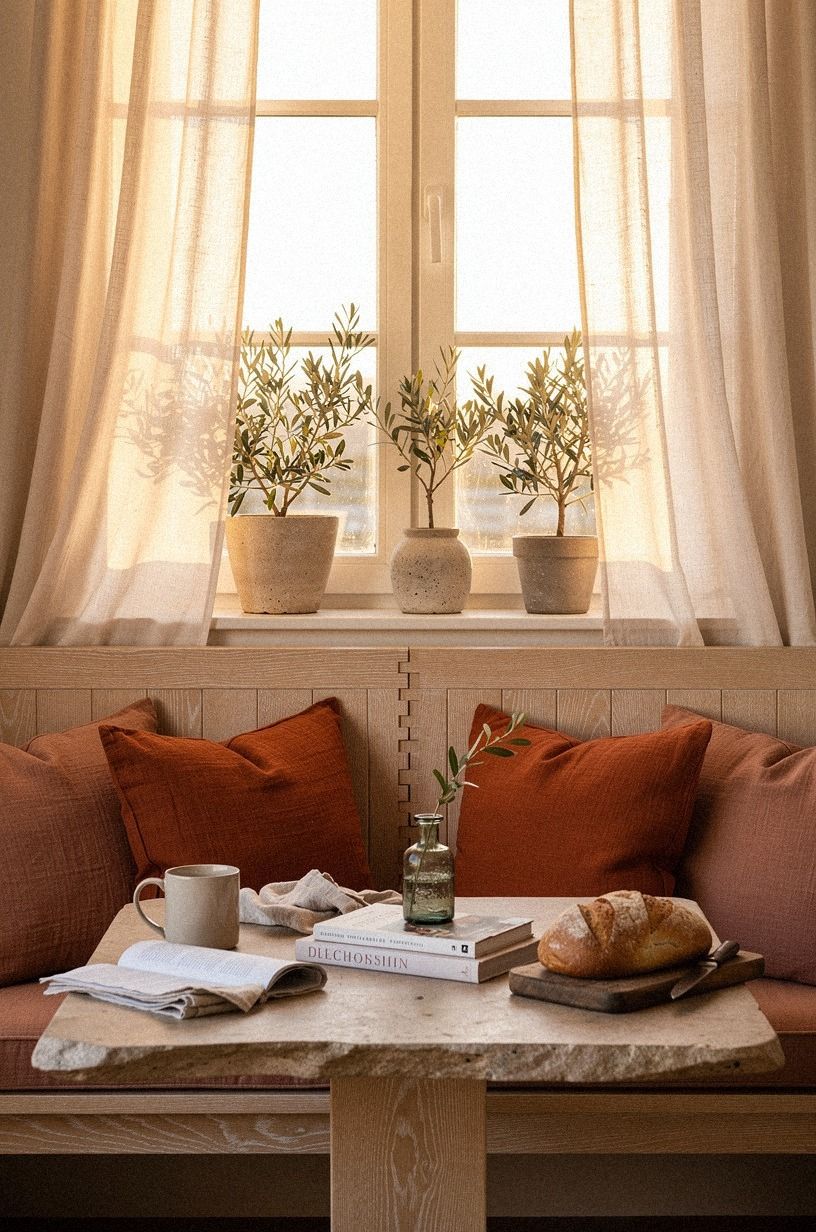
Before I bought anything, I dragged a tape measure from the rod position to the table surface and wrote the number on a sticky note: 42 inches. That's the magic dimension for café curtains.
Anything longer than 48 inches starts to eat your light, and anything shorter than 36 inches starts to feel like a valance pretending to be a curtain. I learned this the hard way with my first set, which I ordered at the standard 54-inch drop and then watched sweep the tabletop every time the kids sat down.
Café curtain drop at table height is the move, and once you commit to it, the rest of the design gets easier. If you're planning out the whole nook, my breakfast nook layout guide covers how the table height and curtain drop work together as one decision.
And before you commit to a fabric, peek at our modern breakfast nook ideas for the clean-lined look that pairs best with café curtains. If you're building the banquette itself, the built-in breakfast nook seating guide shows the cushion heights that line up with this drop.
2Hung café curtains just below the apron
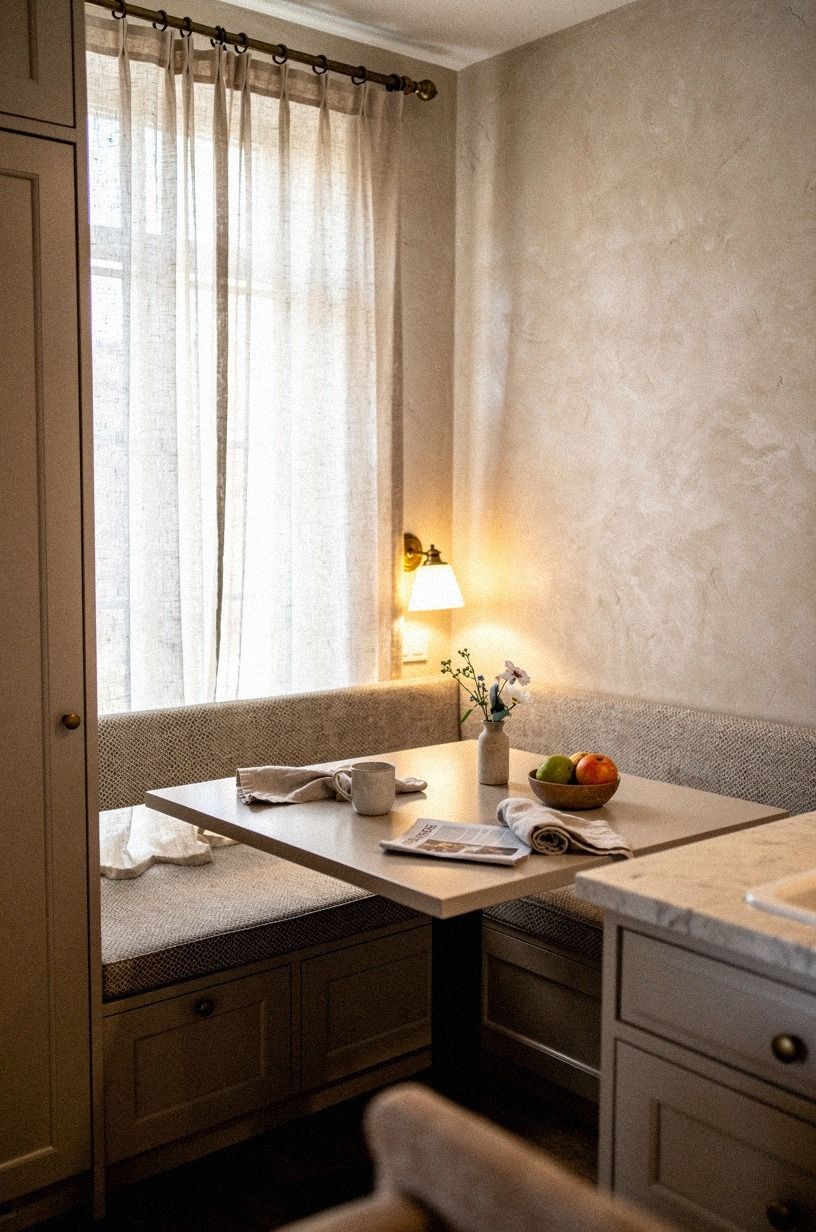
The apron of a curtain is the rod pocket itself, and mounting the rod so the apron sits a few inches below the window casing instead of above it changes everything.
3Chose oatmeal linen to keep the glow
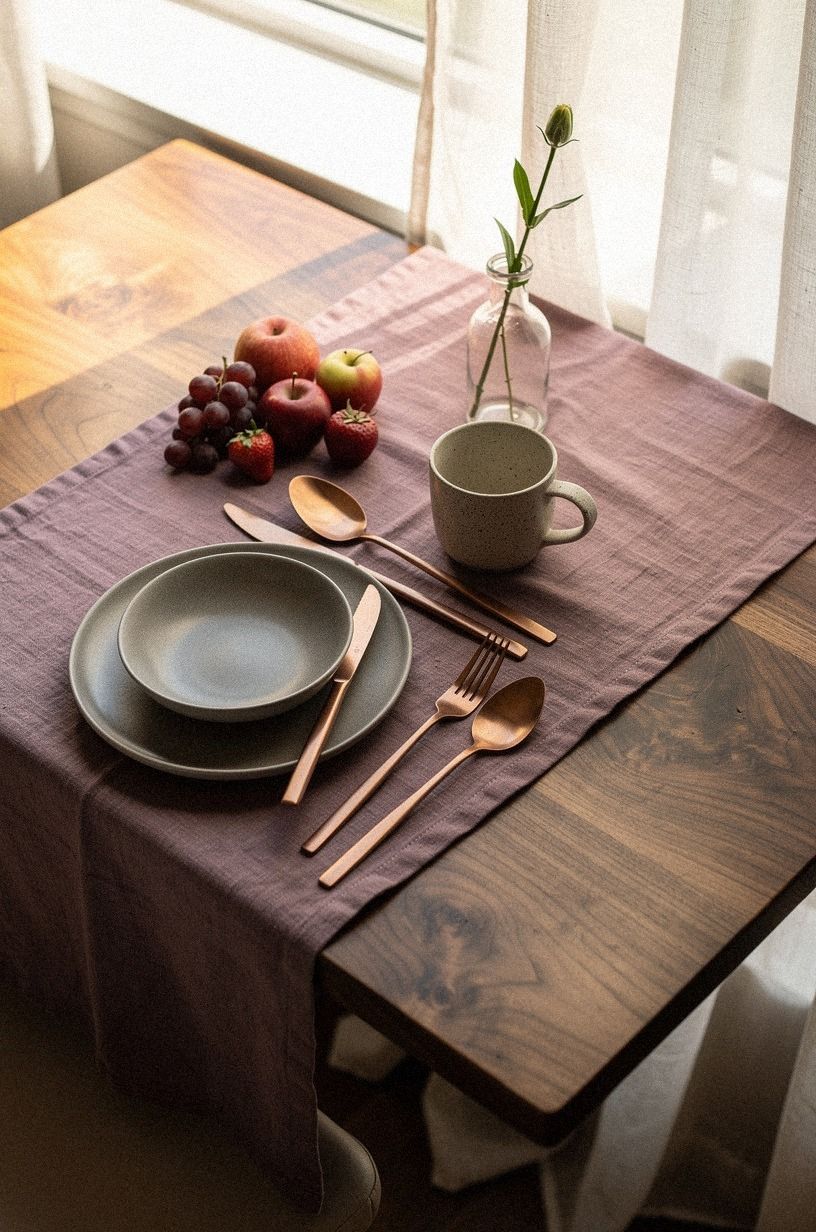
I'd been eyeing pure white panels for two years. They look crisp in a showroom.
In a real breakfast nook, they're a magnet for every coffee ring and jam smear in the house. I went with oatmeal Belgian flax linen instead, which reads as warm white from across the room but forgives the splatter that comes with actual breakfasts. The texture of the linen softens the light in a way cotton never does, and the natural slub of the weave catches the late-afternoon sun in a way that makes the whole nook glow. If you want to push it warmer, Farrow & Ball Joa's White on the walls behind the linen is an unbeatable pairing.
If you're going cooler, Benjamin Moore White Dove OC-17 holds up under the morning light and keeps the room from looking yellow. And if you want the warmest possible read, layer the linen against Sherwin-Williams Creamy SW 7012 and watch the nook turn buttery. Our coastal breakfast nook ideas show the linen-on-creamy palette in a sunlit corner if you want to see it before you commit.
4Lined panels with washed cotton for softness
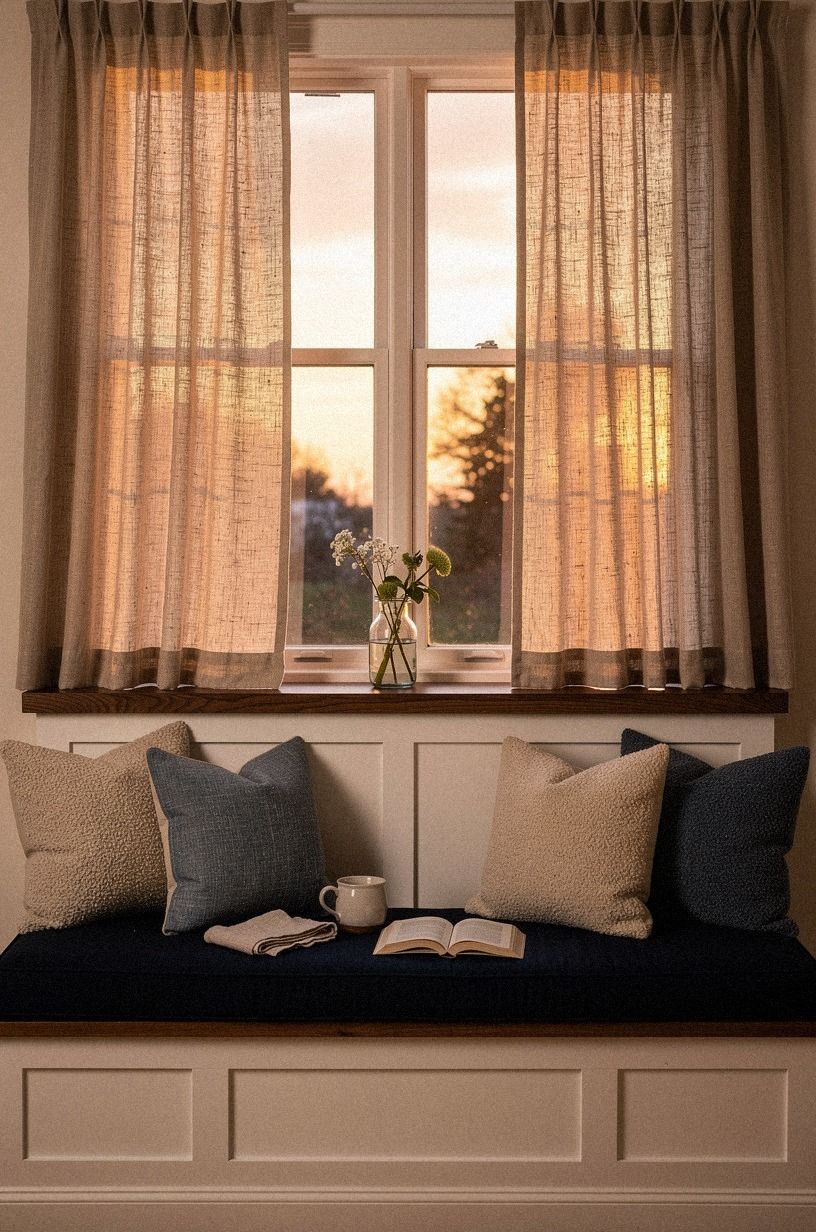
My first linen panels were unlined, and they looked gorgeous for about a week and a half.
5Pinned cottage sheers with vintage sashes
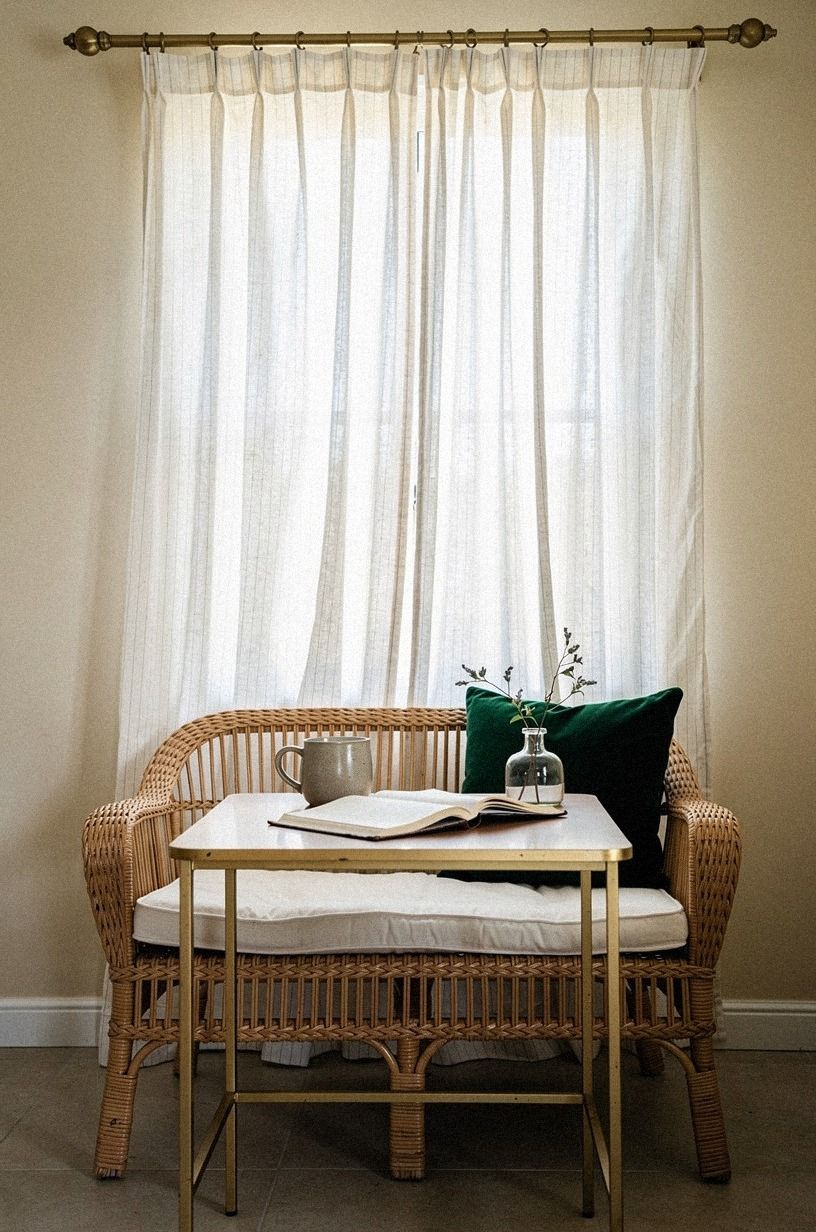
On the second window I wanted something softer, something that felt like an old family kitchen from a film. So I pinned vintage cotton sashes to the corners of a length of sheer cotton and let them tie the panels back at chair-rail height.
The sashes came from a bin at an estate sale, four for ten dollars. The sheers were a wide bolt of unbleached muslin from a fabric store, about nine dollars a yard.
The total for the window was under forty dollars. This is the kind of move that doesn't photograph as well as it looks in person, because it's the imperfections (a bow that won't sit straight, a sash that's slightly different than its pair) that make it feel real. I wouldn't try to perfect this look.
Lean into the unevenness. But if you want a cleaner read, you can swap the sashes for velvet ribbons in a deep moss green. And if the cottage mood is what pulled you in, my charming cottage breakfast nook ideas walk through the rest of that vocabulary across the rest of the room.
6Layered sheers behind the linen pair
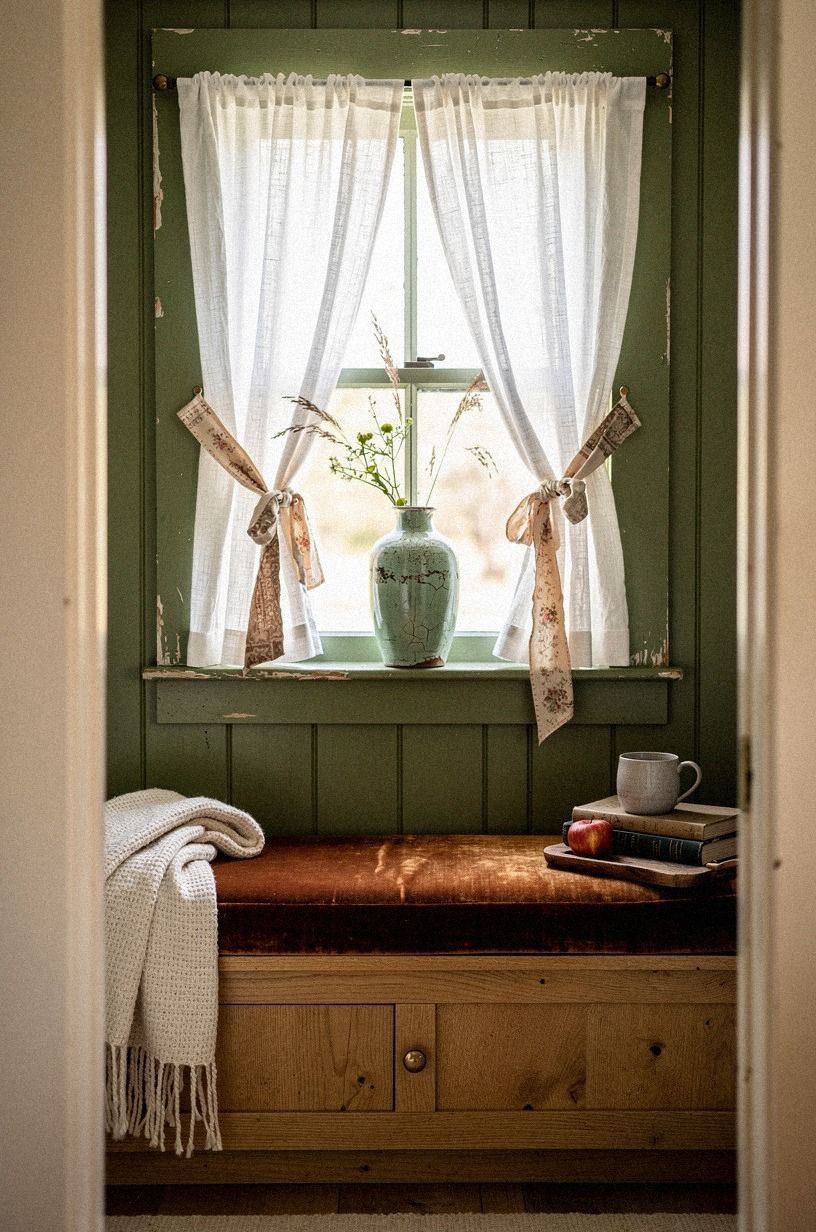
On the third window I committed to the layered look. The sheers sit closest to the glass.
The linen café panels sit about four inches forward on a second rod. When the sun comes through, you get the diffusion of the muslin first and the warm filter of the linen second, and the whole window starts to look like it has its own weather system.
I used a double-rod bracket from Amazon, the cheap kind, and threaded both rods in under ten minutes. The rule here is to keep the back layer sheers (so the front layer still gets most of the light) and to let the back layer puddle half an inch longer than the front.
If you're working with a really small window, our small breakfast nook ideas break down how to layer without crowding. A second sheer panel in ivory keeps the back layer from looking like a separate room, which is the mistake I made the first time around.
7Ran the rod wider than the window frame
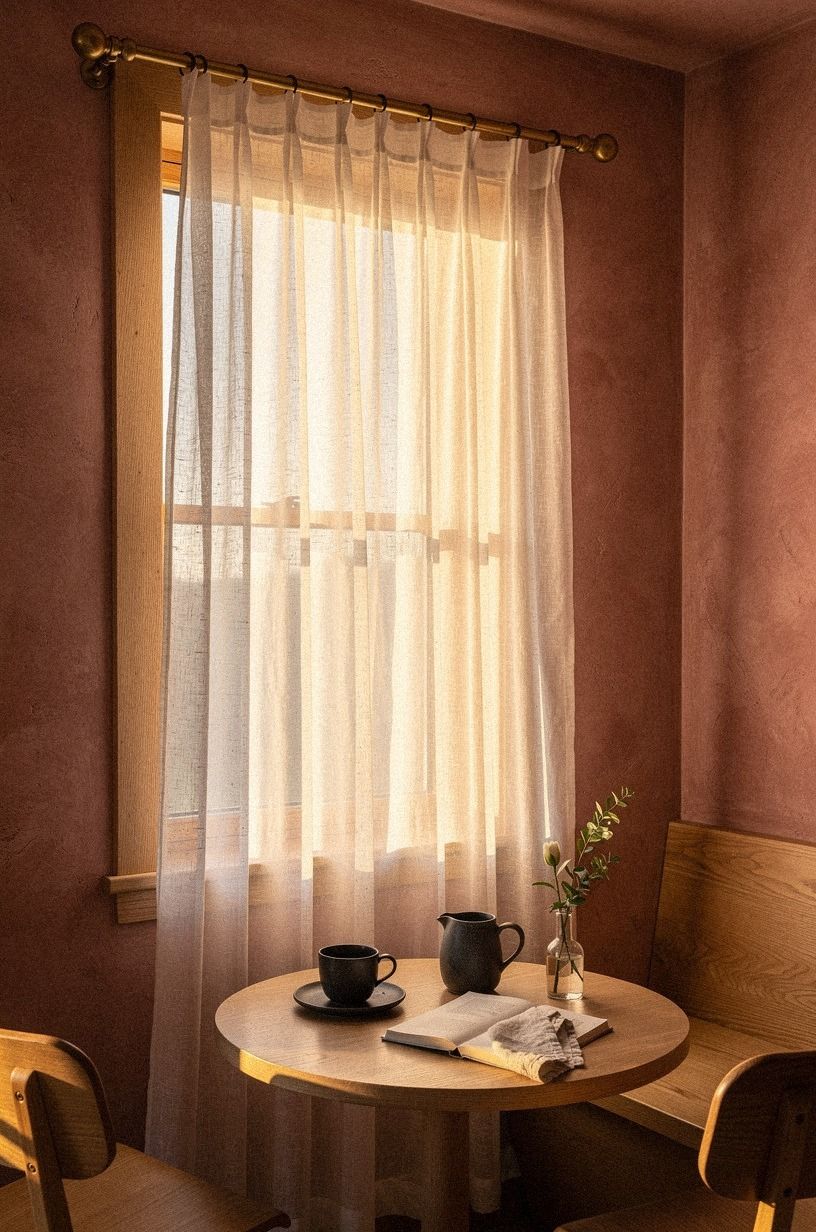
This one is free, and it's the difference between curtains that look like they were thought about and curtains that look like they were hung by someone in a hurry.
8Threaded brass rings onto a slim pole
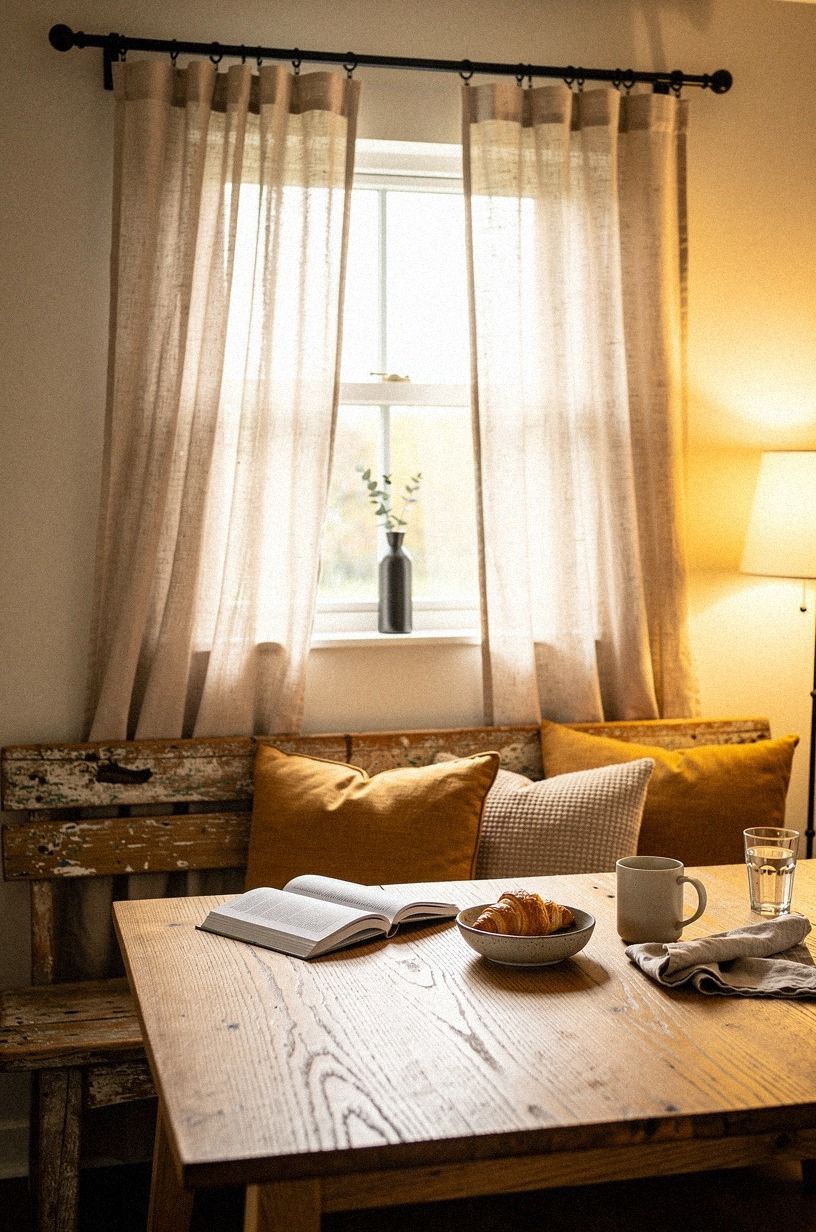
For the fourth window I went moodier. A slim unlacquered brass pole with matching rings and a finial on each end, threaded through the top of the linen panels, then clipped in with brass hooks. The brass is going to patina over the next two years, and that's the whole point. Polished brass looks like a hotel.
Unlacquered brass looks like someone's home. I sourced the pole from Rejuvenation during a sale and the rings separately, which is a tip worth knowing: their kits are priced for convenience, and the individual components are about forty percent cheaper. The total for the hardware was around ninety dollars.
And here's the thing about brass, it only gets better with time! If you want the patina to start sooner, wipe the pole with a paper towel dampened in white vinegar, leave it for twenty minutes, then buff. Skip the lacquer the manufacturer wants to sell you. Lacquer is the enemy of patina.
Rejuvenation's unlacquered brass line is the best US source I know for this exact look, and the price-per-component beats the kit.

9Mounted tension rods inside the casing
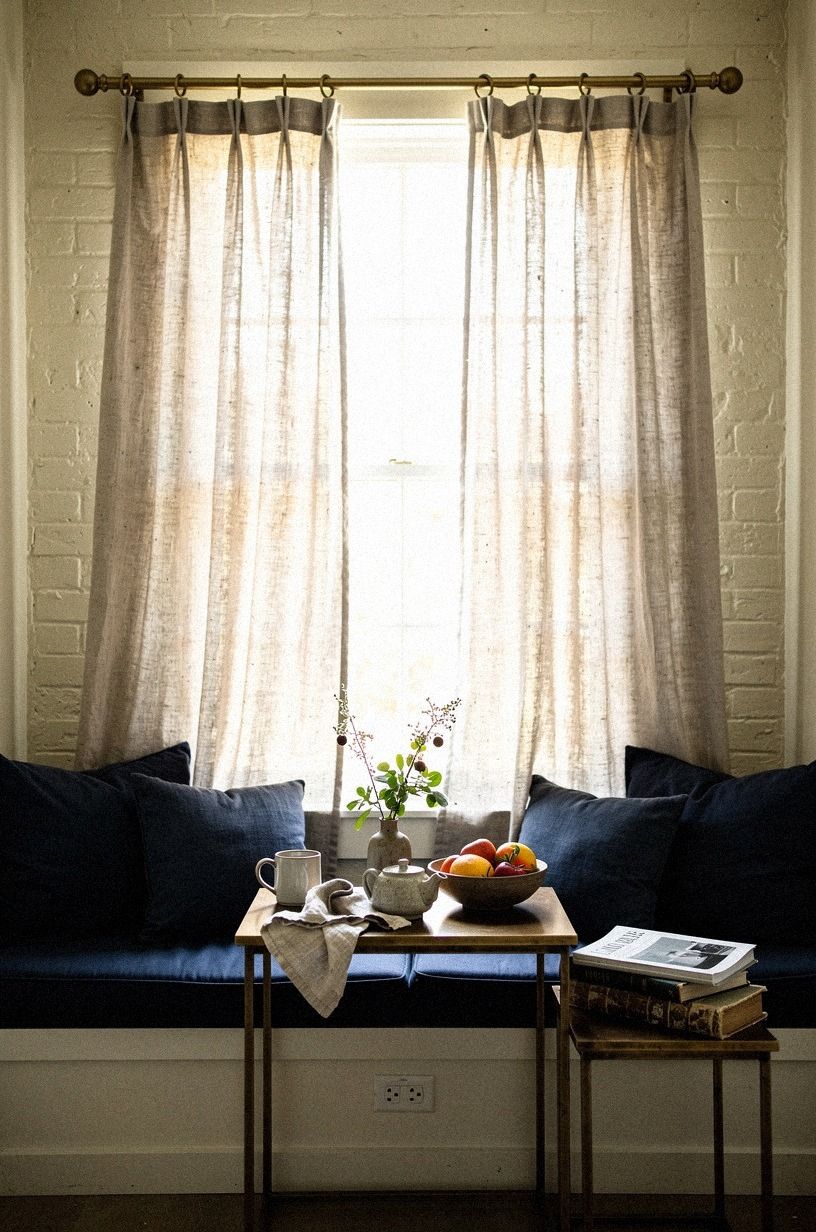
On the smallest window, a 22-inch basement slider, I didn't want to put any holes in the casing.
10Tucked rattan holdbacks beside the pane
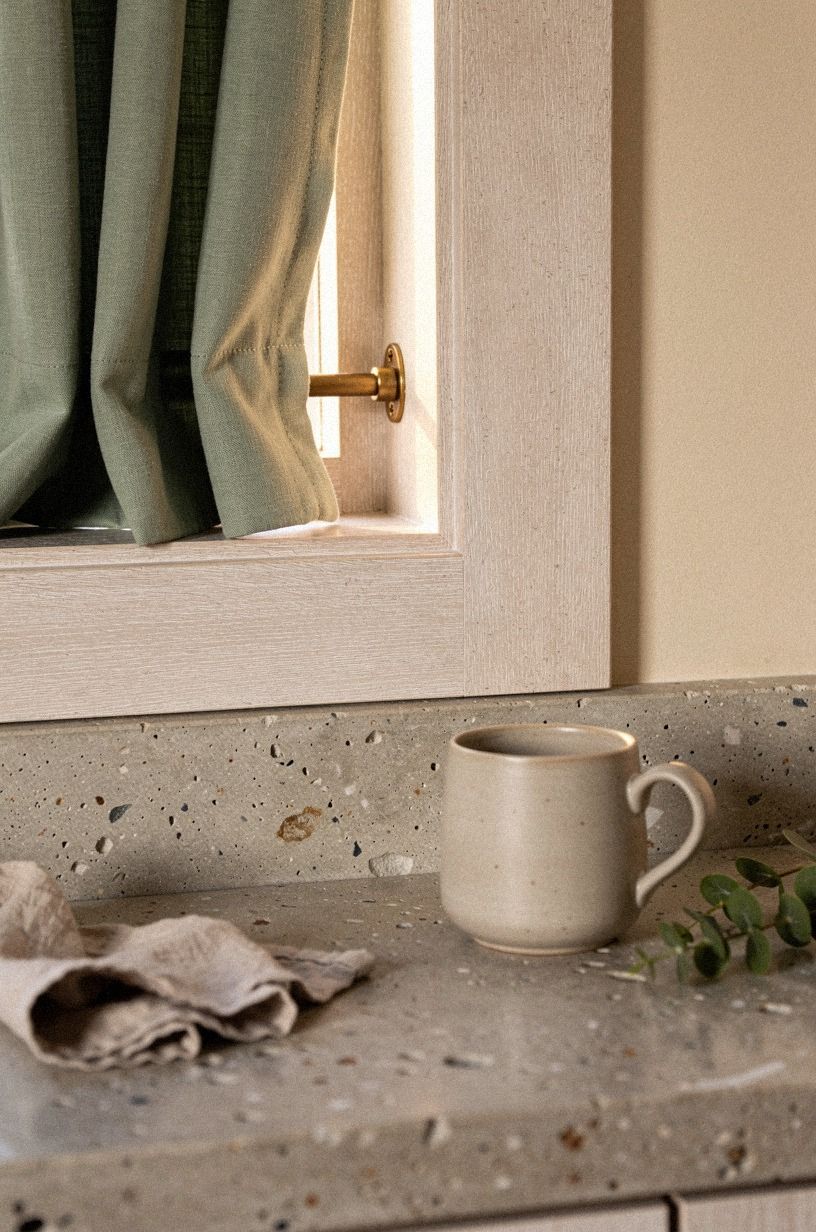
This is the detail that makes the nook look finished. Rattan holdbacks, one on each side of the window, hooked onto the rod and the panels tucked behind them.
The panels stay open all day, the rattan catches the morning light, and the whole window has a finished edge that ties it back to the bench cushion and the table base. I found mine on Etsy for about twenty-five dollars a pair from a small Portuguese seller.
The patina on natural rattan deepens over time, which is the right kind of aging for a nook that's being used day in and day out. If you want a slightly more polished version, CB2 does a brass holdback that's almost identical in feel but about three times the price. And if you want the cottage-core read, a woven seagrass tieback ties in with the rest of a country kitchen without competing with the curtain fabric. For the wider pattern of nook styling, my breakfast nook decor ideas cover the rest of the corner.
Holdbacks are the detail designers notice first and friends never name. They make the window look intentional in two seconds.
11Pulled back gingham tiers at lunchtime
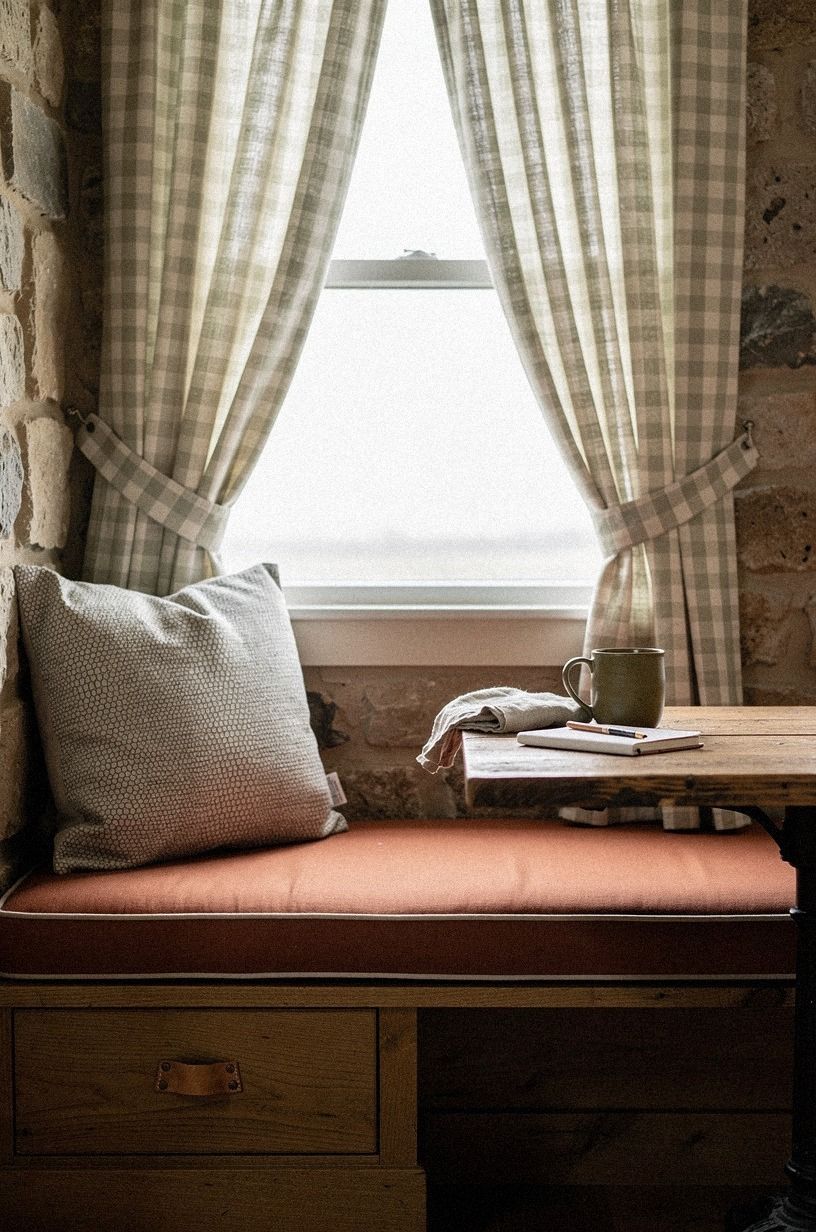
For the weekend mornings when I want the nook to feel like a different room, I swap in a pair of gingham cotton tiers in a faded blue and white. They go up in about two minutes because the rod and rings are already there, and they make the nook feel like a country kitchen that just happens to be in a 1970s ranch.
The gingham is from Target's Threshold line, around twenty-eight dollars a panel, and it washes better than any of my linen panels. This is the curtain for the days you want the room to do the styling work for you.
Pair them with a creamy ceramic pitcher of orange juice on the table and you've got a still life. If you're leaning further into the cottage-core vibe, our cozy cottage kitchen cabinet curtain ideas match this aesthetic perfectly across the rest of the room.
And if you want to extend the mood to the whole kitchen, my kitchen cabinet curtain ideas for a cozy cottage look cover the lower cabinets too.
12Swapped in striped ticking for mornings
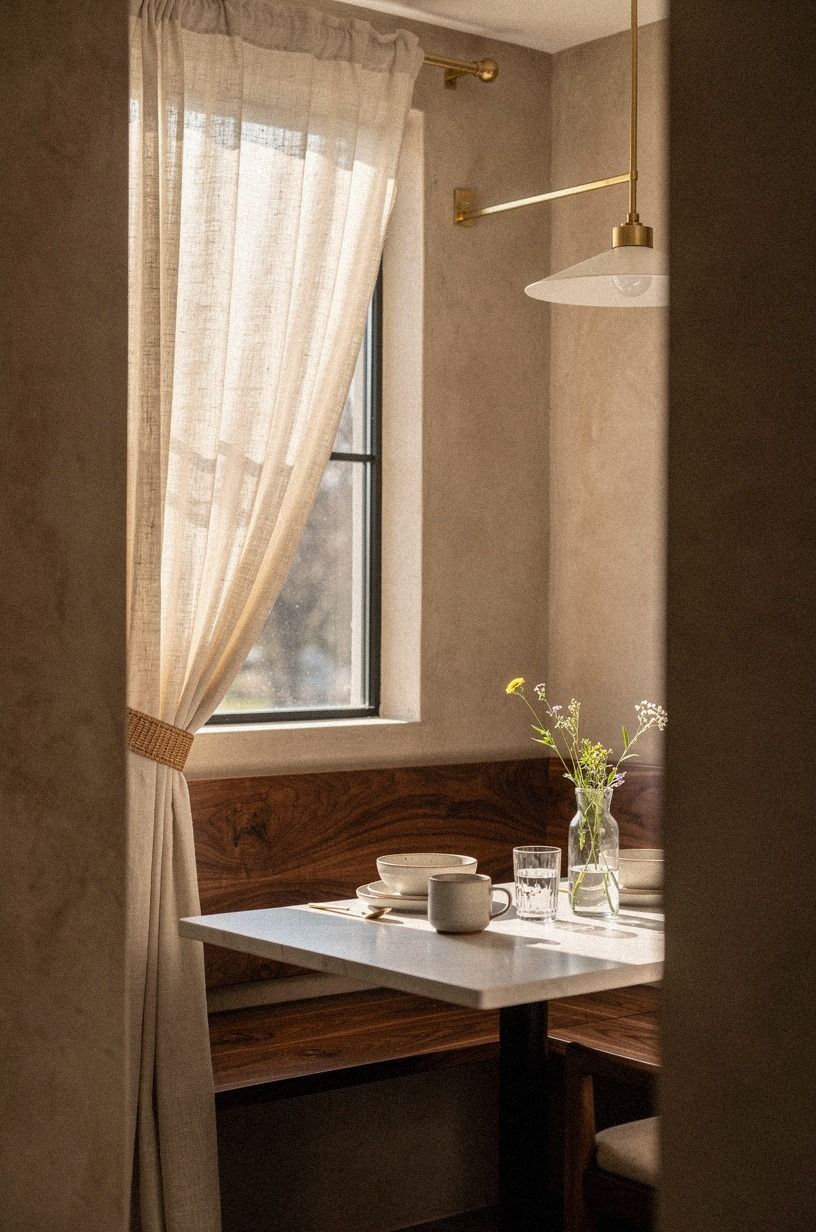
Striped ticking curtain panels in a soft navy and ivory are the morning version of the gingham tiers.
13Steamed every pleat before hanging
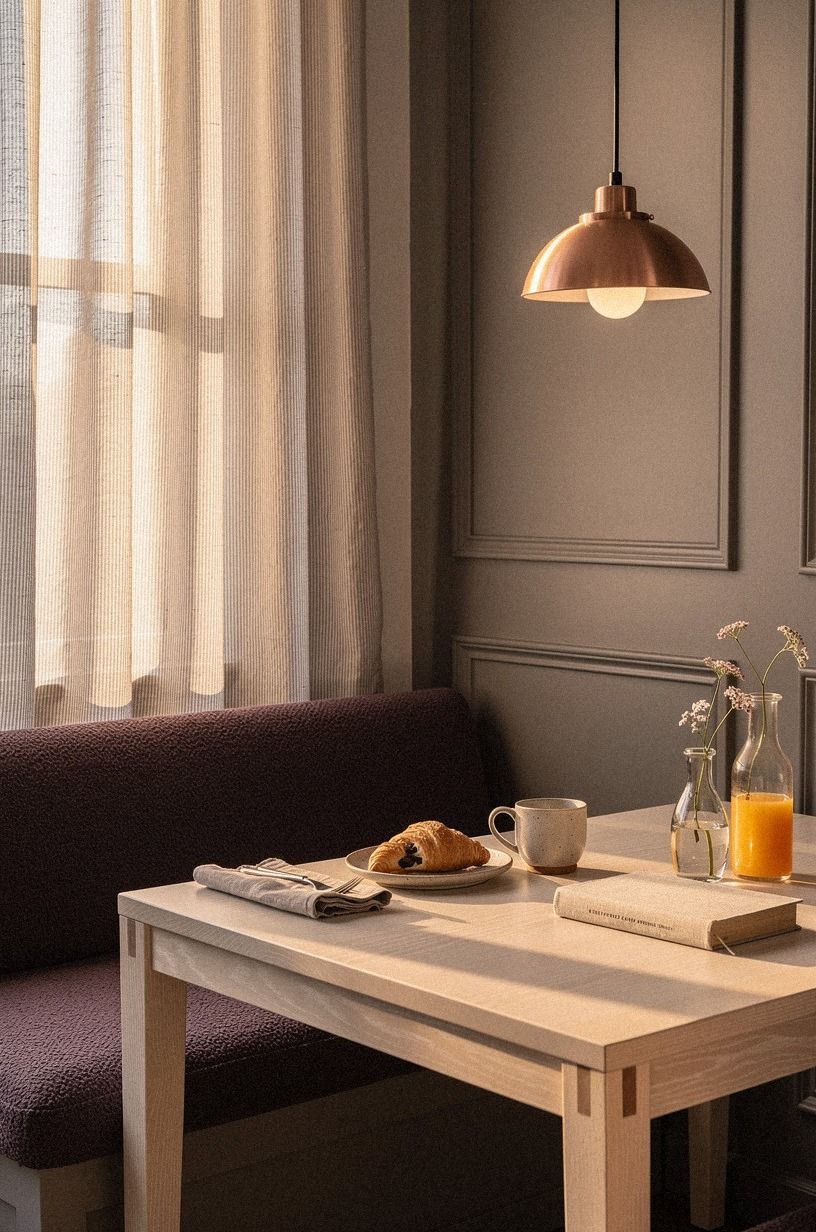
This is the unglamorous move that separates curtains that look expensive from curtains that look hung-by-a-renter. I pull the panels out of the dryer ten minutes early (or steam them if they're linen), and I press every pleat flat with my fingers before sliding them onto the rings.
The whole job takes maybe eight minutes for two panels. The payoff is that the curtains hang evenly from day one instead of taking a season to relax into shape.
If you're working with linen (and you should be), a handheld steamer is worth the thirty dollars. Skip the iron unless you want a pressed look that linen is specifically designed not to have.
A Conair ExtremeSteam at about $35 has lasted me five years and works on everything from linen to velvet to the gingham tiers. The bigger mistake people make is hanging curtains that have been folded in a package for a month.
The creases set, the panels never drop right, and you spend the next year telling yourself the nook looks "fine" when it actually looks wrinkled. Steam first. Hang second. Tell me later.
14Hung a scalloped valance above the bench
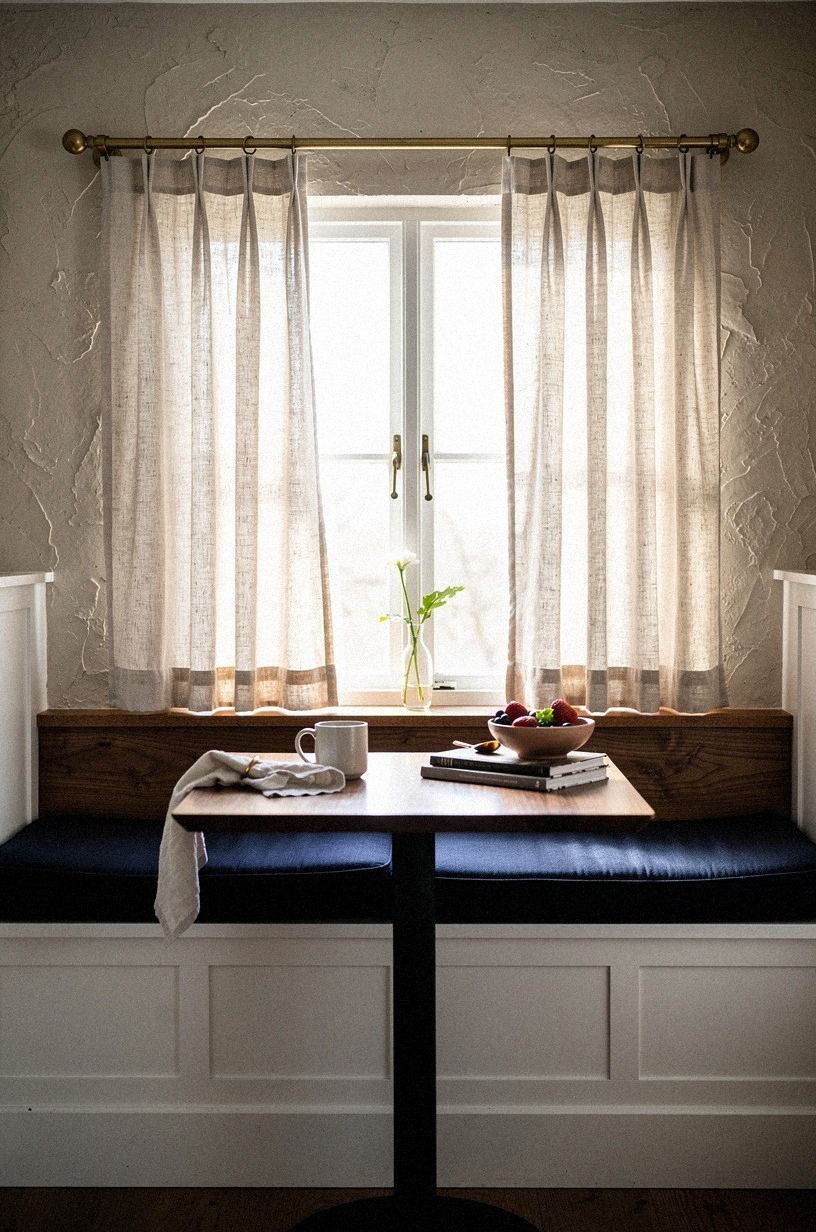
I was on the fence about the scalloped valance for two years, and I was wrong to wait.
15Let the linen puddle an inch on the floor
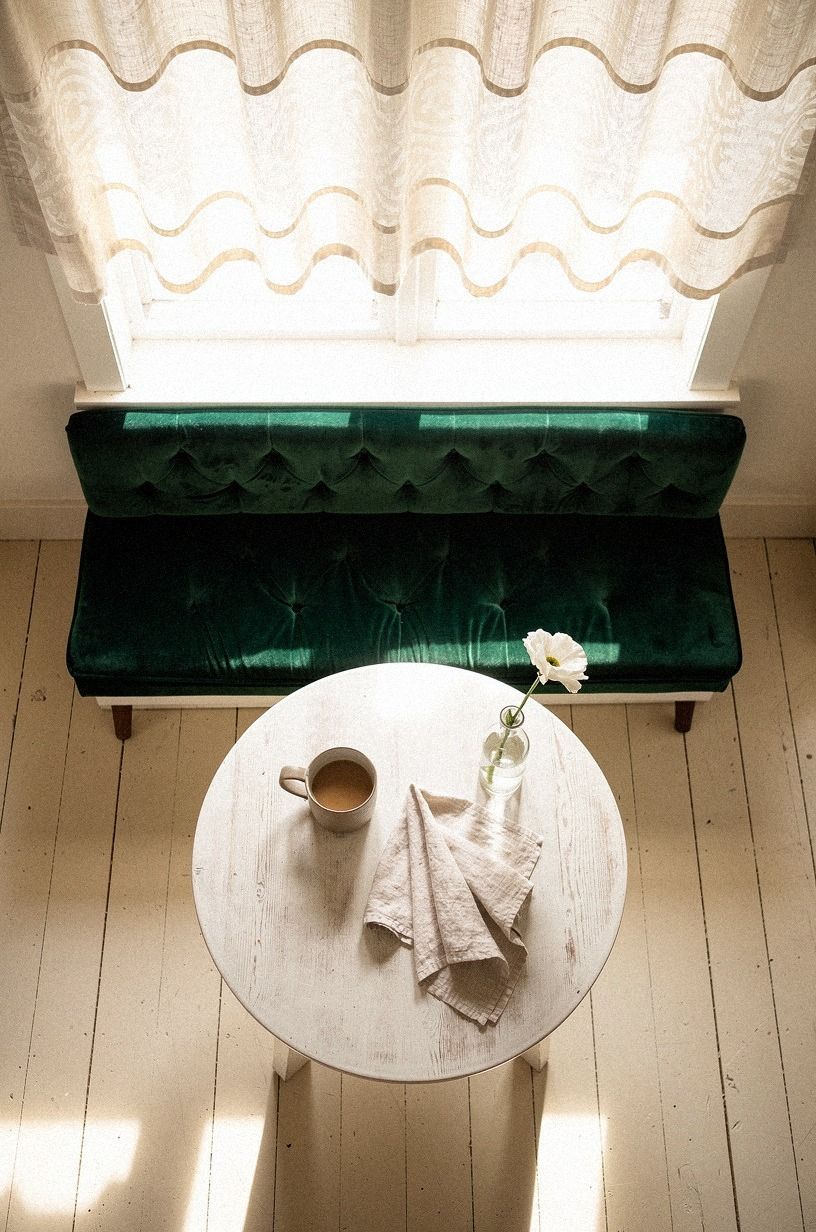
For the long window behind the table (the one that runs almost floor-to-ceiling), I switched to full-length linen panels that puddle an inch on the floor. This is a different aesthetic than café curtains.
It's softer, more romantic, and it changes how the room reads from the rest of the kitchen. The puddling isn't a mistake. It's a deliberate decision to let the fabric relax, which is what linen wants to do anyway.
The rule of thumb is to order four to six extra inches of length so you have the puddle without it looking like the curtains are too long. I've had friends ask if I hired someone to hang these.
I didn't. I just let them be a little messy.
And you should too, because perfect looks staged, and staged looks cold! For the full-room read on this palette, my large breakfast nook ideas show how puddled linen behaves in a bigger footprint.
If your nook is small, skip this move and stay with the café drop. Puddling wants at least eight feet of ceiling height to read right.
16Added a low-cost editorial move I didn't expect
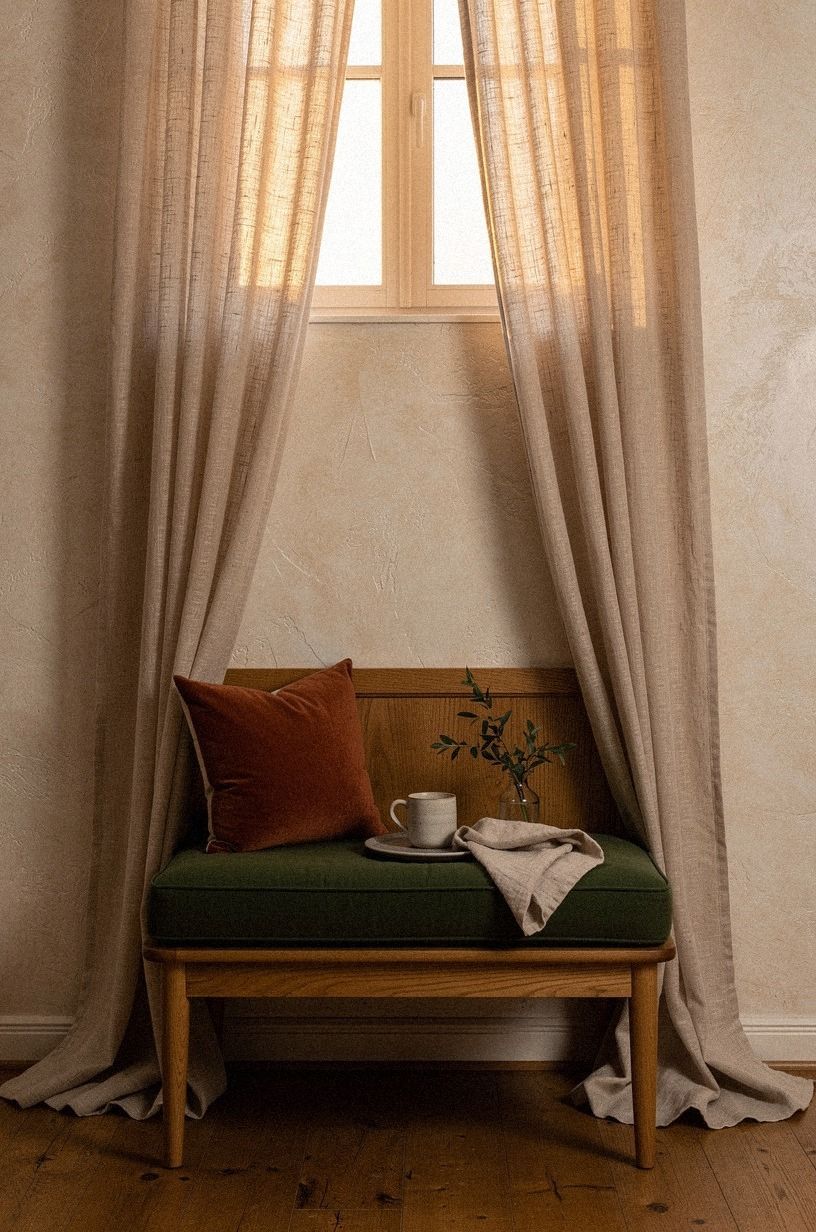
The last move wasn't on my list at all. I bought a pair of drop cloth cotton panels from the hardware store, washed them twice to soften them up, and hung them on the kitchen window opposite the nook.
They aren't in the nook proper, but they're the visual bridge between the nook and the rest of the kitchen, and they're the reason the nook no longer feels like a feature that's been staged. Total cost was fourteen dollars.
This is the move I'd tell every friend to start with. Don't buy designer curtains until you've lived with a set of $14 drop cloths for a month and decided what you want the nook to feel like.
For more styling moves beyond the windows, our cozy breakfast nook decor ideas walk through the rest of the corner. And if you're sketching the whole room from scratch, the banquette vs. booth breakfast nook guide is the right next read, because the curtain choice depends on whether you're sitting on a bench or in a booth.
The Two-Tier Rule That Held Everything Together
After eleven sets of panels, two rods per window, and enough hardware to outfit a small hotel, the move that changed how the nook works is what I call the Two-Tier Rule. A short café curtain for everyday privacy and a full-length panel on a second rod behind it for evenings and weekends.
The café curtain does the work ninety percent of the time. The full panel comes out when you want the room to feel like a different room, or when you want to block a streetlight, or when you want to host a dinner and let the nook be the soft, glowing backdrop.
Two rods. Two fabrics.
One window. It's the only curtain system I'd recommend without hesitation.
And if you want to push the soft glow even further, swap the bulbs above the table for warm 2700K dimmable LEDs and add an amber glass pendant at 30 inches above the surface.
Here's why I think this works when simpler setups don't. A single curtain has to do too many jobs at once: filter the morning light, give you privacy at night, soften the edges of the window, dress the room for company, and disappear when you want the view.
No fabric does all five well. So you end up compromising on at least three. The two-tier setup splits those jobs across two fabrics, and each one only has to do what it's best at.
The oatmeal linen café tier handles privacy, edge softening, and everyday dressing. The sheer back panel handles light filtering and disappears when you pull it open. The full-length panel puddle handles the dinner-party version of the room. None of them has to do everything.
The other thing I learned the hard way. Don't try to make the second tier invisible. The whole point of having two layers is that you can see both at once, in the morning, when the room looks like it's wearing two textures of the same color. A friend came over last spring and said the nook looked like it had weather.
That's the move. Sheer behind linen. Café in front.
Matte black hardware holding it all up. It's the only curtain formula I'd bet on without a backup plan.
Café curtains vs full-length panels: which actually wins?
It depends on what you're asking the curtain to do, and this is the question most curtain guides skip. Café curtains win on everyday livability.
They stay out of the way of the bench, the kids can't grab them, the cat can't claw them, and they don't pretend the window is bigger than it is. They cost less per panel, wash easier, and you can swap them seasonally without thinking about it. They lose on drama.
A café curtain will never make the nook feel like a film set. Full-length linen panels win on mood.
They pool on the floor, they filter the light like nobody's business, and they make the nook feel like a different room at dinner. They lose on livability.
Kids, cats, vacuum cleaners, all of them are now negotiating with three yards of fabric per window. The honest answer is the Two-Tier Rule, which gives you the everyday livability of café curtains plus the option to drop the full panel for the dinner party.
Two systems, two fabrics, one window. For the layout side of that decision, the breakfast nook bench vs. chairs guide covers which seating lets you actually use full-length panels without dragging them into the floor every meal.
Why does linen glow when other fabrics don't?
It's the slub in the weave, and it's the only thing cotton can't fake. Linen is made from flax fibers that aren't perfectly uniform. The yarn has thick and thin sections along its length, and when the yarn is woven, those variations create a slightly uneven surface.
Light hits that uneven surface and scatters instead of reflecting cleanly, which is why a linen panel reads as a soft warm glow instead of a flat plane. Cotton fibers are more uniform, so the weave is more even, so the light reflects as a single temperature.
That's why cotton curtains look "crisp" and linen curtains look "glowy." Belgian flax linen specifically has a longer fiber than most linen, which means more slub, which means more glow. If you want the effect but cheaper, look for a linen-cotton blend in a 60/40 ratio.
You'll lose some slub but keep most of the soft fall. And if you want the glow without the cost, hang a sheer cotton panel behind a heavier linen one and let the back layer do the diffusion work.
Same physics, different price. For the deeper reading on linen care, the mid-century modern breakfast nook ideas guide has the matching wood tones that pair with the glow.
How much it cost
I'm going to break this down by window because the costs varied wildly, and that's the honest version.
The grand total across five windows, including rods, brackets, and labor I did myself: about $560 over three years. Not all at once.
Not in one weekend. A window at a time, when the mood struck.
If I'd hired a professional to install everything in a single weekend, I'd estimate another $300 to $500 in labor for a job that took me about six hours total. That's well under what a single set of custom designer curtains costs, and I have five windows done.
For reference, here's the broader cost tier for the kind of room I was building out:
The Questions I Get Asked Most
What is the best breakfast nook curtain for a soft cozy look on a small budget?
Belgian flax linen in oatmeal is the move. It looks twice as expensive as it is, it softens any window, and a pair runs about $80 to $150 depending on the drop. Skip the polyester blends.
They don't drape the same way and they hold every wrinkle in the package. For more ways to style the corner, our decor ideas to cozy up your corner cover the rest of the nook.
And if you're shopping on a tight number, the cozy breakfast nook ideas on a budget guide has the under-$100 moves that pair with this fabric.
Where can I buy breakfast nook curtains on a budget?
IKEA is the starting point, especially the LILL and DYTÅG lines in natural colorways. Target Threshold has surprisingly good gingham and ticking tiers under $30 a panel.
Wayfair carries deeper selections if you can filter past the noise. And don't skip Facebook Marketplace and local estate sales.
I paid ten dollars for four vintage sashes that would have been forty on Etsy. For more small-space curtain moves, our small breakfast nook ideas dig into the layout side.
How much does a breakfast nook curtain makeover cost?
About $100 to $300 per window if you do it yourself, and $400 to $800 per window if you hire a pro to measure, install, and style. The biggest variables are fabric choice (cotton $30-$80 per panel vs linen $80-$200) and hardware (basic black $20 vs brass or custom $80-$200).
I did five windows for about $560 over three years doing everything myself. For the deeper breakdown of where the money goes, my cozy breakfast nook ideas on a budget guide has the same logic applied to a chicken coop, weirdly useful as a line-item reference!
Can I create a cozy breakfast nook curtain look on a budget?
Yes. Three free or cheap moves to start with: (1) drop cloth panels from the hardware store, $14 each, washed twice for softness; (2) matte black tension rods mounted inside the casing, no holes, $12 a pair; (3) estate-sale sashes for tiebacks, often $5-$10 for a set of four. That's a complete look for under $50 a window.
For more budget layering moves across the whole room, our charming cottage breakfast nook ideas walk through the materials that look collected without costing much.
Is a breakfast nook curtain worth it in a small space?
Worth it, and the truth is small spaces benefit more than large ones. A small nook with café curtains at table height feels intentional and layered, where the same curtains in a big dining room can feel skimpy.
The key is to match the curtain drop to the table height (around 42 inches for standard counter and 36 for standard dining) so the proportions work. If you're designing around a sunny corner, our sunroom breakfast nook ideas pair beautifully with sheer linen panels.
And if the nook itself is tight, the 15 small breakfast nook ideas guide covers layouts that make room for café curtains without crowding the bench.
Are curtains a good idea for a rental breakfast nook?
Perfect for a rental. Tension rods, peel-and-stick brackets, and Command strip hooks for valances all come off cleanly when you move.
I lived in my last rental for six years and the casing still looked brand new when I moved out. If you want to push it, café curtains hung just below the apron leave zero holes in the wall above the window, which is the part landlords notice first.
For more renter-safe moves across the whole nook, the apartment breakfast nook ideas guide is the right read.
The One I'd Do Tonight
If I had to pick one, I'd start with oatmeal linen café curtains at table height, hung on a rod ten inches wider than the window. Get the café curtains right and the nook does its own work. Everything else is polish.