
 by
by I've watched two outdoor countertops fail. The first was a poured concrete slab at a rental I had in 2019. It looked gorgeous for one summer, then it crazed, stained red where a margarita pitcher lived, and the freeze-thaw cracked one corner off by December. The second was a tile job I did with bargain ceramic. The grout turned green by July and a single dropped cast-iron pan chipped two tiles. Both of those would have been fine indoors. Outside, a countertop has to take sun, wine, salt, knives, weather, and your in-laws leaning on it, and it can't get weird about any of it.
So no, "what's the prettiest slab?" is the wrong question. The right one is "what's going to look like it belongs here in year three?" That's what we're comparing.
Real materials, real costs, real weather, and the ones I'd pick again if it were my patio. Quick answer up front so you don't have to dig: a granite or porcelain slab in the $60 to $120 per square foot range handles almost every climate and stays easy to live with, but the "best" one depends on whether you're in Arizona, coastal Maine, or a fourth-floor balcony in Chicago.
If you're planning the full zone from framing to lighting, my outdoor kitchen layout ideas L-shape U-shape more guide pairs well with this one, and the outdoor kitchen lighting ideas for evening cookouts piece covers the bulb side. For a coastal take, my coastal outdoor kitchen ideas for breezy beach house vibes rounds out the softer palette, and if you're planning an al fresco dinner spot, my how to host a cozy backyard dinner party piece lays out the table side.
- anchor the layout with oversized-chip terrazzo
- upgrade to hand-applied Venetian plaster for a warm, old-world line
- swap to a warm-white counter with shagreen accents for the cook-and-clean crowd
- layer two materials with washed Belgian linen at the cooking and serving zones
- float an organic bouclé counter for that poured-in-place look
- build around Nero Marquina black marble if you want pattern and grip
- The Two-Zone Rule for hot and cold surfaces
- Instead of marble, try Carrara marble with subtle grey veining for the quiet read
- stack reclaimed weathered teak in covered zones only
- anchor a small space with a single Calacatta marble island
- Frame the grill with a cerused white oak apron for an old-world read
- The Drainage Groove move that saves the cabinets
- swap to book-matched walnut for a dark, soft, weatherproof finish
- lay warm travertine on the backsplash even if the counter is plain
- build a mobile cart counter with unlacquered brass hardware for renters and small patios
1anchor the layout with oversized-chip terrazzo
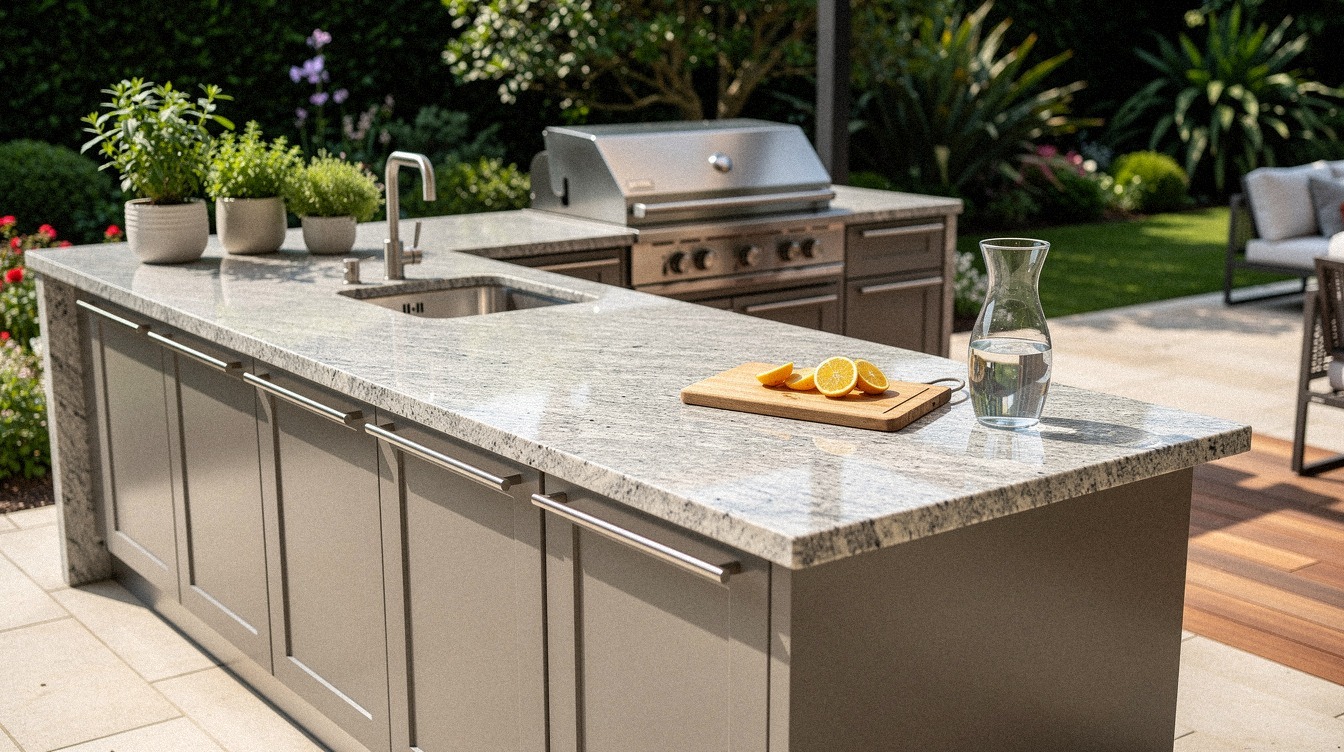
Oversized-chip terrazzo is the move if you want a surface that quietly disappears into the space instead of announcing itself. The matte, aggregate-rich finish doesn't glare in afternoon sun the way a polished slab does, which matters more than you'd think when you're staring at the counter for two hours while a grill preheats.
Terrazzo takes a hot pan off the grate without you flinching, brushes off salt spray, and a quick reseal every couple of years keeps wine from sinking in. The cost lands roughly between $60 and $120 per square foot installed, which puts it in mid-tier territory.
I'd skip the high-gloss polished terrazzo in full sun, it shows every fingerprint and water spot. The stone chips read beautifully against a forest green, rust, and natural oak palette, and for a softer coastal feel, my coastal outdoor kitchen ideas for breezy beach house vibes piece shows how a terrazzo surface plays against weather-worn teak.
2upgrade to hand-applied Venetian plaster for a warm, old-world line
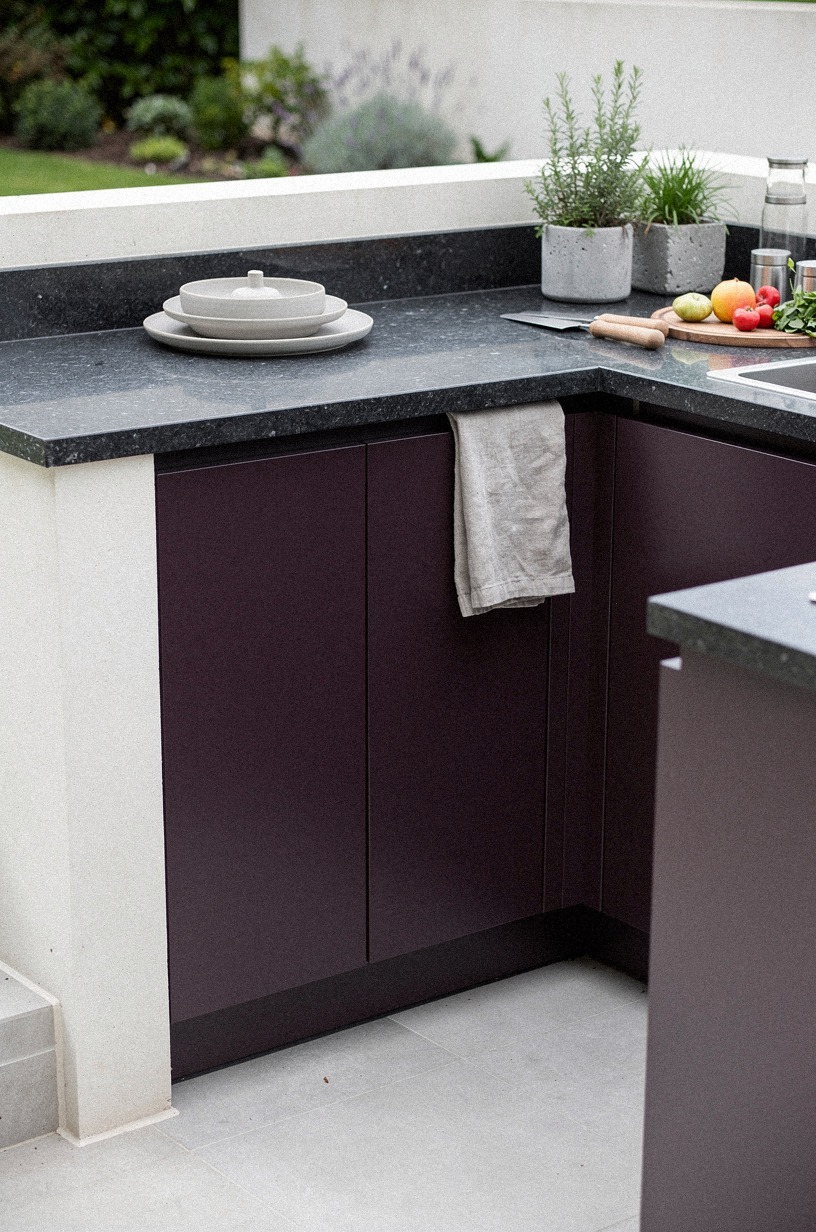
Hand-troweled Venetian plaster is the workhorse most designers quietly use now. Pressed and burnished by hand, the lime-based surface drinks basically nothing once waxed, so red wine, lemon juice, and barbecue sauce sit on top long enough for you to wipe them without panic.
The through-body color means a scratch doesn't show as a white line the way it does on quartz. It's also thin, which helps on a balcony where you're trying to keep weight down.
Cost runs $70 to $150 per square foot installed, which stings a bit, but you will not seal it, ever. That's the trade.
The dusty rose, charcoal, and brass tones of a plaster counter pair with patinated metal details for a soft, weathered read, and if you want the modern application, my modern outdoor kitchen ideas with clean sleek lines piece shows plaster in its natural habitat.
3swap to a warm-white counter with shagreen accents for the cook-and-clean crowd
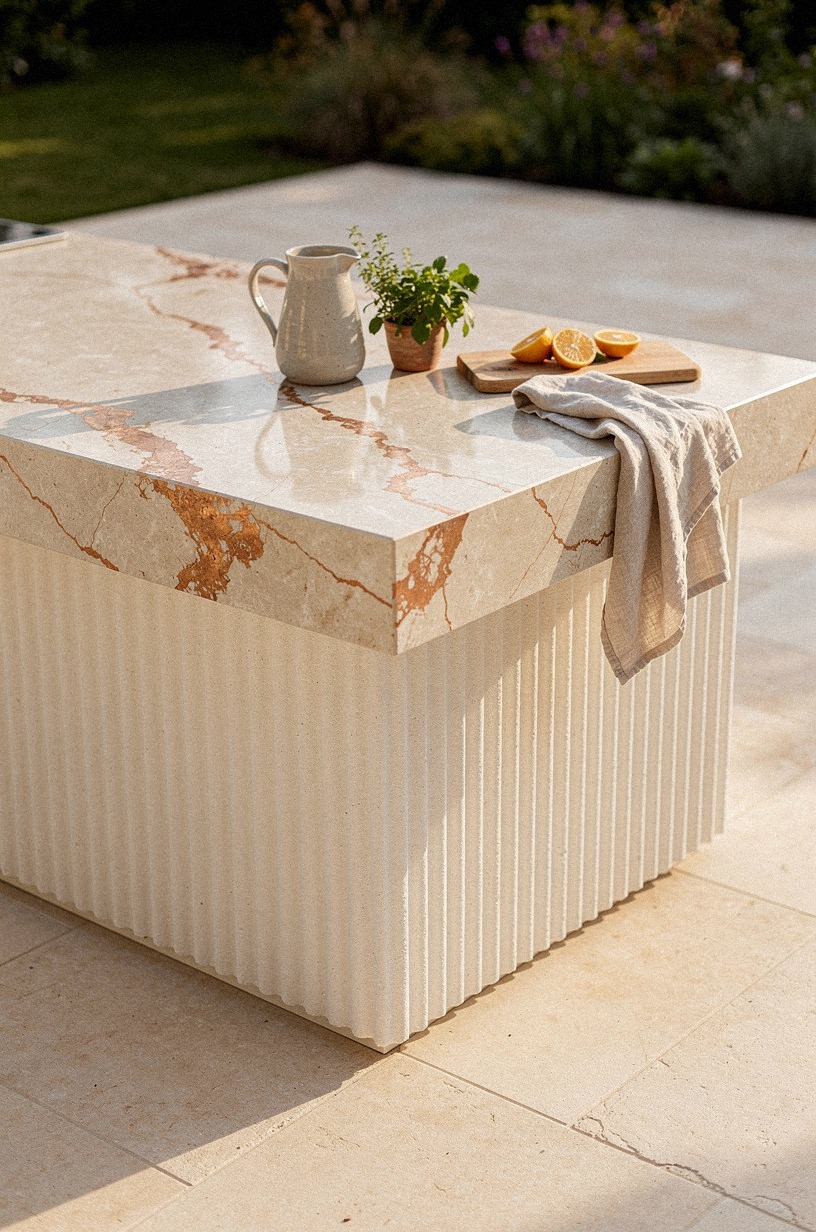
If you cook outside on the regular, a warm-white counter with shagreen-textured accents is the honest choice.
4layer two materials with washed Belgian linen at the cooking and serving zones
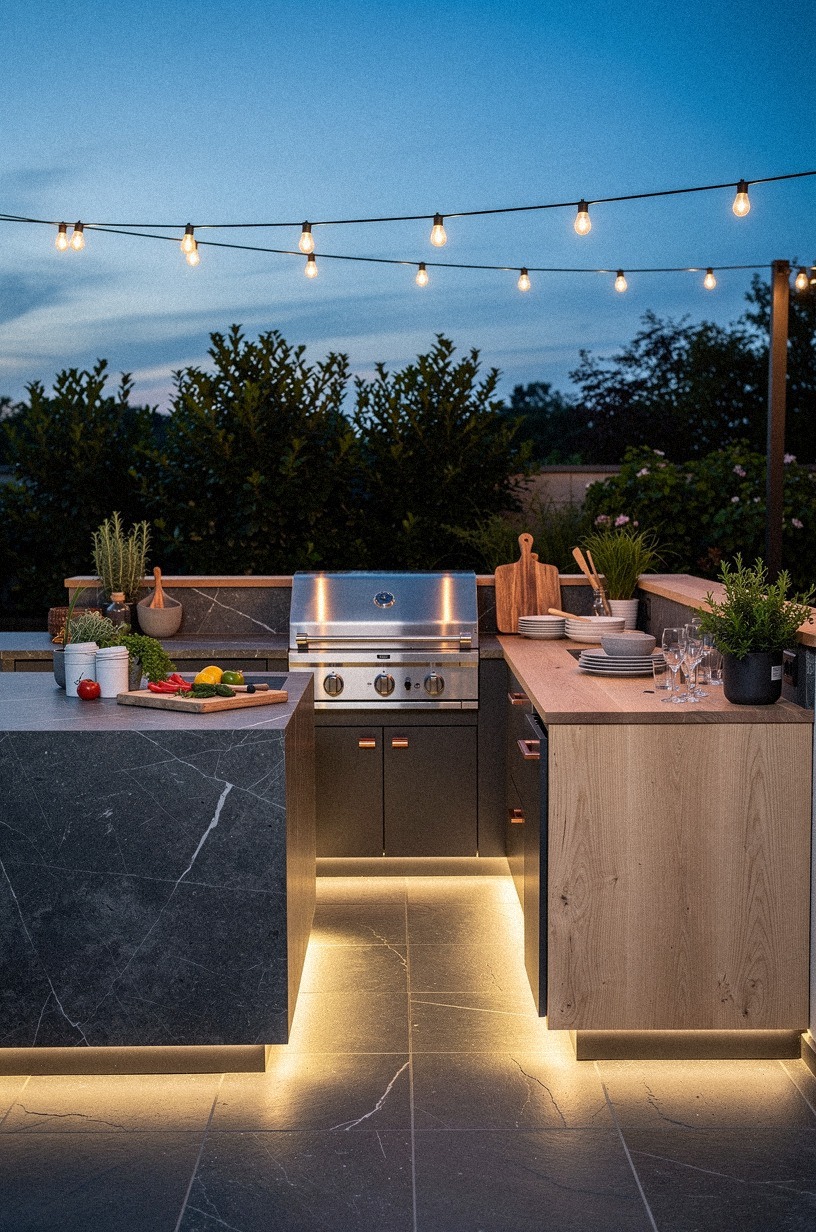
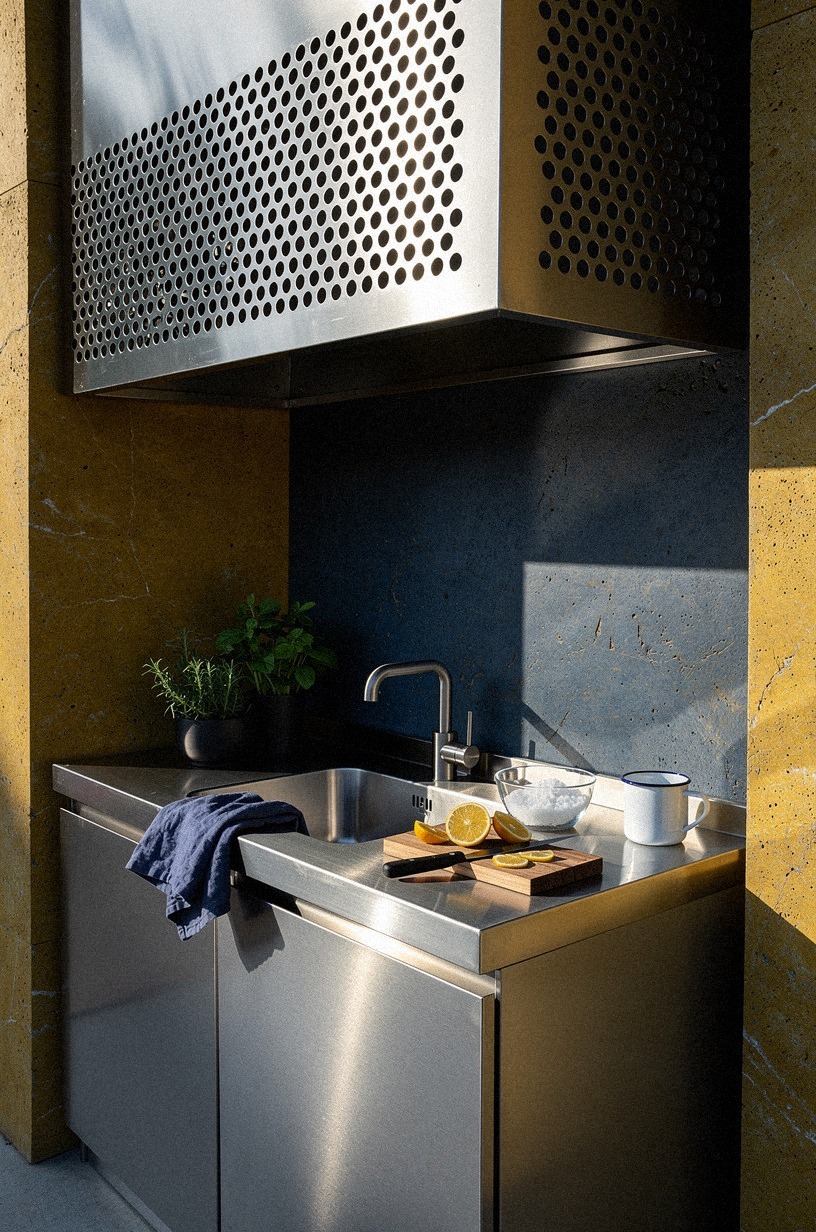
Here's the move that makes a small outdoor kitchen feel twice as useful. Put a granite or porcelain slab where the grill and the prep happen, because that zone takes heat, knives, and spills.
Then drop a washed Belgian linen counter on the bar side where people are leaning with a drink. Two materials, one elevation, and the seam becomes the visual line between "work" and "hang out." It also keeps the budget honest, you only spend the slab money on the area that needs it.
I've used this trick on a 10-foot run and it shaved almost 30% off the material cost. The midnight blue, copper, and ivory palette of a linen counter softens the harder cooking zone, and if you're pairing this with a built-in grill layout, my rustic outdoor kitchen ideas for a charming cookout space piece shows it styled three different ways.
For a rustic cottage read on the same idea, my cozy cottage backyard ideas straight out of a storybook ties the linen counter into the soft, weathered landscape.
5float an organic bouclé counter for that poured-in-place look
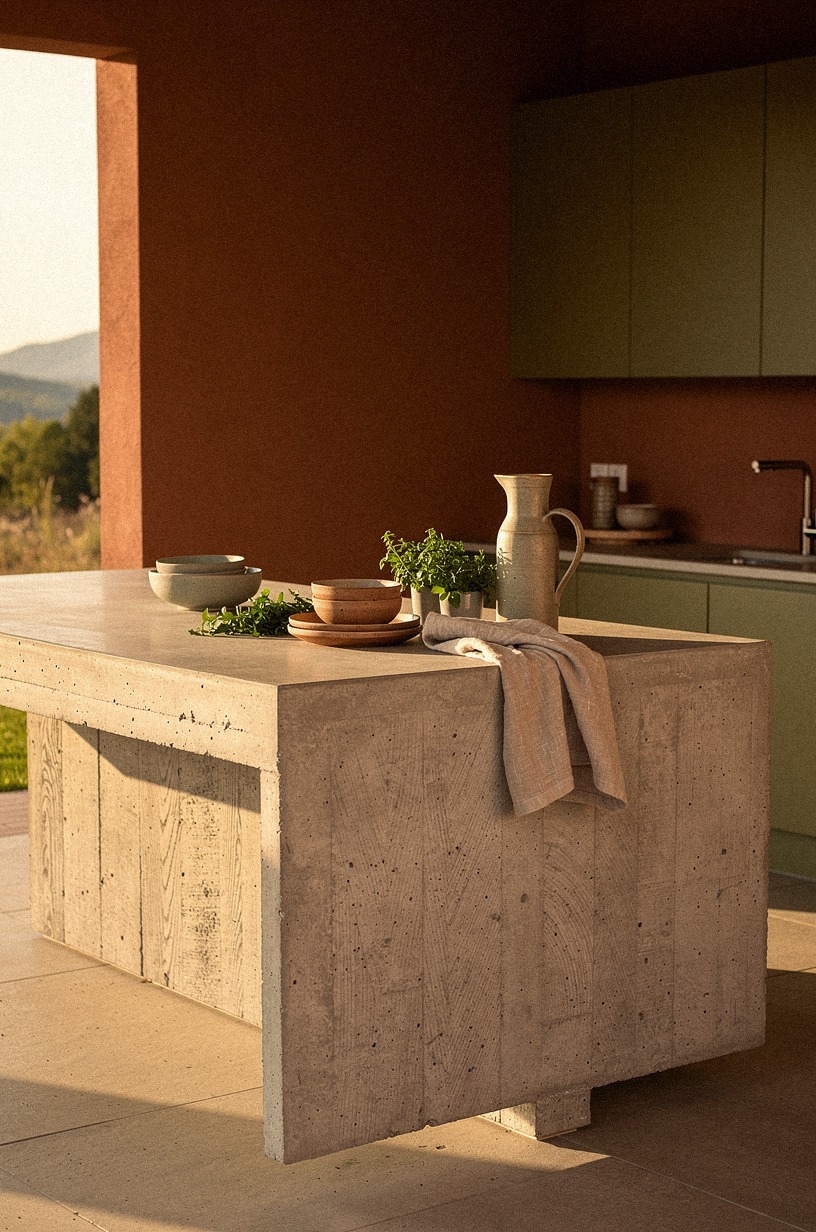
Organic bouclé counters outside get a bad rap because people see the failures and not the good ones. Poured and finished correctly, with proper binding, a UV-rated topcoat, and expansion joints every few feet, bouclé-style surfaces are genuinely great.
They're warm to look at, take a custom shape, and you can press colored aggregate into the matrix for texture. Budget $80 to $150 per square foot for a pro pour with a quality topcoat.
The mistake I see most often is skipping the topcoat or using an indoor-rated one, which is exactly what made my 2019 slab craze by year two. And yes, you'll spend more on the topcoat than you'd like, but skip it and you'll be replacing the counter in five years. The sage green, warm cream, and natural wood palette reads beautifully under a pergola, and for an earthy, hand-built take, my mexican hacienda style outdoor kitchen ideas warm earthy piece shows poured surfaces at their richest.
6build around Nero Marquina black marble if you want pattern and grip
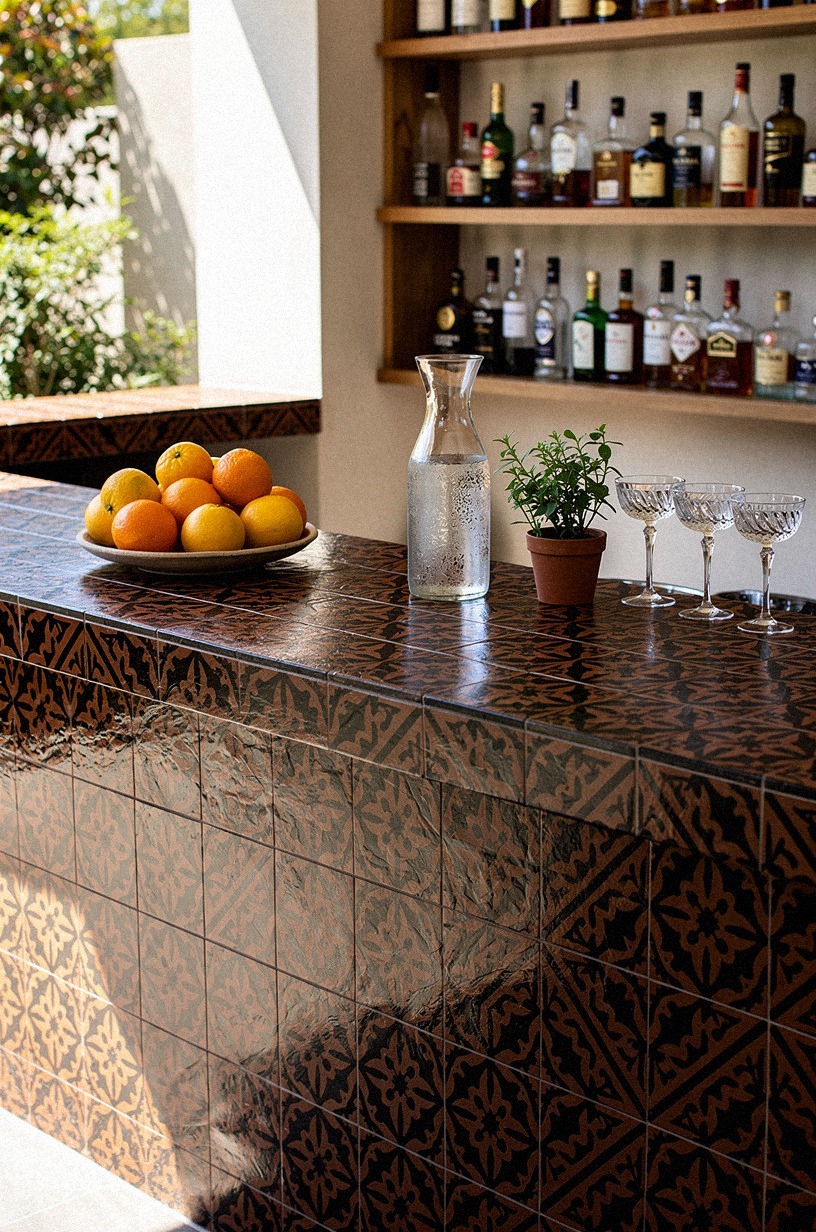
Nero Marquina black marble still wins on pattern and drama, and there's a reason designers keep reaching for it in outdoor kitchens. A honed black marble with white veining gives you grip when the surface is wet, costs around $40 to $80 per square foot for materials, and a single chip is a 20-minute fix instead of a slab replacement.
The honest tradeoff: sealing. Marble is porous, so commit to sealing every six months or accept the patina as part of the look.
If you're working with the patterns and want the floor side to match, my stone outdoor kitchen ideas for a timeless rugged look rounds it out. A Nero Marquina counter anchors a terracotta, stone, and olive palette, and the muted, earthy colorways you can build around it are gorgeous.
7The Two-Zone Rule for hot and cold surfaces
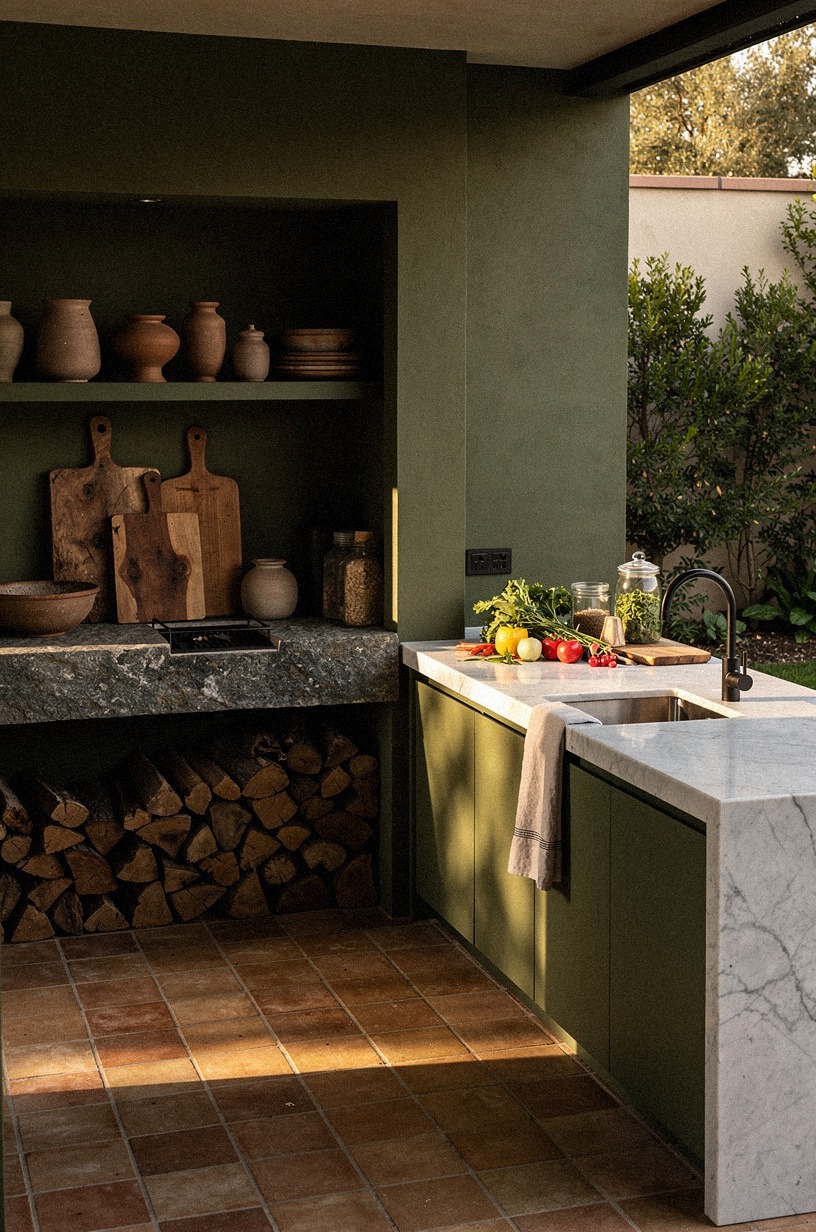
Most outdoor kitchens fail because one slab is doing two jobs, holding a 600°F grill on one end and a chilled watermelon salad on the other. The fix is the two-zone rule. Heat-tolerant material (granite, porcelain, stainless) under and beside the grill, and a contrasting material (tile, marble, butcher block) on the prep-and-serve side.
Even a small 8-foot run benefits, because the heat zone stays narrow, around 18 to 24 inches on each side of the grill, and you don't have to drop slab money on the whole length. It's one of those rules you don't realize you needed until you've burned a plastic cutting board on a quartz counter.
The clay, linen, and aged brass palette of a deep-pile counter softens the hot zone visually, and if you want to put it under a roofed pergola, my cozy backyard pergola ideas for shade ambiance piece shows the cozy, sheltered layout that lets you get away with butcher block or tile on the cool side.
8Instead of marble, try Carrara marble with subtle grey veining for the quiet read
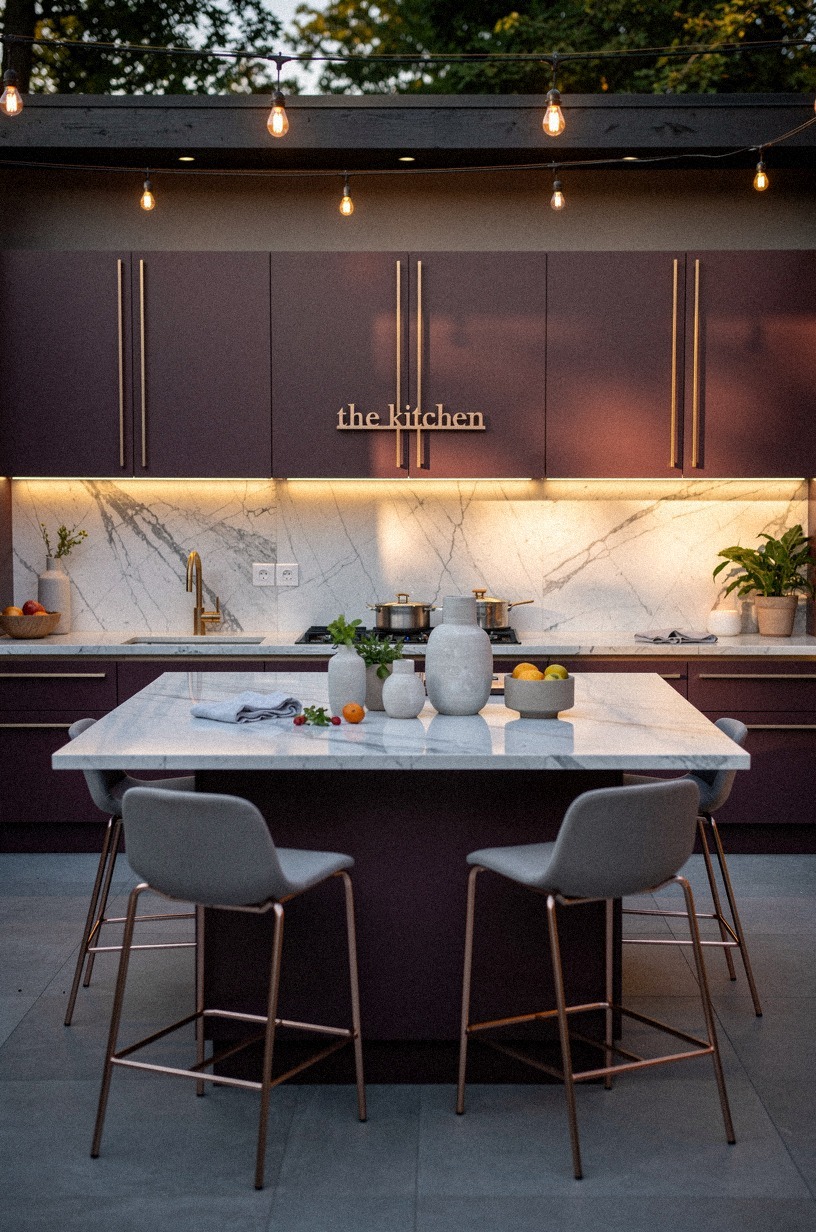
A lot of homeowners want the Calacatta Gold marble look on an outdoor island, then learn in year two that heavily veined marble etches from lemon and stains from wine and turns rough from weather. The honest swap is Carrara marble with subtle grey veining, a natural stone that reads like marble but wears in beautifully instead of falling apart.
Carrara marble is quarried in the same Italian region and the soft grey lines feel livable rather than loud. It runs $40 to $90 per square foot installed, less than Calacatta, and a honed finish hides the small marks that outdoor life puts on stone.
The plum, grey, and rose gold palette of a quiet Carrara counter pairs well with brass hardware and aged copper lanterns, and for the same warm-veining read with a softer palette, my mediterranean outdoor kitchen ideas for al fresco dining piece shows subtle marble under late-afternoon light.
9stack reclaimed weathered teak in covered zones only
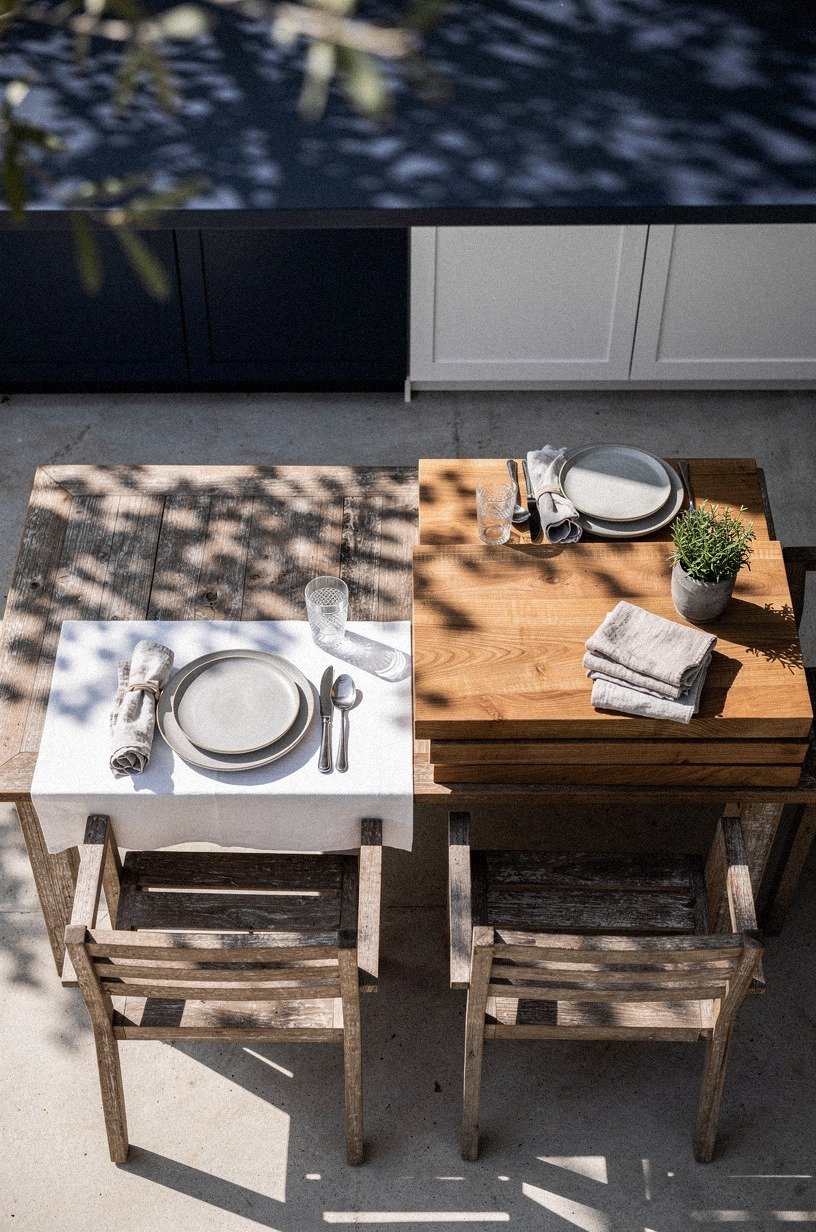
Wood outside is a fight. A lot of designers say no outright, and they're not wrong about an uncovered island. But under a covered patio, in a dry climate, or on a screened porch, reclaimed weathered teak brings warmth no stone can match.
Reclaimed teak is the species that handles moisture, and the silver-grey patina it develops over time is part of the look. Oil it twice a year with a food-safe tung oil.
Budget $50 to $100 per square foot for a quality reclaimed hardwood slab, more if you want a marine-grade edge. Skip this entirely if your counter is in direct rain, the warping will break your heart.
The navy, white, and walnut palette of a weathered teak island reads beautifully against soft linen cushions if you're leaning into a lived-in coastal look.
10anchor a small space with a single Calacatta marble island
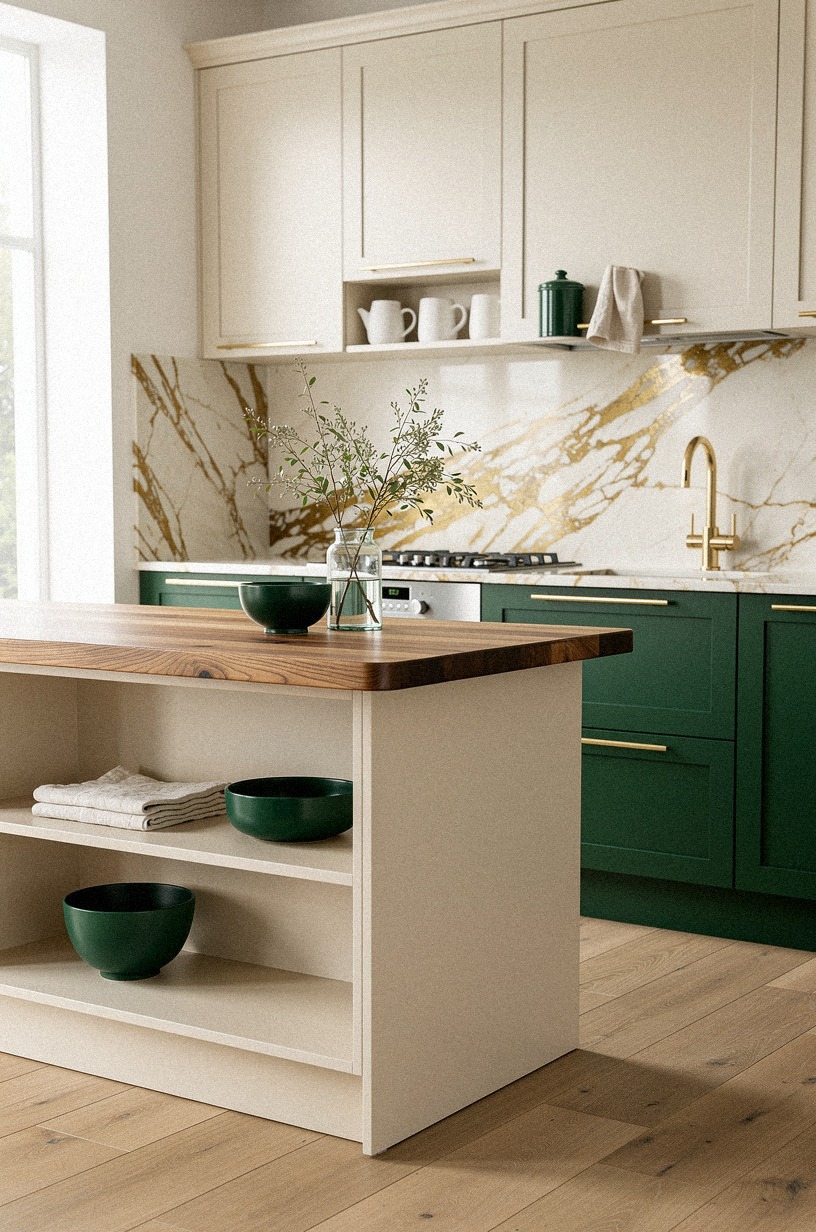
For a balcony or a tight patio where a full L-shaped outdoor kitchen isn't happening, a single Calacatta marble island does more work than any slab. A 30-by-48-inch island on locking casters gives you a prep surface, a bar for two, and rolls out of the way when you're not grilling.
The gold veining of Calacatta marble against an emerald, gold, and cream palette turns a small island into the jewel of the patio. Add a small IKEA KALLAX shelf unit beside it for the grill tools and you've got a functional outdoor kitchen in under 12 square feet.
If that's your constraint, the small outdoor kitchen ideas that maximize every inch piece goes deeper on the layout side, and my 15 cozy DIY backyard projects you can build on a budget covers the rolling cart build with a tight materials list.
11Frame the grill with a cerused white oak apron for an old-world read
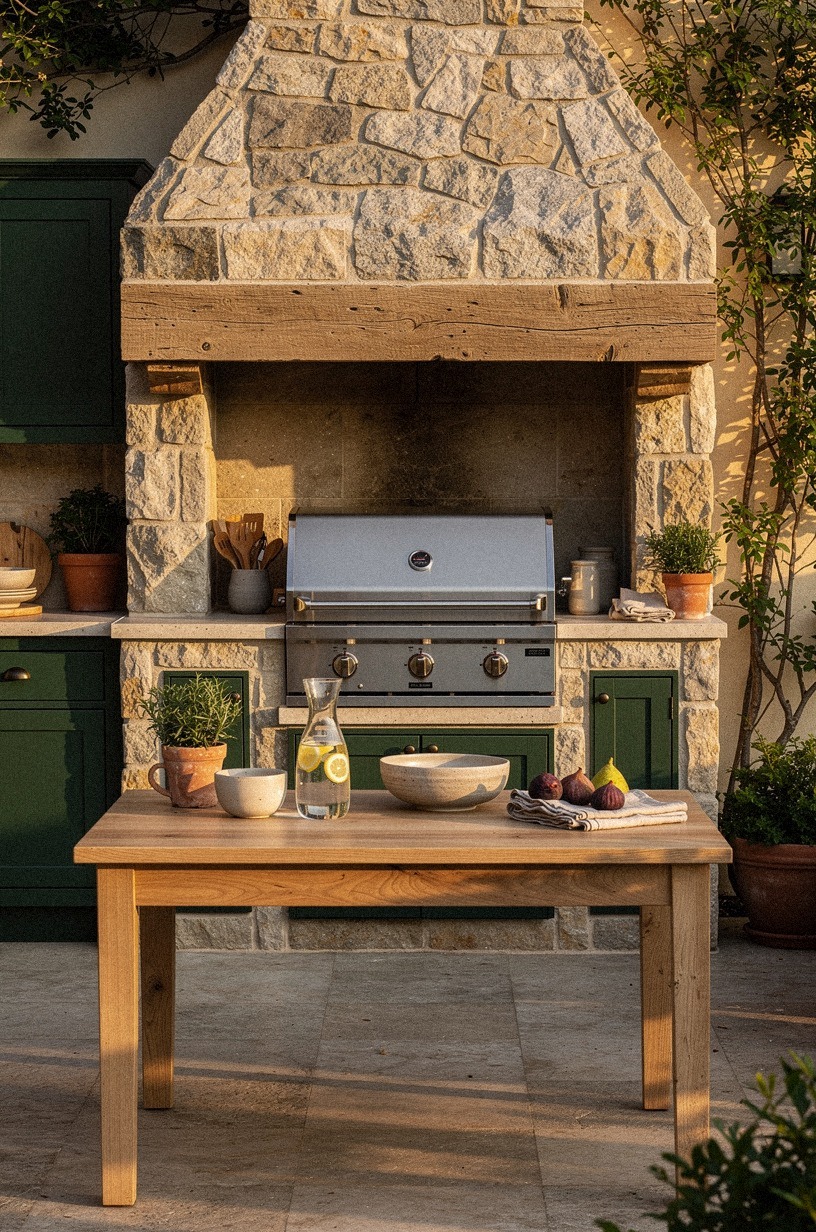
If you want the wood-built look without paying for a full slab, frame the grill itself with a cerused white oak apron and drop a simpler material on the rest of the run. Cerused white oak in a warm honey tone runs about $30 to $60 per square foot for materials and looks like it's been there a hundred years. Pair it with a matte porcelain counter and the contrast does the visual work.
This is the move if you're going for the old-money patio look, a wood-clad grill surround on one side, a stone fireplace on the other, and the rest of the kitchen in a quieter material. The open, grain-filled texture of cerused oak is what gives the soft, lived-in feel designers chase, and the forest green, rust, and natural oak palette ties into the rest of a heritage-style patio.
12The Drainage Groove move that saves the cabinets
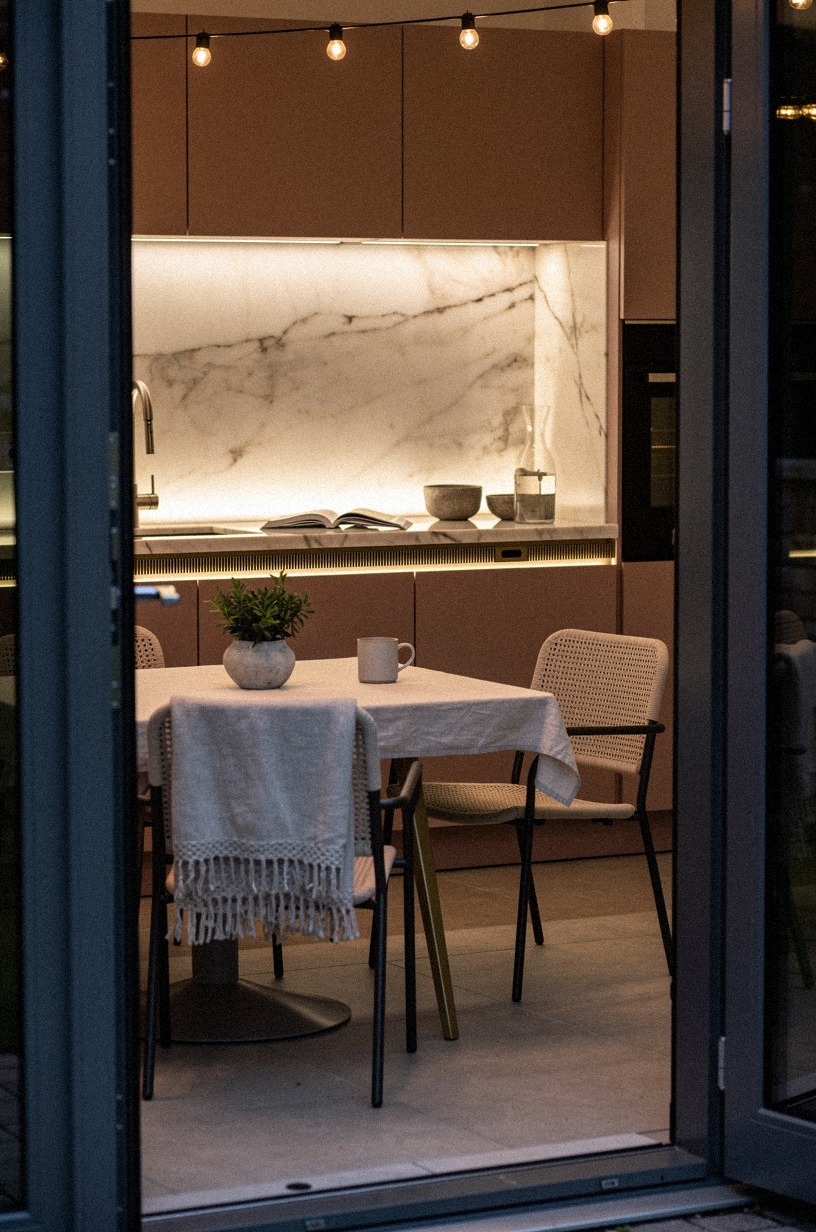
Almost nobody talks about drainage grooves, and almost every outdoor kitchen needs them. A backlit translucent onyx channel along the back of the counter catches wash water before it runs into the cabinet seam, and the soft glow doubles as an evening accent light.
13swap to book-matched walnut for a dark, soft, weatherproof finish
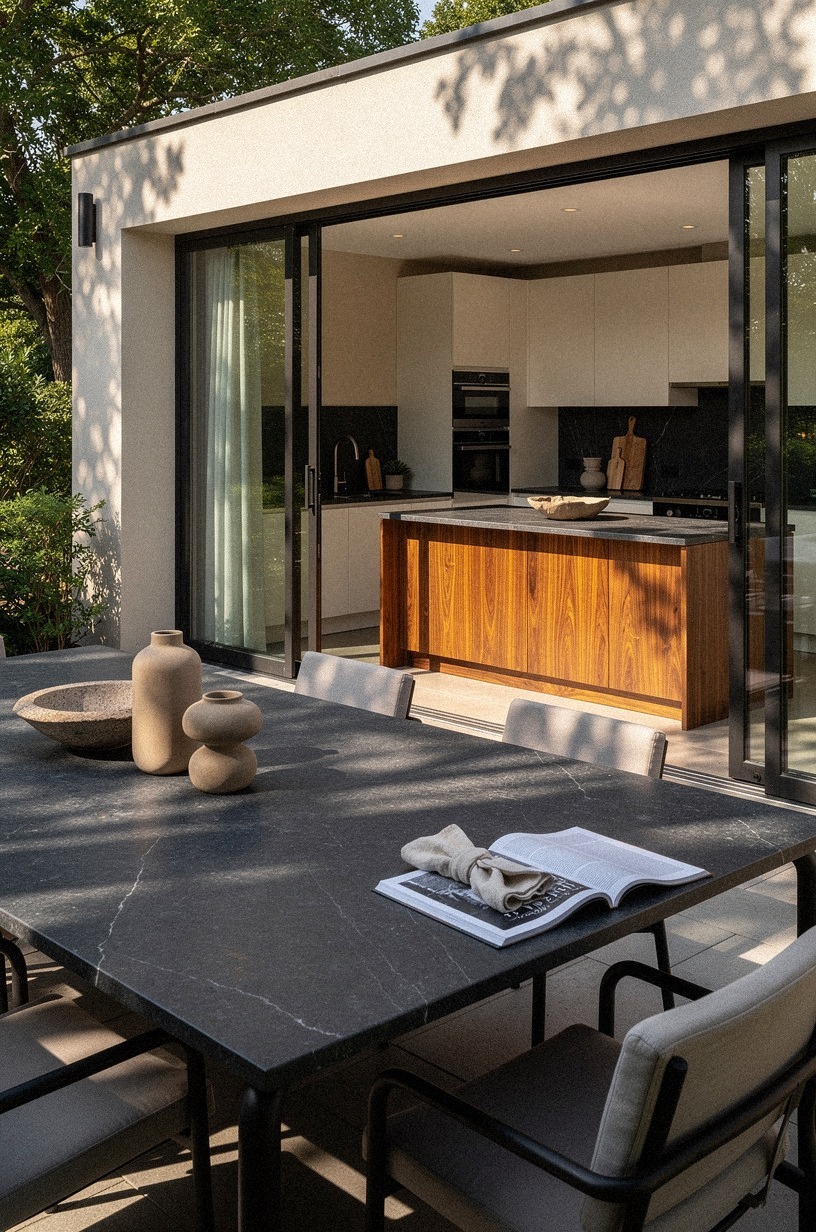
Book-matched walnut is the sleeper pick of the outdoor kitchen world. It's softer than granite, so it will dent, but it doesn't stain, it doesn't etch, and you can sand out the small marks with a piece of sandpaper in about 30 seconds.
The deep chocolate tone reads beautiful against greenery, and a coat of hardwax oil once a season brings out the ribbon grain. It runs $70 to $120 per square foot installed, comparable to granite, and a lot of installers will tell you it's easier to work with because it doesn't crack under stress.
The warm white, camel, and black accents palette of a walnut counter is what gives a shady patio its quiet, moody anchor, and the book-matched figure means every slab is one of a kind.
14lay warm travertine on the backsplash even if the counter is plain
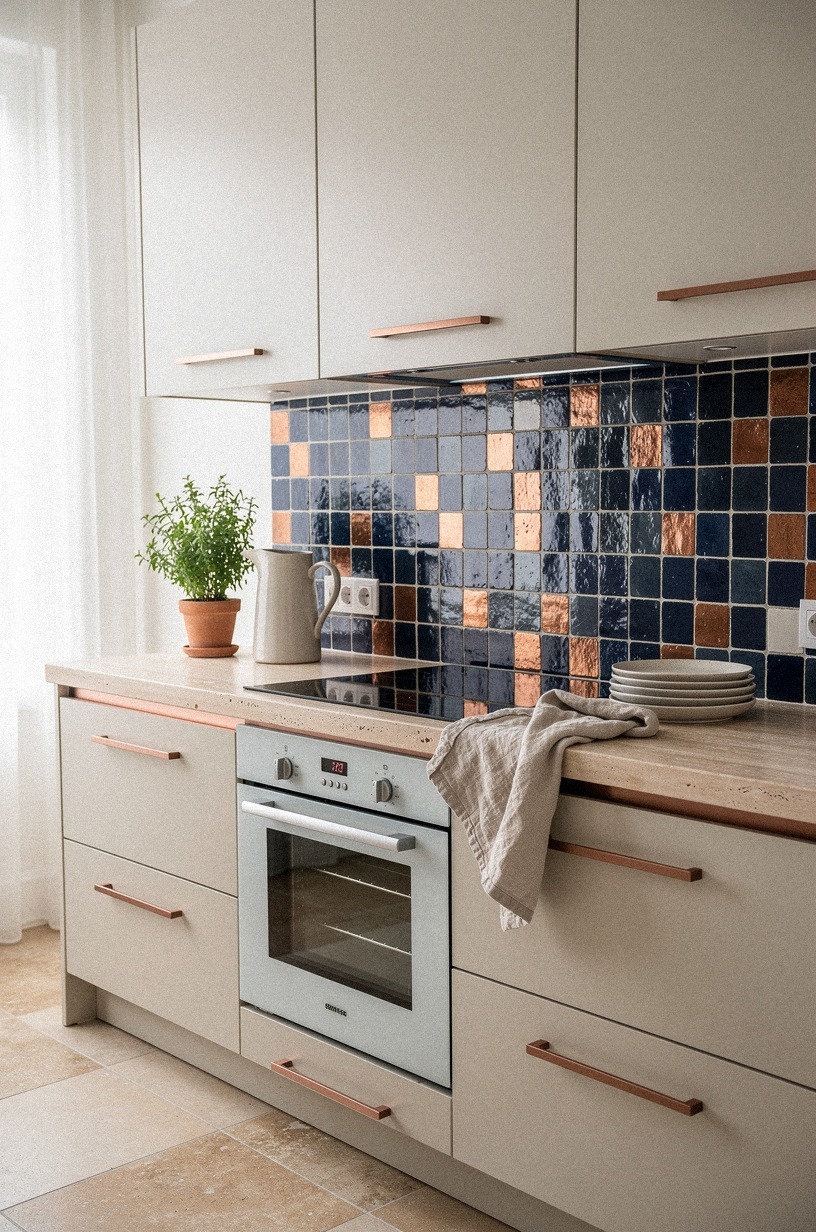
Here's the move that punches above its weight. A plain granite or porcelain counter, paired with a warm travertine backsplash, makes the whole kitchen feel like it was designed on purpose without spending slab money on the vertical. Travertine tile runs about $15 to $35 per square foot for materials, and the porous, layered surface catches light differently at every angle because of the natural pitting and the way it's filled.
The slight variation in tone gives you that handmade read. If you're going for warm patio energy, go for an ivory or honey travertine, against a honed black granite counter, the combination reads like a Mediterranean courtyard.
The midnight blue, copper, and ivory palette is the soul of the kitchen, even when the counter stays simple.
15build a mobile cart counter with unlacquered brass hardware for renters and small patios
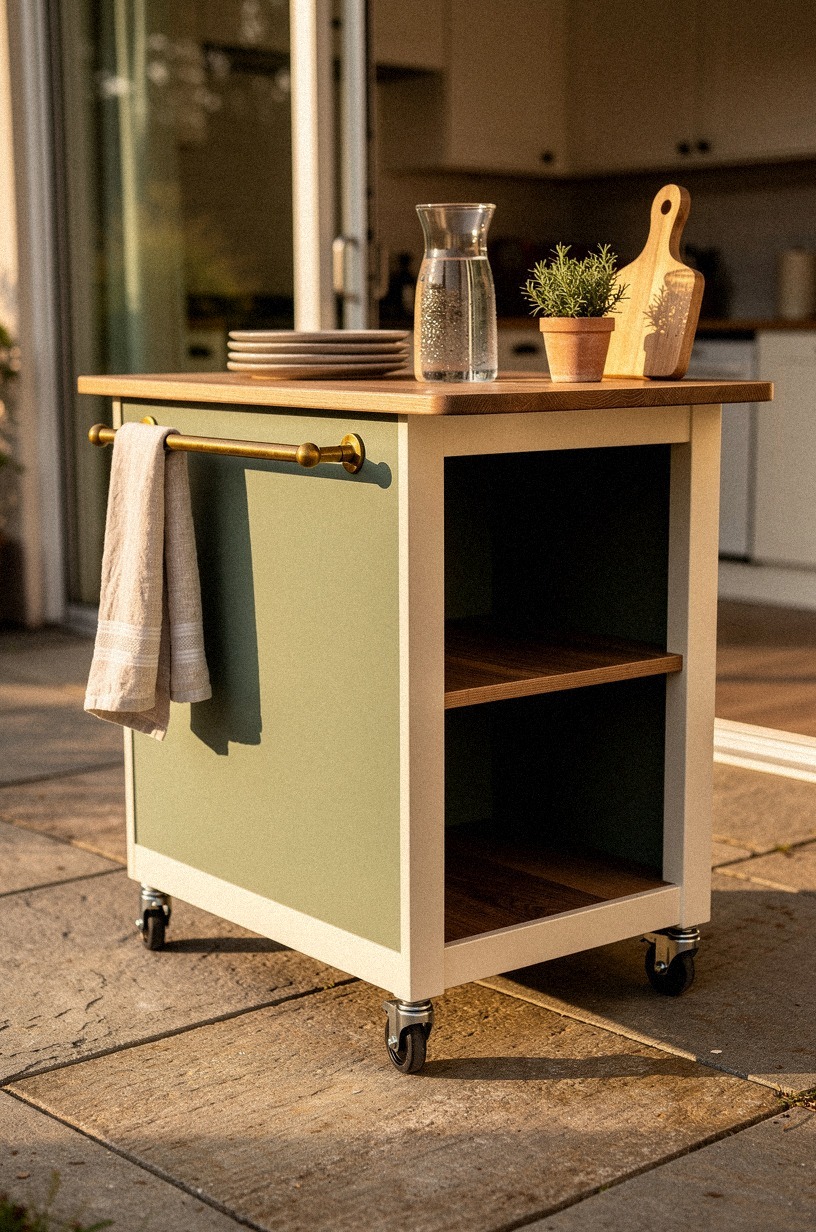
If you're renting, or your strata won't let you pour a slab, a stainless or teak outdoor kitchen cart with unlacquered brass hardware is the move. Brands like CT Industries and Coyote make carts with a real prep surface, a place for a portable grill, and locking wheels so you can roll the whole thing into the garage when the season ends.
The brass develops a patina within a season that gives a sage green, warm cream, and natural wood palette its honest patina. Budget $400 to $1,500 for a cart that will last a decade. Pair it with a small IKEA HEMNES cabinet for storage if you need a place to hide the propane tank and the bug-zapper, and you've got a fully functional outdoor kitchen with no permanent install.
For more on this style of setup, the RV outdoor kitchen ideas for cooking on the road piece has the portable-down-to-a-science details, and my outdoor kitchen ideas on a budget DIY friendly covers the cart-plus-cabinet combo in three price tiers.
A Real Cost Breakdown for an Outdoor Countertop Project
Here's what a real outdoor kitchen counter project runs in the US, depending on how deep you're going. Use these as a starting range, your zip code and the slab availability will move them.
And here's roughly what the individual materials run by the square foot, which is the most useful number when you're comparing quotes.
A standard outdoor counter runs about 36 inches high (91 cm), an island needs 42 to 48 inches of clearance (107 to 122 cm) all around for someone to pass with a plate, and a backsplash gap of about 18 inches (46 cm) between the counter and any upper cabinet or shelf is the move for keeping steam off the wood. For a complete patio frame around the counter, my cozy backyard ideas that hold up no fluff piece shows how to size the rest of the space to match the counter's footprint.
What People Always Want to Know
What is the best outdoor kitchen countertop material for a small patio?
For a small patio, porcelain slab in a dark honed finish gives you the most durable, low-maintenance surface in a thin profile that won't weigh down a balcony or rooftop. Quartzite is the runner-up if you want the natural stone read, but skip quartz entirely, it fades in direct UV and turns yellow within a season or two. If budget's the constraint, tile or a butcher-block island on casters gives you 80% of the function for under $500.
For the layout that goes with it, my outdoor kitchen ideas for small backyards big function is the tightest fit.
Where can I buy outdoor countertop materials on a budget?
For materials, the Home Depot and Lowe's carry tile, butcher block, and stainless stock that works for DIY installations. IKEA has teak serving stations and the KALLAX and HEMNES lines that pair nicely with a custom top.
For slabs, local stone yards will almost always beat the big-box price by 15 to 25%, and many will sell you remnants for a small island at a steep discount. Second-hand, check Facebook Marketplace for stone fabricator offcuts, people give them away to clear yard space.
For DIY frames around the cart, my free DIY outdoor kitchen plans to build this weekend lists the cuts and fasteners with prices.
How much does an outdoor kitchen countertop cost?
A cosmetic refresh with tile or a mobile cart runs $300 to $1,500. A mid-range project with a slab granite or quartzite top, a new faucet, and under-counter lighting lands around $3,000 to $12,000.
A full remodel with a built-in grill, stone veneer, and a porcelain slab counter starts at $25,000 and climbs fast. The widest variable is the slab itself, which can swing the same 10-foot run from $1,200 to $6,000 depending on the material.
To stretch a smaller budget, my outdoor kitchen ideas on a budget DIY friendly covers the cuts that really save you money.
Can I install an outdoor countertop myself?
Yes, for tile and butcher block, with patience and a good sealer. Tile is forgiving if your base cabinet is level, and a butcher-block top from IKEA just needs to be cut to length, oiled, and screwed down.
Stay away from DIY concrete and DIY slab installs unless you've done it before, both require specific tools and a missed step (usually the sealer) shows up in year two. For the heavy stone work, hire a fabricator, the install cost is usually under $500 and saves you a hernia. For a beginner-grade build, my how to build an outdoor kitchen a beginner s guide walks you through the framing and tile-top sequence.
Is an outdoor kitchen worth it in a small space?
Yes, and small spaces benefit more than large ones because every inch has to work harder. A 6-foot counter with a two-burner cooktop, a small sink, and 18 inches of prep space will handle 90% of what most families cook outside.
The key is keeping the layout tight, an L-shape or a single galley against a wall, with at least 42 inches of clearance in front so two people can pass. For layout ideas that fit a tight footprint, my outdoor kitchen layout ideas L-shape U-shape more piece has the diagrams.
Is an outdoor kitchen a good idea for a rental?
Yes, with a no-damage approach. A mobile cart with a portable Weber Q grill, a stainless prep table, and a few IKEA KALLAX shelves on a covered patio gives you a fully functional outdoor kitchen you can take with you when you move.
Tension rods and freestanding shelving keep everything off the walls, peel-and-stick zellige tiles work as a removable backsplash, and a plant screen hides the utility side. Check your lease for grill restrictions before you buy, but for layout the rental-friendly piece in outdoor kitchen pool combos for the ultimate backyard is the portable-down-to-a-science reference.
Where I'd Start First
If I had to pick one, I'd start with porcelain slab. It shrugs off the four things that kill outdoor counters, and you will never seal it, sand it, or oil it. Pin this one for later and start with the outdoor kitchen hot tub ideas for a resort style yard layout guide before you commit.