
 by
by Quick answer
My verdict: Tuft & Needle Original is the better fit if you want a simpler, less springy all-foam feel and strong motion control. GhostBed Classic makes more sense for sleepers who prefer a firmer surface, easier movement, and a latex layer near the top. Neither design is especially complex, so the decision comes down to how each foam stack handles pressure, heat, and movement.
GhostBed Classic uses an aerated synthetic-latex comfort layer over gel memory foam, while Tuft & Needle Original relies on its Adaptive Foam over a polyfoam base, as listed by the manufacturers. That construction difference matters more than broad "medium-firm" labels. Latex responds quickly and tends to feel more buoyant; Adaptive Foam is meant to compress without the slow, deep response many people associate with traditional memory foam.
If you are arriving here looking specifically for Tuft & Needle, I would focus on its balanced, uncomplicated foam feel rather than expect a plush pressure-relief mattress. It is a practical option for sleepers who dislike the stuck-in-foam sensation. GhostBed is the more responsive of the two, but its firmer surface can be less forgiving at the shoulder and hip.
| My short take | Better choice |
|---|---|
| More responsive, firmer feel | GhostBed Classic |
| Calmer motion isolation | Tuft & Needle Original |
| More breathable comfort material | GhostBed Classic |
| Simpler foam construction | Tuft & Needle Original |
| Longer stated warranty coverage | GhostBed Classic |
Tuft & Needle Original vs GhostBed Classic construction
GhostBed Classic is listed as an 11-inch mattress by the manufacturer, with aerated synthetic latex, gel-infused memory foam, and a high-density polyfoam base. The listed layer breakdown includes 1.5 inches of aerated synthetic latex, 2 inches of gel memory foam, and 7.5 inches of support foam. That is a meaningful layout because the latex is the first material taking your body weight.
Latex-like foam near the surface changes the basic character of an all-foam bed. Instead of allowing you to sink steadily into the top layer, it pushes back sooner. I generally see that as a plus for combination sleepers, because it is easier to change positions without fighting a deep memory-foam cradle. The tradeoff is that a firmer, springier top can put more direct pressure on a lightweight side sleeper's shoulder.
Tuft & Needle Original is listed as a 10-inch, two-layer mattress by Tuft & Needle. Its comfort layer is the brand's Adaptive Foam, described by the manufacturer as containing graphite and gel beads, over a denser support-foam base. The design is less layered than GhostBed's, which can be a benefit if your goal is a consistent foam feel instead of a mattress that changes character as you press through the comfort materials.
Two layers also means fewer transition points. On a multi-layer bed, each boundary between materials is a place where the feel can shift as foams age at different rates. A simple stack like the Original's tends to wear more uniformly, even if it never feels as sophisticated on night one. That is the kind of detail I weigh heavily from a materials standpoint, because simplicity in foam construction is often a durability feature rather than a compromise.
The cover is also part of the practical ownership picture. Tuft & Needle uses a knit cover, but it is not presented as a machine-washable component. I would treat that as a normal foam-bed limitation: use a protector from day one, especially if the mattress will be used in a guest room, child's room, or a home where spills are likely.
| Construction point | GhostBed Classic | Tuft & Needle Original |
|---|---|---|
| Primary comfort material | Aerated synthetic latex | Adaptive Foam |
| Secondary comfort material | Gel-infused memory foam | None listed separately |
| Support core | High-density polyfoam | Support polyfoam |
| Listed profile | 11 inches, per GhostBed | 10 inches, per Tuft & Needle |
| Surface character | More buoyant and responsive | More even and foam-forward |
Feel and firmness are not the same on these beds
GhostBed Classic is described at around 7/10 for firmness in the original brand comparison information. That puts it on the firmer side of medium-firm for many sleepers. The important part is not the number alone, it is the fast rebound from the aerated latex layer. You are more likely to feel positioned on top of the mattress than cradled inside it.
Tuft & Needle Original is commonly positioned around 6–6.5/10 in the original comparison information. Its Adaptive Foam gives more easily at first contact, then stabilizes as you settle in. That does not make it a soft mattress. It is still a relatively straightforward foam design with a flatter, more uniform response than a thick memory-foam mattress.
For back sleepers, both can work if the firmness matches your build and preference. GhostBed's quicker pushback may appeal to a sleeper who wants to avoid feeling their hips settle too far. Tuft & Needle may feel easier on the back initially because the comfort foam yields more readily, but the support underneath has to be enough for your body shape and sleeping posture.
For stomach sleepers, I would be cautious about chasing softness on either bed. A stomach sleeper usually needs the pelvis to stay from dipping too far into the comfort layer. GhostBed's firmer, responsive top is the more natural starting point here. Tuft & Needle can still suit a lighter stomach sleeper who likes foam, but it is not automatically the better answer simply because it feels less firm.
| Sleep style | How I would lean |
|---|---|
| Combination sleeper | GhostBed Classic, for its quicker response |
| Light sleeper sharing the bed | Tuft & Needle Original, for its quieter foam feel |
| Back sleeper wanting a firmer surface | GhostBed Classic |
| Side sleeper sensitive at the shoulder | Tuft & Needle Original may feel less abrupt, though neither is a deeply plush design |
| Stomach sleeper | GhostBed Classic is the more logical option of these two |
Cooling: the material story favors GhostBed
GhostBed's aerated synthetic latex is the more breathable comfort material in this matchup. Per GhostBed's listed construction, that layer sits above the gel memory foam rather than burying the sleeper directly in a thick slab of slow-response foam. Airflow through a perforated or aerated material is not the same thing as active cooling, but it can make an all-foam bed feel less sealed-in.
The gel memory foam underneath still matters. Memory foam can hold heat around the body, so its placement beneath the latex layer is a sensible choice. You get some contouring and damping from the gel foam without making it the immediate sleep surface. For a hot sleeper who still wants foam, that layering is the strongest technical argument for GhostBed Classic.
Tuft & Needle's Adaptive Foam includes graphite and gel beads, according to Tuft & Needle. Those additions are intended to manage heat within the foam, and they make more sense than treating ordinary polyfoam as a cooling material. Still, the mattress remains an all-foam design without the open air channels of a coil support unit.
My practical call is simple: Tuft & Needle is likely suitable for many average-temperature sleepers, but GhostBed has the better construction case for someone who regularly wakes warm. If you sleep exceptionally hot, I would not expect either all-foam mattress to behave like a coil mattress with a breathable comfort system.
Motion isolation and edge support pull in different directions
Tuft & Needle has the cleaner motion-isolation story. Its comfort layer and foam base absorb movement without adding much spring-back, which is useful when one partner turns over, gets up early, or has a different sleep schedule. A simple foam stack often has fewer noticeable rebound effects than a mattress with a responsive latex-like top.
GhostBed's latex layer brings some bounce. That is exactly why it can be easier to move around on, but responsiveness and motion isolation are usually a tradeoff. The gel memory foam below helps reduce movement transfer, so I would not call GhostBed a poor choice for couples. Tuft & Needle is simply the more natural pick if minimizing disturbance is your main priority.
At the perimeter, GhostBed has the better case. Its taller listed build and firmer surface tend to make the edge feel more stable than the softer-feeling Tuft & Needle perimeter. Foam edges are rarely as sturdy as reinforced coil edges, so I would keep expectations realistic if you sit on the side of the bed to dress or rely on the far edge for mobility.
Tuft & Needle's edges can compress more under direct sitting pressure. That does not mean the sleep surface is unusable near the side, but it is worth considering for couples who use the whole width of the mattress. This is one of those details that sounds minor until the mattress is your everyday bed.
| Performance area | My read |
|---|---|
| Motion isolation | Tuft & Needle Original has the advantage |
| Ease of movement | GhostBed Classic has the advantage |
| Edge stability | GhostBed Classic has the advantage for an all-foam bed |
| Deep contouring | Neither is built around a deep memory-foam hug |
| Couples with different movement sensitivity | Tuft & Needle is the safer foam choice |
Durability, certifications, and the fine print
GhostBed's limited warranty runs for 20 years, per GhostBed's warranty terms, while Tuft & Needle lists a 10-year limited warranty, per Tuft & Needle's warranty terms. Longer coverage is worth noting, but I never treat warranty length as a direct prediction of how a specific mattress will feel after years of use. Read the sagging threshold, foundation requirements, and exclusion language before making it the deciding factor.
The more useful durability question is what sits in the comfort layers. GhostBed's latex-over-memory-foam arrangement has a different wear profile than Tuft & Needle's single Adaptive Foam comfort layer. A responsive top can help reduce the feeling of getting stuck, while a simpler foam design can feel more uniform. Neither manufacturer's public layer summary alone gives enough detail to make an absolute lifespan promise.
Tuft & Needle's Original carries GREENGUARD Gold certification, according to the manufacturer. GhostBed states that its foam layers are CertiPUR-US certified. Those certifications speak to emissions and foam-content standards, not an assurance that a mattress will fit every sleeper or last a particular length of time.
For ownership questions beyond construction, review the brand policies before ordering. Tuft & Needle shoppers can start with the brand's return policy guide, and anyone dealing with a defect concern should check this overview of a Tuft & Needle warranty claim. Those details matter because a foam mattress is easy to order, but returning or documenting a problem still requires following the stated process.
Who should choose Tuft & Needle, and who should choose GhostBed?
Choose Tuft & Needle Original if you want a straightforward foam mattress with less bounce, a more even surface feel, and strong movement absorption for a shared bed. It is also the better match for someone who wants a lower-profile foam design and does not need the firmer, latex-like pushback GhostBed brings.
Choose GhostBed Classic if you prefer a firmer all-foam feel, sleep warmer than average, change positions often, or care more about edge stability. The aerated synthetic latex is the key construction difference. It is not merely a marketing detail, it changes how the mattress responds when you move and how directly you feel the support beneath you.
If you are deciding between Tuft & Needle models rather than comparing it with GhostBed, this Zinus vs Tuft & Needle comparison may help put the Original's simple foam design into context. I would still make the final call based on your sleeping position and whether you value pressure relief or response more.
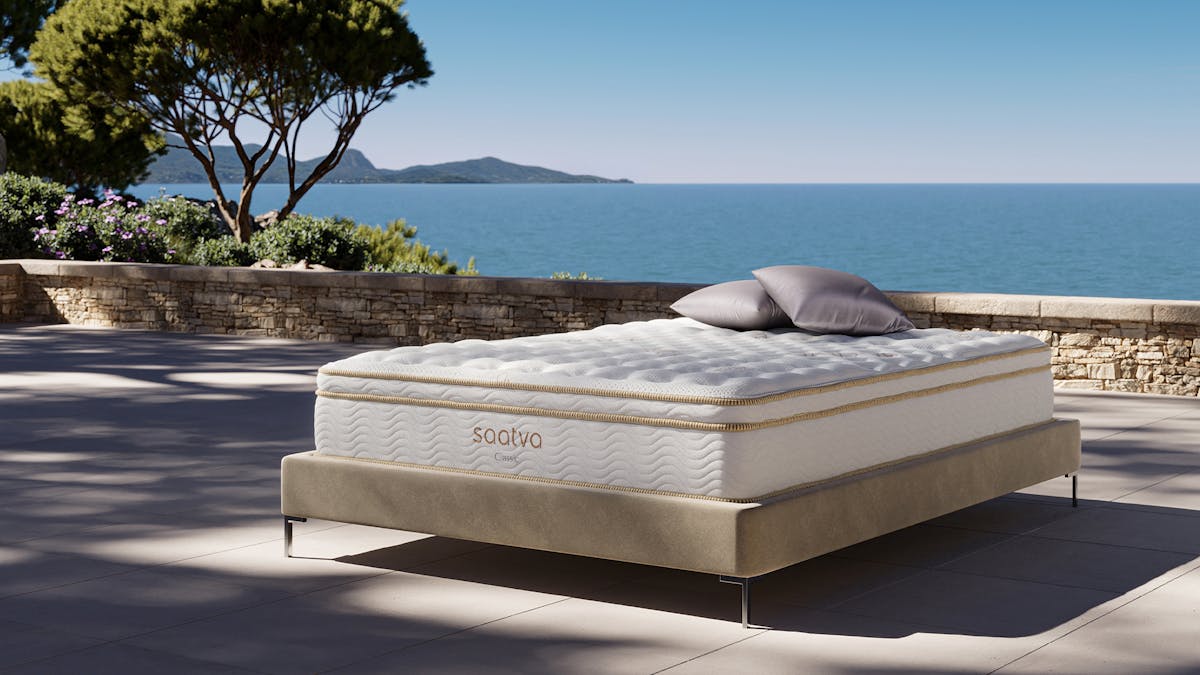
For shoppers who find both all-foam options too limited for long-term daily use, the Saatva Classic is a different construction category. Its dual-coil innerspring design, three firmness options, 365-night trial, and lifetime warranty are listed by Saatva. It costs more, but coils, reinforced support, and a more serviceable comfort design can be worth considering when edge support and long-term structure are central to the decision.
Bounce or quiet — the fine print says look higher
The honest trade this page uncovered: GhostBed’s latex gives you bounce and easier movement, Tuft & Needle gives your partner a quieter night. And the durability fine print reminded you that budget foam is exactly that — budget foam.
Our top recommendation flagged at the very top of this page deserves its card: the Saatva Classic gets bounce from real coils rather than latex chemistry, keeps couples comfortable with its plush euro top, and is delivered white-glove. When both sides of a duel come with fine print, read the Classic’s terms instead — price and trial are on the official page.
Frequently asked questions
Is Tuft & Needle Original softer than GhostBed Classic?
Tuft & Needle Original is generally positioned around 6–6.5/10, while GhostBed Classic is positioned around 7/10, according to the original comparison specifications. More importantly, Tuft & Needle has a less springy foam surface, while GhostBed's aerated synthetic latex responds faster and feels firmer under pressure.
Which mattress is better for couples, GhostBed or Tuft & Needle?
Tuft & Needle is the better fit for couples who place motion isolation first, because its foam design has less rebound. GhostBed may suit couples who need a more responsive surface or want more stable-feeling edges, but its latex layer can pass along a little more movement.
Does Tuft & Needle Original sleep cool?
Tuft & Needle describes its Adaptive Foam as containing graphite and gel beads to help manage heat. That can be helpful compared with standard foam, but it remains an all-foam mattress. GhostBed's aerated synthetic-latex top gives it the stronger construction advantage for sleepers who tend to overheat.
How do the GhostBed and Tuft & Needle warranties compare?
GhostBed lists a 20-year limited warranty, while Tuft & Needle lists a 10-year limited warranty, per each manufacturer's warranty terms. Compare the coverage conditions as carefully as the stated duration, including the requirements for support and documentation.
Is Saatva Classic a better long-term alternative?
Saatva Classic uses a dual-coil innerspring construction and offers a 365-night trial plus a lifetime warranty, according to Saatva. That makes it a sensible alternative for a shopper who has decided that either all-foam option lacks the edge support, airflow, or structural feel they want from a daily mattress.