
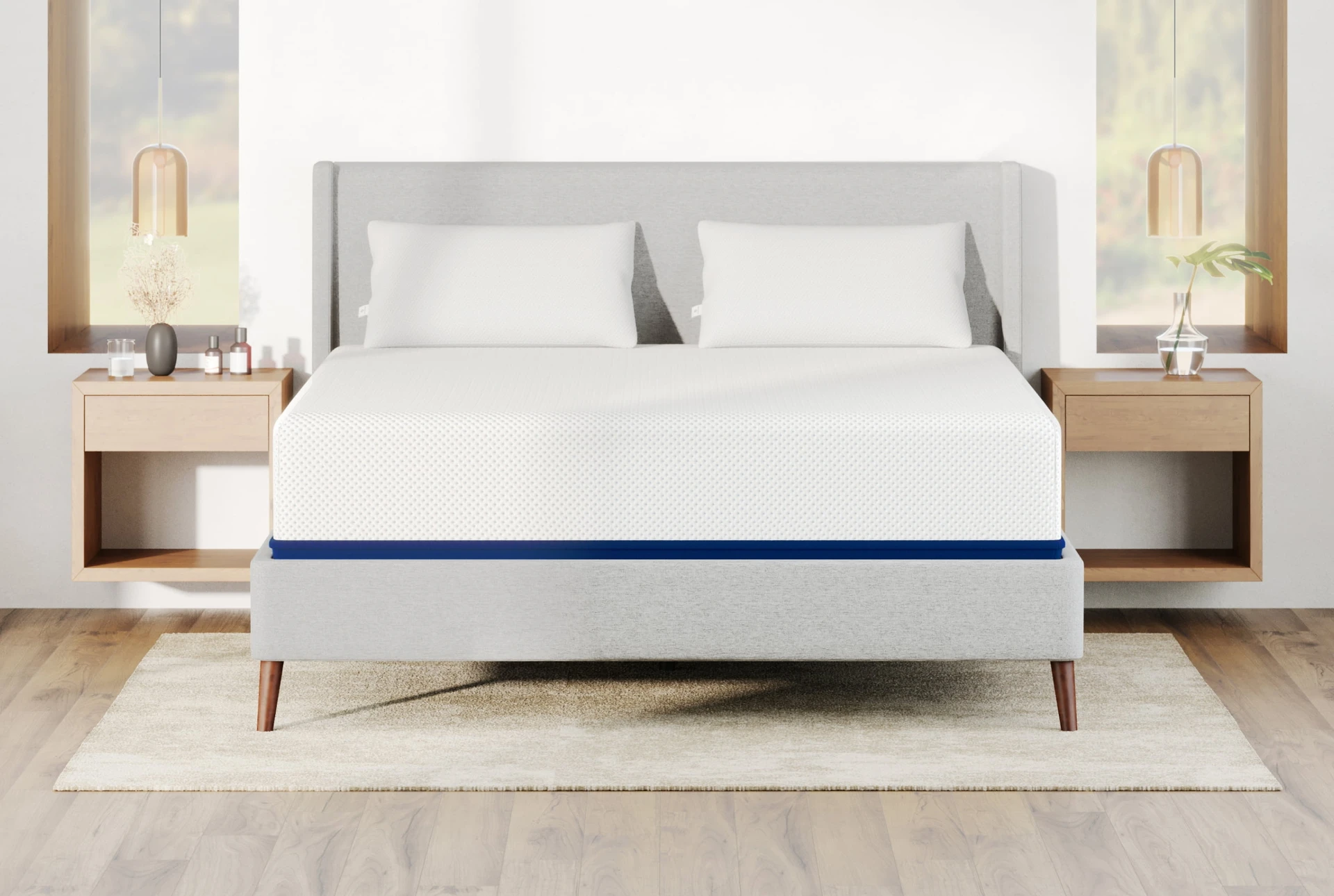
 by
by Amerisleep AS5 is a soft option for readers who prefer that feel; it is not the medium or medium-firm option discussed in the evidence below. Check support and comfort in your usual sleeping position, and talk to your doctor about persistent lower back pain.
Amerisleep AS5

Choose it for a soft feel that suits you. A mattress does not treat lower-back pain; seek clinical advice for persistent symptoms.
The AS5 is Amerisleep's softest all-foam mattress.
What the research says about firmness and lower back pain
The clearest evidence comes from a 2003 Lancet RCT (Kovacs et al.) that assigned 313 adults with chronic non-specific lower back pain to medium-firm versus firm mattresses for 90 days. The medium-firm group reported significantly less daytime pain and less disability. A 2015 systematic review in Sleep Health (Radwan et al.) pointed the same way: medium-firm surfaces tended to do better for sleep comfort and back pain.
The mechanism is straightforward. Too soft and the hips and pelvis sink lower than the lumbar, creating a reverse arch that strains the posterior ligaments and intervertebral discs at L4-L5 and L5-S1. Too firm and the pelvis cannot settle enough to let the spine's natural lordotic curve relax, compressing the discs from the opposite direction. Medium-firm allows the pelvis to settle just enough while keeping the lumbar supported.
Firmness by body weight
"Medium-firm" is the right default for most adults, but body weight shifts the ideal point:
| Body weight | Recommended firmness for back pain | Why |
|---|---|---|
| Under 130 lb | Medium (5 to 6 / 10) | Lighter bodies do not compress the foam enough to activate the support core on firmer surfaces |
| 130 to 230 lb | Medium-firm (6 to 7 / 10) | The weight range where medium-firm is the common starting point |
| Over 230 lb | Firm (7 to 8 / 10) | At higher loads, medium-firm hammocks and puts the lumbar into flexion |
Firmness by sleep position
Sleep position is the second variable that shifts the ideal firmness for lower back pain:
- Back sleepers: medium-firm is the standard pick. A pillow under the knees (not the lumbar) lets the spine settle into natural lordosis.
- Side sleepers: softer (5 to 5.5) allows the shoulder and hip to sink so the spine stays level. Drawing the knees slightly toward the chest and placing a pillow between the knees reduces lumbar rotation further.
- Stomach sleepers: firmest option in range (7+). Soft surfaces let the abdomen sink and hyperextend the lumbar, which is the most mechanically stressful position for the lower back. Stomach sleeping with lower back pain is best avoided where possible.
Why lumbar zoning matters more than firmness alone
The AS5 is a soft all-foam choice. Firmness describes the surface feel; it does not tell you by itself whether the bed supports you comfortably.
Zoned designs aim to give firmer support under the lower back and softer support at the shoulders and hips, which a single uniform firmness cannot do.
Best mattresses for lower back pain (2026)
| Mattress | Type | Firmness | Lumbar support | Trial | Queen price |
|---|---|---|---|---|---|
| Amerisleep AS5 | All-foam | Soft | Soft cushioning | 100 nights | $1,849 (queen) |
| Saatva Classic | Innerspring hybrid | Luxury Firm 5-7/10 | Reinforced lumbar zone pad | 365 nights | $2,229 |
| PlushBeds Botanical Bliss | Organic latex | Medium 5/10 | Natural latex zoned layers | 100 nights | From $1,699 |
| Puffy Lux Hybrid | Hybrid foam | Medium 5.5/10 | Good, cloud-feel pressure relief | 365 nights | From $1,549 |
| Sweetnight Breeze | Hybrid | Medium-firm 6/10 | Good, budget-friendly zoning | 100 nights | From $399 |
Saatva Classic
8.8/10
- Dual-coil construction with a reinforced lumbar zone pad under the lower back
- Three firmness options including Luxury Firm (the back-pain sweet spot)
- Free white-glove delivery, setup, and old-mattress removal
- 365-night trial and lifetime warranty
- Ships flat, not compressed in a box, heavier to move
- $99 return fee during the trial period
Saatva Classic is an alternative to our first recommendation, Amerisleep AS5. Compare its surface feel and delivery arrangements with the first pick.
PlushBeds Botanical Bliss
8.7/10
- GOLS-certified organic latex with natural pressure relief and zoned support
- Naturally cooler than memory foam, no off-gassing
- Customizable firmness layers, OEKO-TEX certified cover
- 25-year warranty
- Higher price point than foam alternatives
- Latex feel is very different from innerspring or foam
PlushBeds Botanical Bliss is an alternative to our first recommendation, Amerisleep AS5. Consider it if you prefer a different construction or trial window.
Puffy Lux
8.6/10
- Cloud-feel comfort layers with strong pressure relief at the lumbar
- Cooling gel infusion in the comfort layer
- Lifetime warranty and 365-night trial
- Good motion isolation for couples
- Softer feel may not suit stomach sleepers or heavier builds over 230 lb
- Less edge support than a coil hybrid
Puffy Lux is an alternative to our first recommendation, Amerisleep AS5. Check the feel in your usual sleeping position before deciding.
Sweetnight
8.2/10
- Best price-to-support ratio for back-pain sufferers on a budget
- Hybrid coil base provides good lumbar support without the premium price
- 100-night trial to confirm fit
- Less advanced lumbar zoning than premium options
- Shorter warranty than top-tier picks
Sweetnight is an alternative to our first recommendation, Amerisleep AS5. Include setup and return arrangements in the comparison.
When softer is the right call
- Body weight under 130 lb. Firmer surfaces register as too rigid because lighter bodies do not press down enough to activate the give zone.
- Dedicated side sleeping. Softer (5 to 5.5) allows the shoulder and hip to settle and keeps the spine level rather than forcing a lateral arch.
- If you have hip bursitis or greater trochanteric pain syndrome, ask your doctor about comfort and support rather than choosing a soft mattress from the diagnosis alone.
- History of shoulder or hip numbness on a previous mattress. This can indicate pressure from a surface that is too firm for your body weight and position combination.
When firmer is the right call
- Body weight over 230 lb. Medium-firm mattresses begin to hammock under higher loads, putting the lumbar into sustained flexion.
- Dedicated stomach sleeping. Soft surfaces allow the abdomen to sink and hyperextend the lumbar, worsening posterior disc pressure.
- For confirmed spondylolisthesis or disc herniation, talk to your doctor rather than choosing firmness from the diagnosis alone.
- Degenerative disc disease with axial pain that worsens in soft chairs or after prolonged sitting.
Topper strategy before buying a new mattress
If the current mattress is under four years old and its firmness is one or two levels off, a 3-inch topper costs roughly $200 to $400 versus $1,500 or more for a new mattress. Too firm: a latex or gel memory foam topper softens the surface. Too soft (hammocking in the middle): no topper fixes this, the mattress itself needs replacing. See the mattress topper for back pain guide for top picks by use case.
How long before a new mattress relieves back pain?
Give a new mattress several weeks; the Kovacs trial measured results after 90 days. Do not return a mattress in the first two weeks: comfort layers soften slightly as you break them in and the body adapts to new contact points. If pain remains worse than when you started, the mattress may not suit you; talk to your doctor about persistent or worsening pain.
An adjustable base set to a gentle zero-gravity position (knees raised 15 degrees) may ease lumbar pressure for chronic sufferers when paired with a zoned medium-firm mattress.
The AS5 is a soft-foam option to compare if that feel suits you. Use the trial to assess support and ease of movement rather than assuming a softer surface is better for back pain.
Frequently asked questions
Is a firm or soft mattress better for lower back pain?
Medium-firm (6 to 7 out of 10) did better than a firm mattress for lower back pain in the main clinical trial. Soft mattresses let the lumbar spine sag; extra-firm mattresses stop the pelvis from settling into natural lordosis and compress the discs from the other direction.
Can sleeping on the wrong mattress cause lower back pain?
Yes. A worn or wrong-firmness mattress can contribute to chronic non-specific lower back pain. Pain that is worse in the morning and eases within 30 to 60 minutes of moving around can suggest the mattress is a contributing factor.
Memory foam or innerspring hybrid for lower back pain?
The AS5 is all-foam. If you prefer coils, compare the alternatives above by how they feel in your usual sleeping position.
How long should I try a new mattress before returning it?
At least 30 days, ideally 60 to 90. The body needs time to re-pattern around new contact points, which is why 100-plus night trials are worth prioritizing over beds with shorter return windows.
This guide is part of our Mattress Buying Guide hub. Compare all the top picks and narrow down your choice there.
Amerisleep AS5
Compare the AS5 only if you prefer plush foam and it feels supportive. The evidence discussed above does not establish it as the first choice for lower back pain.
A queen costs $1,849 on sale ($2,349 regular).
Amerisleep AS5
You have 100 nights to assess the feel at home.
The mattress includes free shipping and returns.